 Andrew Wright
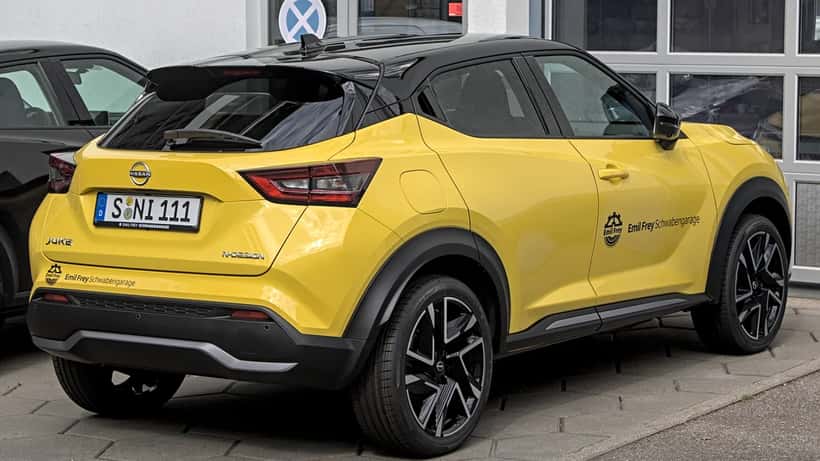
Nissan officially unveiled the all-new electric Juke on 14 April 2026, confirming that the UK's best-selling compact crossover will go fully battery-electric — and that it will be built at Nissan's Sunderland plant. With a target price of around £21,000, a range of up to 250 miles, and pilot production already underway, the Juke EV is set to be the most significant mainstream EV launch of 2026 for British drivers.
What Nissan Has Confirmed About the Juke EV
According to Nissan's official UK press release and coverage by Autocar and Car Magazine, the Juke EV will be built on the CMF-EV platform — the same architecture used by the Renault 5, Renault 4, and new Nissan Leaf. Key confirmed specifications include:
- Battery options: 40kWh and 52kWh (shared with the Nissan Micra EV)
- Range: Up to approximately 250 miles from the larger battery
- Fast charging: 100kW capability, allowing 15-80% charge in roughly 30 minutes
- Power: Front-mounted motor with 130kW or 160kW outputs expected
- V2G technology: Vehicle-to-Grid capability, allowing owners to feed energy back to the grid
The launch timeline points to a full commercial release in spring 2027, with the current Sunderland pilot production representing early manufacturing runs. Nissan is aiming for a starting price near £21,000, though current Juke Pulse petrol models start at £27,865 — a target the company acknowledges will be "challenging" to meet.
Why the Juke EV Matters for UK Drivers
The original Nissan Juke helped define the compact crossover segment in the UK when it launched in 2011. With the electric version, Nissan is betting that the same combination of style, practicality, and approachable pricing can do the same for the mainstream EV market.
According to the Society of Motor Manufacturers and Traders (SMMT), battery electric vehicle registrations in the UK reached 19.6% of the new car market in March 2026 — a record share, but one that masks significant anxiety among private buyers about charging infrastructure, running costs, and long-term reliability.
For the millions of UK drivers who are EV-curious but not yet EV-committed, the Juke EV arrives at an important moment. It is small enough to be practical in urban environments, familiar enough to reduce the anxiety of switching, and priced — in theory — at a point where it competes directly with conventional petrol alternatives.
What Changes When You Go Electric: A Mechanic's Perspective
The Juke EV's CMF-EV platform represents a genuinely different maintenance proposition compared to its petrol predecessor. Here is what UK drivers should understand before they switch:
What disappears: No engine oil changes. No spark plugs. No cambelt service. No exhaust system. The Juke EV has roughly 20 moving parts in its drivetrain, compared to approximately 200 in a petrol equivalent. Routine servicing costs are, on average, 30-40% lower for battery electric vehicles over a five-year period, according to data compiled by Which? and consumer groups.
What remains: Tyres, brakes, suspension, air conditioning, and coolant systems all still require professional attention. In fact, EVs can be harder on tyres than petrol cars — their instant torque and additional kerb weight accelerate tyre wear, particularly on the front axle. Budget for more frequent tyre replacements and rotations.
What is genuinely new: The high-voltage battery system. The on-board charger. The thermal management system. The V2G inverter, if fitted. These components require specialist diagnostic equipment and trained technicians. Not every independent garage is equipped to work on high-voltage systems safely.
When to Call a Specialist EV Mechanic
The growing availability of electric cars in the UK has created an emerging skills gap in the independent repair sector. A mechanic trained solely on petrol and diesel vehicles may be qualified to change your tyres and brake pads, but cannot legally or safely work on the high-voltage components of an EV.
Situations where you should specifically seek an EV-certified mechanic include:
- Any fault code related to the battery management system (BMS) — flashing turtle mode, reduced range warnings, or charging failures
- After a collision that may have affected the battery pack — even minor underfloor impacts can compromise battery integrity
- Any issue with the charging system — OBC faults, charging port problems, or slow-charge anomalies
- Brake regeneration irregularities — these involve both the electrical and mechanical braking systems
- Annual or biennial inspection of coolant circuits — the battery thermal management system uses coolant that must be maintained by a qualified technician
On Expert Zoom, you can find electric vehicle repair specialists who are trained and equipped to work on high-voltage systems safely, including Nissan and Renault-platform EVs.
What the Juke EV Means for Home Charging
V2G technology, included in the Juke EV specification, allows the car's battery to feed electricity back to your home or the grid during peak demand periods. This is not yet standard on most EVs, and it requires specific home charge point compatibility.
If you are planning to buy a Juke EV when it launches, budget for a home wallbox installation. The UK government's EV Chargepoint Grant covers up to £350 towards the cost of a home chargepoint for flat owners and renters; homeowners can access Ofgem's Warm Homes Plan for broader home energy upgrades.
A qualified electrician — not just a general handyman — should install your home chargepoint. The installation must comply with BS 7671 wiring regulations and, for V2G-capable equipment, additional grid connection standards.
Is the Juke EV Right for You?
The Nissan Juke EV is not available to buy today. Full UK sales are not expected until spring 2027 at the earliest. But the announcement has accelerated conversations among drivers who are considering switching — and with the UK's ZEV mandate requiring manufacturers to ensure 28% of new car sales are zero-emission in 2026 (rising each year), the pressure to switch is growing.
If you are weighing up the switch and want to understand the real-world running costs, service requirements, and charging implications for your specific situation, an independent mechanic with EV certification is one of the most useful consultations you can have before signing any order form.
Note: Specifications and pricing for the Nissan Juke EV are based on information published in April 2026 and are subject to change before the commercial launch.
For expert guidance on maintaining your current vehicle or preparing for an EV transition, consult a qualified mechanic on Expert Zoom.
