 Abigail Clarke
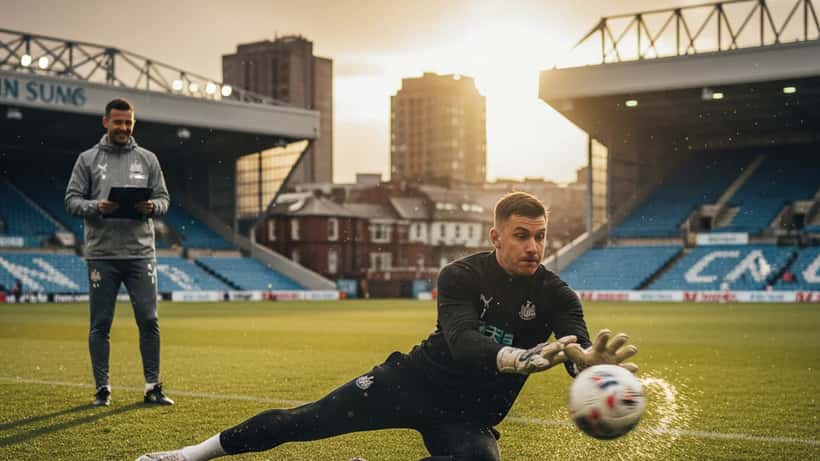
Newcastle United goalkeeper Nick Pope is back in contention for the first team after a groin strain sidelined him for several weeks during the 2025–26 season. As one of the Premier League's best shot-stoppers, his recovery has been closely monitored — and his return to training has sparked renewed hope for the Toon Army ahead of the final run-in. But his injury journey raises a question relevant far beyond professional football: how do you know when you're truly ready to return after a soft-tissue injury?
What Happened to Nick Pope
Pope sustained a groin injury during a training session earlier in the 2025–26 campaign. After missing multiple fixtures, the 32-year-old received specialist assessment and was placed on a structured rehabilitation programme. He has since returned to training and is pushing for selection ahead of upcoming matches.
Newcastle manager Eddie Howe described his goalkeeper as "looking sharp" in recent sessions, noting that the player has recorded strong form — 21 saves, three clean sheets — across his last seven appearances since recovering from the earlier setback.
Groin injuries are notoriously tricky in sport. They affect the adductor muscles running from the inner thigh to the pelvis, and they are prone to re-injury if the athlete returns too soon or without proper conditioning.
Why Groin Strains Are Particularly Dangerous for Return-to-Play
According to the National Health Service (NHS), groin strains are classified in three grades:
- Grade 1: Mild stretch or micro-tear. Recovery: 1–3 weeks with rest and physio
- Grade 2: Partial tear of the muscle fibres. Recovery: 3–6 weeks with structured rehab
- Grade 3: Complete tear. Recovery: 3–6 months; may require surgical intervention
The key risk is premature return. Many athletes — professional and amateur — underestimate how healed a Grade 2 injury actually is. The pain subsides, movement improves, and confidence returns. But without full tensile strength in the muscle, any explosive movement — a goalkeeper diving for a low cross, a footballer sprinting for the ball — can cause a re-tear that is significantly worse than the original injury.
The Return-to-Play Criteria Professionals Use
Top-level sports medicine staff don't rely on pain alone to determine readiness. They use functional testing, including:
- Isokinetic strength testing: Comparing adductor strength in both legs. Full return is typically allowed when the injured side reaches at least 90% of the uninjured side's strength
- Single-leg hop tests: Assessing asymmetry in power output during explosive movements
- Sport-specific drills: Simulating the exact demands of the athlete's position — for Pope, this means diving, cutting, and quick directional changes
- Psychological readiness assessment: Fear of re-injury is one of the leading predictors of underperformance and actual re-injury after return
This approach, endorsed by UK sports medicine bodies, is often far beyond what amateur players or gym-goers receive when they return from similar injuries.
What Weekend Warriors Get Wrong About Soft-Tissue Recovery
In the UK, over 6 million people play amateur football every week, according to the Football Association. Groin strains are among the most common injuries in the sport. Yet most amateur players lack access to the sophisticated rehab protocols that Nick Pope benefits from at Newcastle.
Common mistakes include:
"It doesn't hurt anymore — I'm fine." Pain reduction is not the same as full tissue healing. Collagen remodelling after a muscle tear can take 6–12 weeks even when pain disappears after 2.
Skipping physiotherapy: Self-managed rest without progressive loading exercises fails to rebuild the neuromuscular coordination needed for dynamic sport.
Returning before full range of motion: Limited hip adduction range is a red flag that the tissue isn't ready for explosive lateral movements.
Ignoring biomechanical weaknesses: Many groin strains are caused not by one incident but by underlying hip flexor weakness or poor movement patterns. A sports medicine specialist can identify and correct these.
When to See a Sports Medicine Doctor or Physiotherapist
Not every groin twinge requires a hospital visit. But professional assessment is strongly recommended if:
- Pain persists after two weeks of rest
- There was a sharp, sudden "pop" during the initial injury
- Swelling or bruising is visible in the inner thigh
- You have had a previous groin injury in the same area
- You play sport at any competitive level, even amateur
A sports medicine doctor or physiotherapist can provide targeted diagnosis, imaging referral if needed, and a personalised return-to-play programme that significantly reduces re-injury risk.
Goalkeepers and Hip Stability: A Specific Vulnerability
Goalkeepers face unique physical demands that make groin and hip injuries particularly common. The position requires explosive lateral dives, rapid direction changes, and sustained low squat positions — all of which place exceptional demand on the adductors and hip stabilisers.
Elite goalkeepers like Pope typically follow year-round hip and adductor strengthening protocols to protect these vulnerable areas. For amateur goalkeepers, these prevention strategies are often overlooked entirely.
The Lesson From Pope's Return
Nick Pope's measured recovery — assessment by specialists, structured rehab, gradual re-introduction to training — is a blueprint that any athlete can benefit from. The temptation to rush back, whether you're playing for Newcastle or your Sunday league team, is understandable. But the cost of a re-injury is always higher than the cost of extra recovery time.
If you're managing a groin strain or any soft-tissue injury and want personalised advice on return-to-sport, a consultation with a sports medicine specialist is the smartest investment you can make.
