 Harriet Price
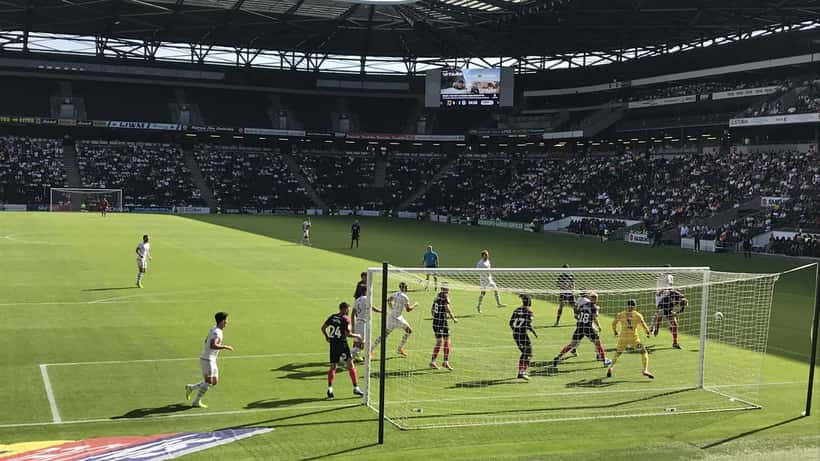
MK Dons entered Saturday's home fixture against Reading FC on 10 October 2026 sitting 22nd in League One — bottom three after just ten matches of the club's first season back in the third tier following their League Two promotion last spring. For the club's several thousand season ticket holders, that position raises a question few considered when they renewed in the summer: what rights do they actually have if MK Dons go straight back down?
The Relegation Arithmetic: How MK Dons Got Here
MK Dons secured automatic promotion from League Two in May 2026, finishing second with 86 points from 46 matches under manager Paul Warne — the second-highest points total in the fourth tier that season. That promotion triggered genuine optimism at Stadium MK, with season ticket sales reportedly outpacing the previous two campaigns. The mood entering 2026-27 was buoyant.
Ten games in, the picture has changed sharply. A 4–1 EFL Cup defeat to Championship side Norwich City on 8 August 2026 set an uncomfortable early tone. Back-to-back draws against newly-relegated Oxford United and promotion-chasing Huddersfield followed, but wins have been elusive. With just two points from ten games, the Dons need something from Saturday's match against Reading — seventh in the table and a single point outside the top six — to stop the slide from becoming a structural collapse.
Reading, meanwhile, arrive with momentum. Jack Marriott, their top scorer, is ruled out with an ankle injury for "a number of weeks" according to pre-match reports, but the Berkshire side have the depth of a genuine play-off contender. This is the kind of six-pointer that could define the Dons' season within 90 minutes — or confirm fears that this is a club fighting a losing battle.
Season Tickets, Promotions and the Law
When a club wins promotion, season ticket pricing usually rises to reflect the jump in status. A League One ticket at Stadium MK costs more than a League Two equivalent — rightly, given higher-profile opponents, better crowds and a more competitive product. But what the commercial literature rarely covers is what happens if the promoted club fails to survive.
In England and Wales, football season tickets are subject to the Consumer Rights Act 2015, which requires that services be performed with "reasonable care and skill" and that any unfair contractual terms — ones that create a significant imbalance in the parties' rights to the consumer's detriment — are not binding on the purchaser. Separately, the EFL's June 2026 rulebook revision introduced two new obligations specifically designed to protect supporters in exactly this kind of situation.
First, clubs must now ring-fence season ticket funds. Money paid before the season begins must be held in a designated client account, separate from the club's operating funds, until the corresponding fixture has been played. This rule emerged as a direct response to several high-profile administrations at League One level between 2022 and 2025, during which supporters lost hundreds of thousands of pounds in pre-season ticket payments. Second, clubs must now designate a named fan engagement contact — published on the club's website within two weeks of the season's start — through whom supporters can raise ticketing and commercial disputes without going straight to the legal team.
What Fans Can Actually Claim: A Concrete Scenario
Consider a supporter — call her Sarah from Bletchley — who bought a standard adult League One season ticket at Stadium MK in June 2026 for £395, having renewed based on the club's stated ambition to "consolidate and compete" in League One following promotion. Now, with MK Dons sitting in the bottom three after ten rounds, Sarah wants to understand her position.
The if/then logic is as follows:
If MK Dons finish the season in League One and avoid relegation, Sarah's £395 purchase delivers exactly what was described. No refund entitlement arises.
If MK Dons are relegated at the end of 2026-27 as a going concern (financially stable, no administration), Sarah's current-season ticket still entitles her to every remaining home fixture in 2026-27. Compensation for the drop itself — the fact that the team she paid to watch in League One will next year be in League Two — is not automatically available. However, if the club made specific representations at the point of sale about a competitive, mid-table campaign and those representations were materially inaccurate, Sarah could pursue a partial claim under the Consumer Rights Act. Such cases are not slam dunks, but they have succeeded at the Small Claims Court level when documentation of the misrepresentation exists.
If MK Dons enter administration during the season, the picture changes dramatically. An insolvency practitioner would assume control, and any outstanding consumer claims — including Sarah's unplayed home fixtures — become unsecured creditor claims. Secured creditors (HMRC, lenders) take priority. In past football administrations at this level, unsecured supporters have recovered as little as 8p in the pound. The EFL's ring-fencing requirement, if properly complied with, should protect money held for unplayed home games — but enforcing that protection requires Sarah to register as a creditor within 21 days of the administration appointment. Miss that window, and her claim may be extinguished entirely.
The financial exposure for a season ticket holder in an administration scenario is £395 minus the proportion of games already played. At the halfway point of a 23-home-game season, that represents roughly £197 at risk. Small in isolation — significant when multiplied across thousands of supporters.
What the EFL's 2026 Rule Changes Actually Protect
The EFL's ring-fencing requirement, introduced in June 2026, is the most meaningful structural protection available to League One supporters this season. If MK Dons have complied with the rule, funds paid for home fixtures between now and May 2027 should be held in a separate account inaccessible to general creditors. A compliant club should be able to confirm this on request through its designated fan engagement contact.
The change matters because pre-2026 administrations showed how easily fan money could be absorbed into general operating deficits before insolvency was declared. Clubs drew down on season ticket income to meet wages, HMRC liabilities and loan repayments — leaving supporters as among the largest unsecured creditors when the administrator stepped in. The new rules create a structural firewall, though they cannot prevent mismanagement and they are only as effective as the EFL's monitoring capacity allows.
Supporters wanting to verify compliance should contact the club's fan engagement representative and ask two specific questions: whether the June 2026 ring-fencing policy has been implemented, and where the relevant account is held. A club that refuses or deflects that question warrants closer scrutiny — and potentially a formal complaint to the EFL's fan relations team.
Practical Steps for MK Dons Supporters to Take Now
Acting before a crisis is always more effective than acting during one. For MK Dons supporters concerned about the club's League One standing, there are four concrete steps worth taking before the end of October 2026.
Read your season ticket terms in full. The Consumer Rights Act 2015 provides that unfair terms — ones that significantly disadvantage you without being individually negotiated — are not binding. Any clause that purports to remove your right to a refund in the event of administration is likely unenforceable.
Verify ring-fencing compliance. Under the EFL's June 2026 rules, the club should have published its season ticket policy before the start of the season. Check whether it explicitly confirms that pre-season payments are held in a ring-fenced account.
Document all commercial representations. If you received promotional materials, attended a launch event, or were told at the point of sale anything about the club's League One ambitions or playing budget, keep those communications. Screenshots of social media posts count.
Consult a solicitor before a crisis develops. If the situation deteriorates — a points deduction, a winding-up petition, or reports of unpaid wages — act quickly. The 21-day creditor registration window is short, and a solicitor familiar with sports insolvency law can ensure your claim is filed correctly and at the right priority.
Football supporters rarely consider themselves consumers in the formal legal sense, but under UK law that is precisely what they are. The Consumer Rights Act 2015 and the EFL's updated regulations give League One fans meaningful protections — but only for those who know how to invoke them.
For tailored advice on consumer rights disputes, season ticket claims, or sports-related employment and contract issues, ExpertZoom connects you with qualified legal professionals across the UK — available for a consultation within 24 hours.
This article contains general legal information only and does not constitute legal advice. If you have a specific dispute with a football club or concerns about your consumer rights, please consult a qualified solicitor.
