 Rebecca Taylor
Melanie Walters, the 64-year-old Welsh actress best known as Gwen West in Gavin & Stacey, was confirmed on 12 August 2026 as the final celebrity joining the BBC's Strictly Come Dancing 2026 cast. Partnered with professional dancer Aljaž Škorjanec, Walters — who already teaches Pilates — is set to perform in front of millions from September 2026. For thousands of Britons over 60 inspired by her announcement, the question health professionals are now fielding is the same: what should you check before you swap the sofa for sequins?
Why Walters's Strictly Debut Has Struck a Chord
The announcement completed a 15-celebrity line-up that will launch on BBC One in September 2026 under the new presenting team of Emma Willis and Johannes Radebe. Walters said in her statement that she was ready to "swap her fairy wand for sequinned dance shoes" — a reference to 15 years of pantomime work that has kept her physically active but, she joked, largely confined to a dressing room when Strictly was actually on air.
What sets her casting apart is not just the Gavin & Stacey fan base it brings to the show — it is that Walters represents an increasingly visible demographic: women in their mid-sixties stepping into demanding physical performance. She also teaches Pilates, meaning she arrives with core strength and body awareness that many of her fellow celebrities will not have. That detail has not been lost on health professionals watching the initial reaction.
According to Sport England's Active Lives 2023 data, only 2% of UK adults currently dance regularly — and that figure falls sharply with age. The Strictly effect has historically translated into a surge in ballroom and Latin class sign-ups in the weeks after the launch show each year. In 2026, with a cast member who is 64 and openly enthusiastic, that surge is expected to skew older than usual.
The Gap Between Inspiration and Preparation
Health professionals across the UK broadly welcome the Strictly effect — but they flag a consistent concern. The gap between watching a beloved actress begin an intensive training programme and deciding to join your local ballroom class yourself can look narrow on screen. Off screen, it can be significant.
Ballroom and Latin dance involves sustained aerobic effort, rapid direction changes, and — in competition-style training of the kind Strictly requires — sessions that can run three to four hours. Even a weekly 90-minute beginner class demands more from the cardiovascular system, joints, and proprioceptive balance than most sedentary adults over 60 will have tested recently.
The NHS physical activity guidelines for adults over 65 — published at nhs.uk — recommend at least 150 minutes of moderate-intensity activity per week, with two or more sessions per week of muscle-strengthening and balance exercises. Dancing counts toward both. However, the guidelines are clear that individuals with long-term health conditions should consult a GP or health professional before beginning a new programme of structured physical activity.
Common concerns for over-60s beginning dance training include cardiovascular strain during aerobic bursts, hip and knee stress from lateral movement and turns, lower-back load from prolonged postural demands, and dizziness or balance-related falls in early training when unfamiliar movement patterns are being learned.
What a Health Check Before Dance Classes Actually Covers
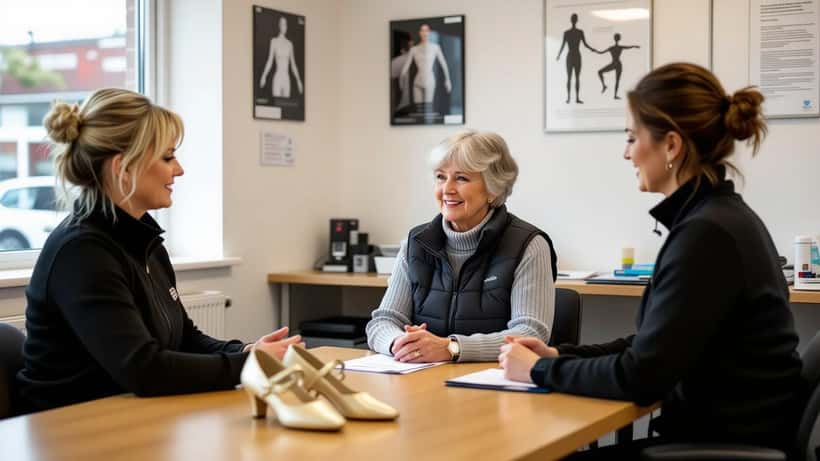
Sports medicine practitioners and health consultants increasingly offer structured pre-exercise assessments tailored to older adults starting new physical activities. A standard consultation will typically address four areas:
Cardiovascular baseline. For anyone over 60 with hypertension, elevated cholesterol, or a family history of heart disease, a resting blood pressure measurement and, where indicated, an ECG provides a meaningful starting point. This can be accessed via an NHS Health Check — available free every five years to adults aged 40 to 74 — or via a private health consultation.
Musculoskeletal assessment. Hips, knees, ankles and the lower back all absorb significant impact in dance. A physiotherapy assessment of baseline mobility and any existing joint conditions helps identify which dance styles are lower-risk and whether a period of targeted strengthening is advisable before classes begin.
Balance evaluation. Dance improves balance reliably over time, but an existing deficit increases fall risk in the early weeks of training. A physiotherapist can assess this more formally than the rough self-test of standing on one foot for ten seconds — and can prescribe specific balance exercises if needed.
Medication review. Certain blood pressure medications, diuretics, and other common drugs in this age group affect stamina, hydration status, and dizziness risk during physical exertion. A brief conversation with a GP to flag any relevant interactions costs very little time and can prevent a significant early setback.
A University of Leeds study involving 685 people aged over 55 across Leeds, Bradford and Doncaster found that weekly dance classes improved physical activity, balance and overall wellbeing — including among those aged over 85. That study also found that fall-reduction dance programmes could potentially save the NHS an estimated £158 million annually. The evidence base for dance as a health intervention is strong. The evidence that it works best when participants have been properly assessed first is equally strong.
When the Enthusiasm Gets Ahead of the Body: A Realistic Scenario
Consider the situation of a 62-year-old woman from Cardiff — call her Julie — who watched Walters's announcement and signed up for a twice-weekly beginner ballroom class the following week. Julie is a retired nurse, moderately active (walking three to four times a week), with well-managed mild hypertension and some intermittent pain in her left knee that she has not had formally assessed.
If Julie begins classes without a prior health check, she is likely to manage the first few weeks on enthusiasm and existing fitness. The knee becomes the variable. A lateral chassé step in week three, performed without the quad strength and proprioceptive conditioning to stabilise the joint, leads to a medial ligament strain. She is off classes for eight weeks. Physiotherapy to resolve the injury requires six sessions at £55–£90 each: a cost of £330–£540, plus lost class fees and the motivational setback of stopping at exactly the moment when most beginners are starting to feel confident.
If Julie instead begins with a single private health consultation — typically £80–£150 for a 45-minute GP or sports medicine assessment — she learns that her antihypertensive is fully compatible with moderate aerobic exercise, and receives a brief referral for a single physiotherapy session (£55–£90) to assess the knee. The physio identifies that her left quad is 20% weaker than her right and prescribes a four-week home strengthening programme before classes begin. The total preventive cost: £135–£240.
The if/then logic is direct: if Julie invests in a baseline assessment before her first class, then she arrives with the structural capacity her body needs for the lateral movement patterns ballroom dancing demands. If she does not, the knee issue that was always present becomes the thing that ends her Strictly journey before it has properly started. A £135–£240 precaution prevents a £330–£540 consequence — and, more importantly, keeps her dancing.
What Strictly 2026 Is Actually Modelling
The BBC's Strictly Come Dancing 2026 production reportedly includes a dedicated cast wellbeing protocol, including medical assessments before training begins. Every celebrity participant undergoes health screening as part of the show's duty of care — a standard that reflects the physical demands of the programme, not its glamour.
Aljaž Škorjanec, who returns to the show as a professional partner for the first time since his brief comeback in 2023, is known among professional dancers for adapting choreography sensitively to his partner's physical profile. That adaptation depends entirely on knowing what the medical picture is.
Walters's combination of age, Pilates training background, and long professional experience with physical performance puts her at the stronger end of the Strictly celebrity spectrum. For viewers inspired to follow her lead, that combination does not automatically translate — but it is replicable, at least in part, through the kind of structured preparation that health professionals can provide.
Start with the Right Conversation
Melanie Walters's Strictly announcement is, by any measure, a positive moment for older adults and physical activity in the UK. The health data supports what her casting signals: dancing is genuinely good for you, including in later life, and the benefits accumulate reliably with consistent practice.
The first step, though, is not buying new shoes. It is a conversation with a health professional who can assess your baseline, identify any contraindications, and help you begin at an intensity that is sustainable — not just achievable for the first three weeks. Whether that is a GP, a physiotherapist, a sports medicine specialist, or a health consultant with expertise in older-adult fitness, that hour spent at the beginning of the process is what makes everything that follows more likely to last.
Disclaimer: This article provides general health information only and is not a substitute for professional medical advice. Always consult a qualified health professional before beginning a new exercise programme, particularly if you have pre-existing health conditions or take regular medication.
