 Daniel Davies
On 5 January 2026, large boulders fell onto Monmouth Beach at Lyme Regis as a fresh landslip opened up on the cliff face above. Coastguard officers issued a safety warning and attended the scene. Less than six weeks later, a major collapse at Stonebarrow — two miles east, near Charmouth — sent a significant section of the South West Coast Path crashing down, forcing Dorset Council to close the trail. These were not exceptional events. They were the latest in a series of ongoing collapses that have characterised the Jurassic Coast for centuries. What is changing is that thousands of British homeowners now have properties within striking distance — and many have no legal protection they know about.
How Fast Is the Lyme Regis Coastline Actually Eroding?
The geology here is uniquely hostile to stability. Hard Jurassic limestone sits above thick beds of unstable clay and shale. As wave action and rainwater erode the softer layers beneath, the cliff above loses support and fails in large rotational slumps — the dominant failure mode at Black Ven, the landslide complex immediately east of Lyme Regis and one of the largest in Europe.
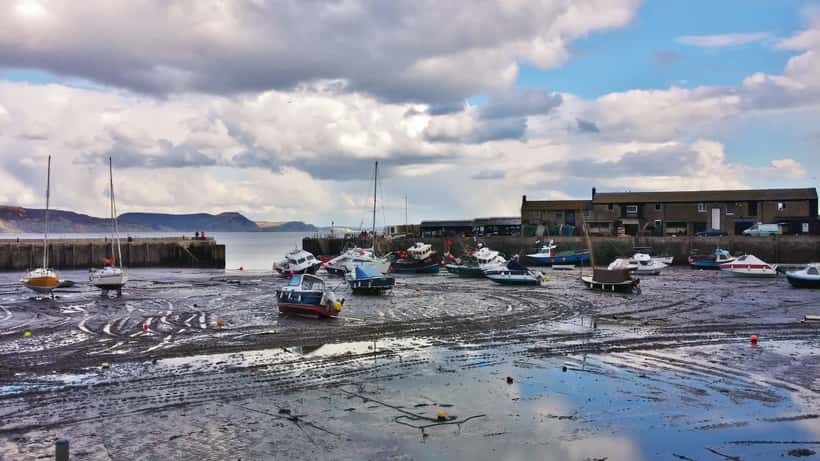
More than £35 million has been spent on coastal protection works at Lyme Regis since 1994, across four phases of the Environmental Improvements Programme. Despite that investment, Dorset Council has committed a further £6.2 million from its Community Infrastructure Levy fund — announced in April 2026 — toward Phase 5: the Cobb Stabilisation Scheme. Planning applications are expected to be submitted in Summer 2026, with construction starting between Winter 2026 and Spring 2027. Without the scheme, the Environment Agency warns that properties along Lyme Bay face accelerating erosion and destructive landslide risk.
Who Is Responsible When Coastal Erosion Damages Your Property?
This is the question coastal homeowners most often bring to solicitors — and the answer is rarely straightforward. In England, there is no general duty on the state to protect private land or property from natural coastal erosion. The Environment Agency, local councils, and the Crown Estate all have powers but not absolute obligations.
What this means in practice is that if a cliff collapses and takes part of your garden, or undermines your foundations, the default legal position is that you bear the cost. Claims against the council or Environment Agency for failing to maintain sea defences typically fail unless you can demonstrate a specific legal duty was breached — a very high bar.
Neighbouring landowners may carry liability if their land use has contributed to destabilisation — for example, by diverting water or building in a way that undermines a cliff. A surveyor and a specialist property solicitor together can assess whether this route is viable. It is rarely straightforward.
Home Insurance: The Gap That Catches Owners Out
Standard buildings insurance policies in the UK cover sudden, accidental damage. Coastal erosion — which is gradual and predictable — is almost universally excluded from standard policies. Crucially, insurers classify erosion as a "gradually operating cause" even when the actual failure appears sudden.
This is not just a technicality. Homeowners in known erosion risk zones, particularly in Dorset, Devon, and Suffolk, find that insurers either refuse to cover erosion-related structural damage or apply such high excesses as to render the cover meaningless.
What you should check in your policy:
- Whether "ground movement" is covered, and whether erosion falls under that clause
- Whether "subsidence" is distinguished from "erosion" in the policy wording
- Whether the insurer requires ongoing survey reports as a condition of cover
- What your excess is for ground movement claims, specifically
An independent home improvement specialist or structural surveyor can provide a condition report that strengthens any insurance application and creates a documented baseline if a future claim is needed. This is particularly important for properties near flood-prone and erosion-affected areas.
What the 2026 Harbour Revision Order Means for Lyme Regis Owners
On 20 February 2026, the Lyme Regis, Bridport (West Bay) and Weymouth Harbour Revision Order 2026 came into force. This Statutory Instrument replaced legislation dating back to 1584 — over 440 years of piecemeal harbour law — with a single modern regulatory framework.
For property owners and developers near the Cobb, the Order is significant: it formally defines harbour limits for the first time, modernises powers over navigation, mooring, dredging, and unserviceable vessel management, and introduces environmental considerations into harbour governance. Any property owner who holds rights over land adjacent to harbour-controlled areas should review whether the Order affects access, planning, or maintenance obligations. A solicitor familiar with maritime and property law can advise.
Can You Force the Council to Act?
Not easily, but not never. Where a local authority has adopted a Shoreline Management Plan (SMP) that commits to a policy of "hold the line" — meaning it intends to maintain coastal defences in a particular location — that commitment can, in some circumstances, give rise to a legitimate expectation that defence works will proceed.
If the council subsequently fails to act in accordance with a stated SMP policy, a solicitor may be able to challenge that failure through judicial review or seek compensation where the failure has caused quantifiable harm. Legal aid is not typically available for these cases, but conditional-fee arrangements may be.
What Experts Recommend Doing Now
For any property owner within 500 metres of an active erosion zone on the UK coast, home improvement and property specialists recommend four immediate steps:
- Commission a professional structural survey that specifically assesses erosion and landslide risk. Standard mortgage surveys do not cover this.
- Review your insurance policy against the guidance above, and seek specialist coastal cover if standard policies exclude erosion.
- Check your title deeds and boundary documentation — boundaries near eroding cliffs can shift in ways that affect your legal title.
- Register an interest with Dorset Council's consultation process for the Cobb Stabilisation Scheme. Property owners whose land is near the scheme area may have statutory rights to comment on planning applications.
The Jurassic Coast's instability is not new. What is new is the combination of rising sea levels, increasing storm intensity, and an expanding coastal property market. Waiting until the cliff moves is not a strategy. Seeking expert advice while your property is still stable is.
Disclaimer: This article is for informational purposes only. For advice specific to your property's situation, consult a qualified solicitor and a RICS-registered surveyor.
