 Phoebe Wilson
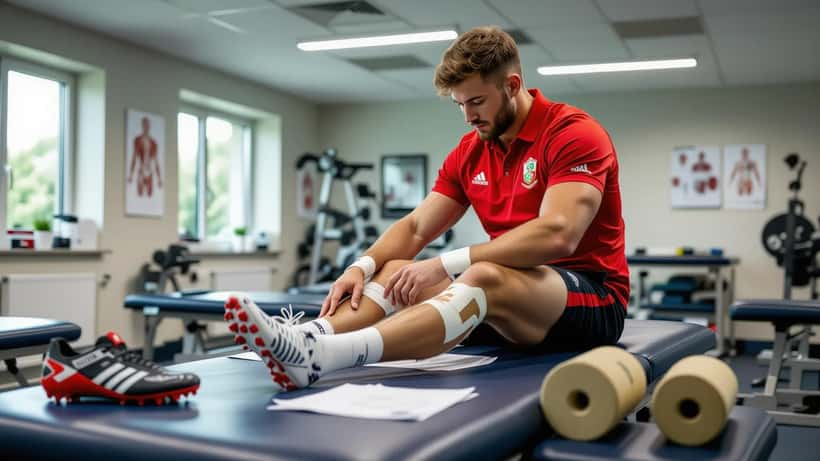
Louis Rees-Zammit is racing the clock. The 24-year-old Wales winger — who made global headlines when he left the Kansas City Chiefs to pursue an NFL career before returning to rugby with Bristol in August 2025 — suffered a toe injury playing against Saracens on 4 October 2026 and has since missed his club's last two Premiership matches. Wales assistant coach Danny Wilson confirmed this week that Rees-Zammit is "moving in the right direction" but stopped short of guaranteeing his availability for the Autumn Nations Series opener against Argentina. The story grips rugby fans across the UK. Yet beyond the sport headlines, there is a quieter and more consequential question: at what point should an injured athlete — professional or amateur — stop relying solely on club medical staff and seek an independent sports health specialist?
The Injury Behind the Headlines
Toe and foot injuries are among the most deceptively serious in rugby. The sport's contact demands — scrums, rucks, collapsed mauls — place repetitive mechanical stress on the metatarsals and phalanges, especially for backs who plant their feet at speed to change direction. Rees-Zammit's injury reportedly occurred against Saracens in a Premiership match played on 4 October 2026, one of the sport's most physically demanding encounters.
What makes this case medically significant is the context: Rees-Zammit had already managed a back injury during his time with the Jacksonville Jaguars in 2025, which contributed to his decision to leave the NFL and return to rugby. His body has been navigating the cumulative demands of two elite sports across two continents. Athletes who transition between sports codes with distinct biomechanical profiles face a significantly elevated risk of lower-limb stress injuries in the 12 months following the switch — a window that Rees-Zammit is still within.
Wales assistant coach Danny Wilson has told reporters that the coaching staff is monitoring the situation closely. The Autumn Nations Series begins in November 2026, giving the medical team a narrow window to assess and treat. But who, exactly, is doing that assessment — and in whose interest?
What Sports Medicine Specialists Say About Club Medical Conflicts
Sports medicine specialists make an important distinction that most injured players never learn: a club's medical team, however professional, has an institutional interest in player availability. Their primary client is the club, not the player. This does not mean club doctors and physiotherapists act against athletes' welfare — the vast majority do not — but it does mean that when a player is weighing whether to push through a toe injury for a high-profile fixture, their own long-term health interests are not automatically the primary factor in the assessment.
A sports medicine specialist working independently of a club or national union has a single client: the athlete. Their assessment is governed by what is medically optimal for that individual's long-term health and career, not the fixture calendar or a team's promotion push.
For Rees-Zammit, careful management of his toe injury could mean the difference between making his Wales autumn return as planned, or risking a more serious fracture or ligament disruption that sidelines him for a further six to eight weeks. The NHS notes that toe fractures — especially those involving the base of the fifth metatarsal — frequently present with symptoms similar to soft-tissue sprains, and misdiagnosis without imaging is common when medical decisions are made under fixture pressure.
For UK amateur rugby players facing similar decisions, the calculus is different but the underlying question is the same: is the medical advice you are receiving genuinely independent?
When Independent Advice Changes Everything: A Concrete Scenario
Consider a 32-year-old club rugby player — call him James — who twists his right foot making a tackle during a league fixture in early October. His club physio assesses the injury pitchside, concludes it is likely a soft-tissue sprain, applies ice and compression, and tells him he should be fit for the following Saturday's match if the swelling reduces. The club is three points off a promotion spot. James feels the social and competitive pressure to return.
Here is what the numbers tell us: approximately 20% of suspected ankle and foot sprains in contact sport turn out on imaging to involve a small fracture or significant ligament tear that requires four to eight weeks of non-weight-bearing rest, according to NHS sports injury guidance. If James plays through a hairline metatarsal fracture, the risk of a displacement fracture — requiring immobilisation and potentially surgery — rises sharply. A displaced metatarsal fracture carries an average recovery time of 12 to 16 weeks, compared to six to eight weeks for the original injury if managed correctly from the outset.
The financial impact compounds the medical risk. If James is self-employed, those additional weeks of impaired mobility can translate directly into lost income — potentially £3,000 to £6,000 for a tradesperson or freelancer at average UK earnings during a 4-week forced absence. If he works in a physically demanding role, a workplace absence beyond his employer's sick pay threshold may push him onto statutory sick pay of £116.75 per week, a significant shortfall.
An independent sports medicine consultation — typically costing between £90 and £200 for an initial private assessment in the UK in 2026 — would provide James with an independent imaging referral and an opinion untethered from any fixture calendar. If the result is "you're fine to play with appropriate strapping," he plays with confidence. If the result is "this is a hairline fracture, rest now or risk twelve weeks," he has the information he needs. The cost of that consultation is a fraction of the cost of mismanagement.
This is exactly the kind of decision point where an independent health specialist — not just a club physio, but a qualified sports medicine consultant — can make a material difference to an amateur athlete's health, career, and financial wellbeing. An expert consultation through a platform like Expert Zoom connects you directly with accredited sports medicine professionals who work for your interests alone.
The Multi-Sport Athlete Risk Profile
Rees-Zammit's situation also illustrates a growing challenge in modern sport: the cross-code or multi-sport athlete. His body adapted to rugby's sprint-and-contact demands, recalibrated for NFL blocking and special teams work — an entirely different biomechanical profile requiring different movement patterns, different footwear, and different soft-tissue stress distribution — and is now back in rugby mode. Each transition places distinct stress on tendons, ligaments, and bones previously optimised for a different sport.
Research from UK Sport suggests that multi-sport transitions increase soft-tissue lower-limb injury incidence significantly in the first year post-transition, with foot and ankle injuries accounting for a substantial share of those incidents. For professional athletes like Rees-Zammit, this risk is managed through sophisticated load monitoring and specialist screening. For amateur athletes making their own sport transitions — switching from football to rugby, from marathon running to CrossFit, from cycling to martial arts — the risk profile is similarly elevated, but the expert oversight is usually absent.
As reported earlier this season, the Kansas City Chiefs' 2026 injury crisis highlighted how NFL and elite rugby players face remarkably similar healthcare dilemmas when it comes to balancing competition pressure with genuine medical recovery needs. For athletes on both sides of the Atlantic, the challenge of navigating institutionalised medical advice is universal.
Practical Steps for Every Injured Rugby Player
Rees-Zammit's situation offers four clear lessons for any athlete navigating a suspected foot or toe injury:
Get imaging before playing through pain. An X-ray or MRI is the only reliable way to distinguish a soft-tissue injury from a stress fracture. Clinical examination alone, even by a skilled physiotherapist, carries a meaningful misdiagnosis risk in the foot and ankle.
Understand whose interest your medical team represents. Club or team physios are not independent advisors. For significant injuries — those that could worsen with premature return to play — an independent sports medicine consultation provides advice aligned purely with your long-term health.
Account for cumulative load. If you have recently changed sports, increased training intensity, or returned from a previous injury, your soft-tissue injury risk is elevated. Factor this into any decision about return-to-play timelines rather than relying solely on how the injury "feels."
Consider the full consequences of mismanagement. A few extra days of rest now can prevent weeks of forced absence. For self-employed people, freelancers, and anyone whose livelihood involves physical capacity, the economics of proper injury management are straightforwardly in favour of caution and independent assessment.
Louis Rees-Zammit's story encapsulates the tension at the heart of elite sports medicine: a gifted athlete with access to both club and international medical support is still navigating the same uncertainty that a club rugby player in the Midlands faces every autumn Saturday. You do not always know whether the advice you receive is designed primarily for your wellbeing or for the fixture list.
This article provides general health information for educational purposes and does not constitute medical advice. If you have sustained a sports injury, consult a qualified health professional before returning to physical activity.
