 Abigail Clarke
Liverpool face Paris Saint-Germain in the Champions League quarter-final on 9 April 2026, with Steven Gerrard calling it a "key opportunity" for Arne Slot's side — and the pressure on players, staff, and fans could not be higher.
The match that has everyone talking
Liverpool enter this Champions League quarter-final as underdogs, having suffered a 4-0 defeat to Manchester City in the FA Cup just days earlier. In the eyes of pundits and supporters, the tie against PSG has taken on enormous significance — not just for the club's European hopes, but for manager Arne Slot's position at Anfield.
Steven Gerrard, speaking to broadcast media on 8 April 2026, said he believed the Champions League qualification run could determine Slot's long-term future at Liverpool. The stakes, for everyone connected to the club, are extreme.
But behind the drama lies a question that goes beyond football: how do elite athletes — and the people around them — cope with this level of pressure? And what does sport science tell us about performing when everything is on the line?
What happens to the body under competitive pressure
Sports medicine researchers have studied the physiological response to high-stakes competition for decades. When an athlete enters a defining match, the body releases cortisol and adrenaline. Heart rate climbs. Reaction times become sharper — but only up to a point.
The phenomenon known as "choking under pressure" is well-documented in sports science literature. According to research published in the journal Frontiers in Psychology, athletes who have invested the most emotionally in an outcome are paradoxically more vulnerable to performance drops when the stakes are highest. This is not a sign of weakness — it is a neurological response to perceived threat.
For elite professionals like those at Liverpool or PSG, managing this response is a core part of their preparation. Teams at this level work with clinical psychologists, sports therapists, and performance specialists whose sole job is to keep athletes in the optimal arousal zone — what psychologists call the "flow state."
The role of sports psychologists in elite football
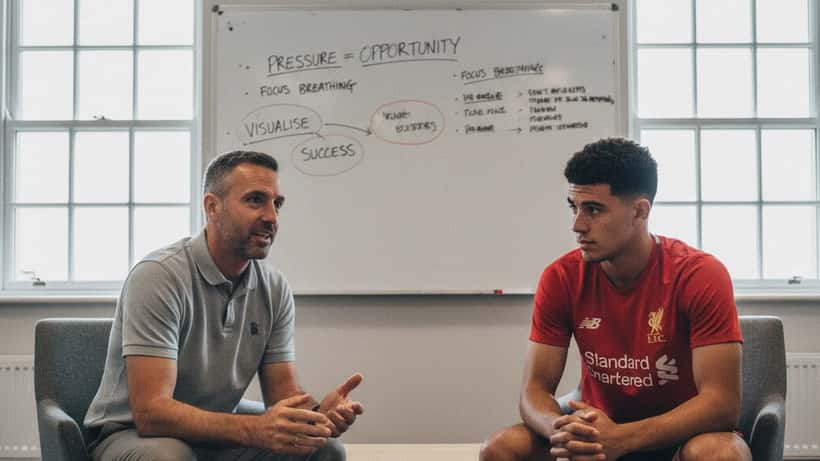
Most Premier League and Champions League clubs employ full-time sports psychologists. Their work includes pre-match visualisation sessions, breathing techniques to regulate the nervous system, and post-match debriefs to process results — both wins and defeats.
According to the NHS Mental Health and Wellbeing programme, sport can be a powerful source of mental wellbeing but also a significant stressor when performance expectations become excessive. The line between healthy competitive drive and damaging performance anxiety is thinner than many people realise.
For amateur players — Sunday league footballers, club runners, tennis league participants — the mechanisms are identical, even if the audience is smaller. The same cortisol spike, the same pre-match nerves, the same post-result emotional crash after a hard loss.
When competitive sport becomes a source of anxiety
Sports psychologists in the UK report a steady rise in referrals from amateur athletes experiencing sport-related anxiety. Symptoms can include persistent pre-competition insomnia, intrusive negative thoughts about performance, physical symptoms such as nausea or trembling before matches, and difficulty recovering emotionally after defeat.
These are not signs that sport is the wrong choice — they are signals that the psychological dimension of performance needs as much attention as the physical. Just as you would see a physiotherapist for a recurring hamstring strain, consulting a sports psychologist for performance anxiety is a legitimate, evidence-based step.
What the Liverpool-PSG match tells us about resilience
Watching how Liverpool respond to the Manchester City thrashing will tell us something important about resilience — a concept central to sports psychology. Resilience is not about pretending the defeat did not happen. It is about processing it, extracting what is useful, and returning to focus.
Gerrard's own coaching career — from successes to setbacks at Aston Villa and Al Ettifaq — illustrates this cycle. Elite sport demands the ability to hold both failure and ambition simultaneously, without one destroying the other.
Should you speak to a sports psychologist?
If you play sport regularly and find that competitive anxiety is affecting your enjoyment, your sleep, or your daily life in the week around a big match or race, a consultation with a qualified sports psychologist could make a real difference.
Sports psychology is not reserved for professionals. Practitioners working through platforms like Expert Zoom offer one-to-one sessions aimed at recreational athletes across all sports — from local football leagues to parkrun participants preparing for a personal best. The goal is not to eliminate nerves — a degree of arousal improves performance — but to manage them so they work for you rather than against you.
Liverpool may or may not overcome PSG. But the conversation their campaign is sparking about pressure, resilience, and mental performance is one every amateur athlete in the country should be having too.
Research from the British Journal of Sports Medicine shows that athletes who receive psychological support alongside physical training report significantly higher satisfaction from their sport and are less likely to experience burnout or dropout. The mental game, in other words, is not a luxury — it is an essential part of sustainable performance at any level.
The quarter-final at Anfield on 9 April 2026 is not just a football match. It is a reminder that what happens between the ears matters as much as what happens on the pitch.
