 Amelia Ward
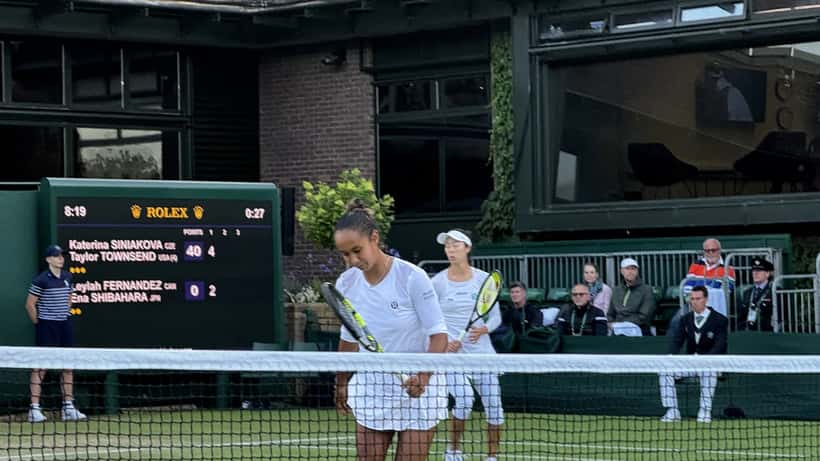
Leylah Fernandez, the Canadian star who reached the US Open final at age 18, was knocked out of Wimbledon 2026 in the first round on 29 June. Debutante Janice Tjen defeated her 6-1, 7-6 in just over an hour — her fourth Grand Slam first-round exit of the year. With her 2026 record standing at 12 wins and 17 losses — a win rate of just 41% — sports health professionals say the pattern raises a question relevant to athletes at every level: when a high performer's results fall this sharply, what is the body and mind actually signalling?
From US Open Finalist to First-Round Exit: The Season That Changed Everything
Fernandez turned professional as a teenager and reached the US Open final in 2021 at just 18, defeating three top-five players in succession. That result set expectations many players would struggle to carry. By 2025 she had rebuilt her career, winning the DC Open — the biggest title of her career — defeating top-10 opponents across the draw. Going into 2026, the trajectory looked promising again.
The 2026 season has been a stark reversal. On grass specifically — Wimbledon's surface — Fernandez managed just one win from five matches before her June first-round exit. She stated it plainly after the defeat: "This season has been a lot more downs than ups." That candour reflects something many elite athletes resist: acknowledging difficulty is not weakness but the first step toward addressing it.
The contrast was visible throughout this year's tournament. While Fernandez exited in round one, players at the sharp end of the 2026 Wimbledon draw consistently cited structured, team-supported preparation as central to their results. The gap between those two groups is rarely just talent.
What Sports Medicine Experts See in a Pattern Like This
A sustained performance slump in an elite athlete rarely has a single cause. Sports medicine consultants typically examine three domains simultaneously: physical health, psychological resilience, and competitive load.
On the physical side, grass-court tennis demands a specific type of lateral movement and explosive stopping that places considerable stress on the ankles, knees, and hip flexors. A player carrying even a minor underlying issue — a tight muscle group, an early-stage tendon problem — may report no pain yet lose fractions of a second in reaction time. Those small losses compound over a match. A 0.1-second delay returning to a neutral position can shift a 50/50 rally into a forced error across multiple games.
Psychologically, athletes with Fernandez's career arc carry the weight of public expectation. Sports psychologists describe this as one of the most underestimated performance inhibitors in professional sport. When an athlete's sense of self is closely tied to past results, an unexpected first-round exit triggers more than competitive disappointment — it activates a deeper identity threat. That creates a feedback loop: elevated pre-match cortisol, reduced sleep quality, and narrowed tactical thinking under pressure.
Fernandez's own post-Wimbledon response was instructive. She took a brief reset, deliberately reconnecting with why she started playing tennis in the first place. That approach — which performance coaches call motivational grounding — is precisely what sports psychologists would prescribe. Many athletes only arrive at that insight after prolonged difficulty, and some never reach it without external guidance.
The Science Behind Sustained Decline: What the Body Is Communicating
The NHS recognises that unmanaged stress in high-demand performance environments affects sleep, concentration, coordination, and immune function — all directly relevant to athletic output. In elite sport, this can produce what practitioners broadly term overtraining syndrome: a state where normal training volumes generate diminishing returns and, eventually, active regression in results.
The indicators across Fernandez's 2026 season map consistently onto this profile. A 41% win rate against a competitive baseline significantly above that figure, poor surface-specific performance (1-4 on grass), and her own acknowledgment of mental difficulty together form a recognisable pattern. These are the data points that warrant professional assessment rather than simply more hours on the practice court.
Sports medicine guidelines show consistently that early intervention — combining physiotherapy, strength-and-conditioning review, and psychological support — produces better long-term outcomes than allowing a slump to run and attempting correction mid-season without expert input. The principle is not that something is clinically wrong. It is that expert assessment identifies what solo effort cannot.
A Concrete Case: Recognising the Threshold Before It Becomes a Crisis
Consider a 22-year-old competitive club player based in Leeds. Through 2024, she won 68% of her county league matches and earned promotion to the regional league. By June 2026, her win rate has dropped to 37% — a fall of more than 30 percentage points over 18 months. She is training a similar number of hours, eating consistently, and reports no obvious injury.
Sports medicine practitioners apply a practical if/then rule to situations like this. If a competitive athlete's win rate drops more than 20 percentage points below their established baseline for three consecutive months — confirmed across at least six matches — a professional consultation is warranted within four to six weeks.
In this Leeds player's case, that threshold was reached in April 2026. A 45-minute physiotherapy assessment might identify a minor biomechanical asymmetry — a slightly overloaded right hip — that has accumulated gradually over 18 months of play. A separate session with a sports psychologist could help her recognise that her pre-match routine shifted significantly following a personal event in late 2025. Together, those two consultations — each costing between £80 and £150 in the UK depending on location and specialism — could halt a performance decline that typically compounds over one to two seasons if left unaddressed.
The numbers matter: an £80-£150 investment in professional assessment is almost always less costly — in financial terms and in wellbeing — than a full season of declining results, reduced selection, and accumulating self-doubt.
What Fernandez's Approach Can Teach Amateur Athletes
One of the most instructive aspects of Fernandez's response to 2026 is what she has chosen not to do. She has not made impulsive coaching changes, has not overhauled her game style, and has not withdrawn from competition to protect her ranking. Instead, she is heading directly to Washington to defend her DC Open title — returning quickly to structured competition after a setback.
That approach mirrors what health and performance consultants recommend for athletes at every level. Returning quickly to competition after a difficult result is a proven method for restoring physical confidence and motor memory. Sports medicine professionals call it graduated re-exposure, and it is grounded in the same principles used in anxiety rehabilitation: measured return to the triggering environment, with appropriate support in place.
The instinct to overhaul everything during a slump — coach, technique, training schedule — is common but counterproductive. Evidence consistently shows that athletes who make multiple structural changes simultaneously during a performance dip take longer to stabilise than those who implement small, targeted adjustments identified through professional assessment. Fernandez's measured response, informed by genuine self-reflection, is the more effective approach.
When to Book an Expert: The Practical Threshold for Club Athletes
If you are a competitive athlete at club, county, or regional level, the question is: when does a difficult run of results become a professional health concern?
Sports medicine practitioners identify a working threshold: three consecutive weeks of performance below your personal baseline. Pair that with at least one of the following — disrupted sleep, reduced motivation to train, more frequent minor injury, or noticeable changes in movement patterns — and a dual consultation is clearly indicated. One physiotherapy assessment and one session with a sports psychologist gives the most complete picture and the fastest route back to performance.
Attempting to train through that combination of signals without expert input is not resilience — it is risk. For most club athletes in the UK, the cost of a two-consultation assessment is lower than a season of declining results, lost selection places, and the compounding mental toll that sustained underperformance creates.
ExpertZoom connects athletes across the UK with verified health professionals and sports medicine specialists who understand competitive performance. Whether your concern is physical, psychological, or structural, a single expert consultation can be the pivot point between a temporary dip and a prolonged decline.
The health and performance information in this article is for informational purposes only and does not constitute professional medical or psychological advice. Consult a qualified health professional for personal health or performance concerns.
