 Mark Roberts
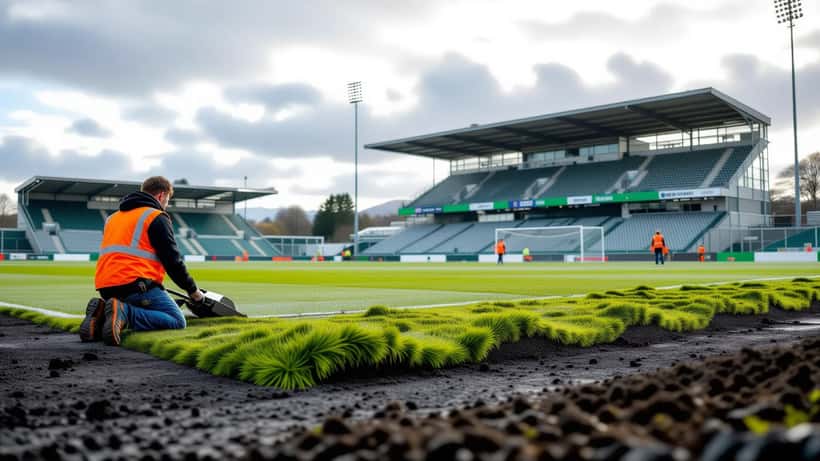
Kilmarnock's Premier Sports Cup tie against Raith Rovers was pulled from Rugby Park on Tuesday 14 July 2026 and switched to Beechwood Park, home of Auchinleck Talbot, because the club's famous artificial surface is being dug up and replaced with a hybrid grass pitch. The relocation is the visible edge of a bigger change: from the 2026/27 season, Scottish Premiership clubs have voted to ban plastic pitches from the top flight entirely.
For football, it is a governance story. For the hundreds of thousands of British households that laid artificial grass in their gardens over the last decade, it is something more pointed — a signal that the tide has turned against fake turf, and a prompt to ask whether the plastic lawn out the back is an asset or a liability.
What actually happened at Rugby Park
Kilmarnock's Rugby Park was the last remaining artificial surface in the Scottish top flight following Livingston's relegation, and the club had already planned to return to grass. The trigger was a 2024 vote in which Premiership clubs backed phasing out artificial pitches, a decision reported by Sky Sports and confirmed in an SPFL board statement. Clubs were handed a two-year window to plan the switch, which is why the work is landing now, in the summer of 2026.
It has not been universally popular. Clubs including Raith Rovers, Falkirk, Hamilton Accies and Queen of the South publicly condemned the plans as "grossly unfair", warning that maintaining a natural pitch could cost more than £750,000 a year, according to reporting in the Falkirk Herald and the Scotsman. The economics of grass versus plastic, in other words, are contested even among professionals with groundskeeping budgets — which is worth remembering before assuming that ripping out a domestic lawn is a simple win.
Why the artificial-grass debate reaches your garden
The reasons stadiums are moving away from plastic overlap with the concerns campaigners have raised about residential use. Artificial grass degrades into microplastics that can pollute waterways and harm wildlife, and it forms a barrier to the earthworms and insects that lay their eggs in soil, as the Natural History Museum set out in its coverage of the controversy.
The political mood has shifted alongside the science. Multiple petitions to ban or tax residential artificial grass have been lodged with the UK Parliament, and while the Government has repeatedly stated it has "no plans" to legislate a ban, it has confirmed that surfaces of no value to wildlife work against the biodiversity net gain that developers and councils are now required to demonstrate. You can read the current petition and the official Government response on the UK Parliament petitions site.
That combination — reputational pressure, planning rules that reward greenery, and mounting evidence on microplastics — is exactly what pushed Kilmarnock's decision-makers. The same forces are slowly reshaping how estate agents, buyers and local authorities view a plastic lawn.
What it means if you already have artificial grass
None of this makes an existing artificial lawn illegal, and there is no requirement to remove one. But three practical questions are now worth asking.
First, drainage and lifespan. Most domestic artificial grass is sold with a 10-to-15-year expectancy, and older installations laid on poorly prepared bases can trap water, flatten and shed fibres. If yours predates 2015, it may be approaching the point Kilmarnock reached with Rugby Park — technically playable, but past its best.
Second, resale perception. In gardens marketed to families and first-time buyers, a tired plastic lawn is increasingly read as a job to redo rather than a feature. The direction of travel among planners and campaigners suggests that perception will harden, not soften.
Third, disposal. Artificial grass is difficult to recycle and usually goes to landfill, so removal is not a quick skip job. Kilmarnock is spending heavily to lift and replace a professional surface; a domestic tear-out has smaller numbers but the same awkward waste stream.
When it pays to call an expert
This is where the football story and the household one converge. Kilmarnock did not lift its pitch on a whim — it worked with specialist pitch consultants, the same category of professional the SPFL board engaged to raise grass standards across the league. Homeowners rarely have that on speed dial, but the logic is identical: a surface decision that involves drainage, groundworks, cost over time and future resale is worth a professional opinion before the spades come out.
A landscaping or home-improvement specialist can assess whether your base can support natural turf, whether a hybrid or reinforced-grass system makes sense for a high-traffic garden, and what the realistic removal and disposal cost will be. For anyone weighing the switch, an expert consultation turns a vague worry into a costed plan — and can flag the cheaper option of rehabilitating what you have rather than replacing it wholesale.
The bottom line
The Raith Rovers tie moving to Beechwood Park is a footnote in a cup competition. But the reason behind it — Scotland's top flight formally turning its back on plastic before the 2026/27 season — is part of a wider reassessment of artificial grass that now runs from elite stadiums down to suburban back gardens. If your lawn is plastic and ageing, the sensible next step is not panic but advice: get a professional read on its condition, its lifespan and the true cost of change before you decide whether to follow Kilmarnock's lead.
