 Charlotte Hughes
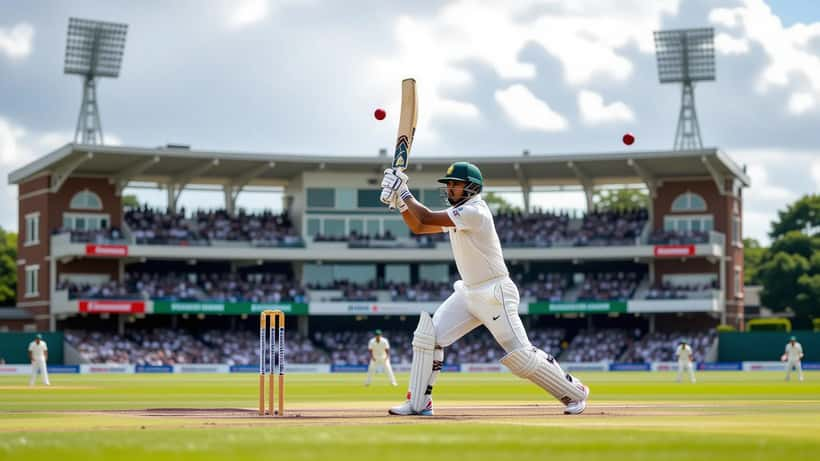
Pakistan's fast bowler Khurram Shahzad walked out to bat at Headingley on 19 August 2026 — survival instincts engaged as England's Josh Tongue pursued a hat-trick in front of a roaring Yorkshire crowd. Shahzad pushed neatly through the covers for four, sparing his side immediate collapse. What made his presence remarkable was not only that he weathered the storm, but what it represents off the pitch: a Pakistani international seamer simultaneously holding a Pakistan Cricket Board (PCB) touring contract and a Worcestershire county deal, navigating two entirely separate employment frameworks beneath one English summer sky.
As Pakistan's squad battles England in a three-Test World Test Championship series — which opened at Headingley, moves to Lord's (27-31 August), then concludes at Edgbaston (9-13 September) — thousands of British cricket fans and aspiring professionals are quietly asking a question that rarely makes back-page news: what actually happens to a county cricket contract when your country calls?
The News: Pakistan Bowled Out for 171 as Rain Stalls Day Two
England chose to field first at Headingley on 19 August and immediately exposed vulnerabilities in Pakistan's batting order. Ollie Robinson claimed 5 for 51 and Josh Tongue 5 for 46 in one of England's most dominant opening days in recent Test history, reducing Pakistan to 171 all out. England closed day one at 112 for 2 — Joe Root 45 not out, Jordan Cox 46 not out — with a significant first-innings lead already in sight.
Khurram Shahzad, selected as Pakistan's third seamer ahead of Aamir Jamal, survived Tongue's hat-trick delivery to deny England a moment of total humiliation. But the harder challenge arrives when Pakistan must bowl.
Day two on 20 August brought persistent rain across Leeds. The outfield remained waterlogged through the morning session, covers stayed on, and play was delayed indefinitely as more showers were forecast. For Shahzad — who signed with Worcestershire as an overseas player from July 2026 — the enforced rest does nothing to resolve the contractual complexity surrounding his summer in England.
The Expert Angle: When Two Contracts Collide
For professional cricketers in England, a county contract is not just a job offer — it is an employment contract governed by the Employment Rights Act 1996, the Professional Cricketers' Association (PCA) standard terms, and any specific clauses negotiated individually by the player or their representative.
When an overseas player such as Shahzad is selected for international duty, the county typically issues a temporary release under the terms of the ICC's Standard Player Release Agreement. The mechanism looks clean on paper. In practice, it creates a layered set of obligations that very few players — and fewer counties — have mapped in advance.
Three legal questions arise almost immediately in dual-contract situations like Shahzad's:
Salary continuity during international duty. The PCB pays match fees and tour allowances once Shahzad joins the touring party. His Worcestershire salary is typically suspended, not terminated, during the international window. The county retains the right to reactivate the contract once the PCB releases the player at the end of the tour.
Liability for injury sustained abroad. If Shahzad suffers a stress fracture — as he did on Pakistan's 2023-24 tour of Australia when a rib injury cut short his involvement — during the England tour, the PCB's medical team manages treatment. But the county contract may include a fitness clause requiring the player to return "fit and available for immediate selection." Failure to meet that threshold, even through no fault of the player, can trigger salary suspension provisions and — in the most adversarial county relationships — contractual termination procedures, as set out under UK employment contract law.
Notice protections and visa linkage. An overseas player on a Tier 5 (Creative and Sporting) work permit is employed by the county as sponsor. If the county terminates or declines to renew the contract — including on the grounds that the player returned injured from international duty — the player's work permit is tied to that specific employer. Termination triggers a 60-day departure window unless the player secures a new county sponsorship swiftly. That is a consequence most county contracts do not spell out clearly, and one that can affect a career trajectory far beyond a single season.
The Concrete Case: What the Numbers Actually Look Like
Consider a scenario that maps directly onto Shahzad's situation — one that applies equally to any county-contracted overseas professional this English summer.
A 27-year-old overseas fast bowler signs a standard county deal worth £52,000 for the 2026 season, running April through September. In July, he is selected for his country's England tour. His county releases him for the 28-day ICC window. Three weeks into the tour, during an intense pre-match net session at a Test venue, he develops acute side-strain — the injury cluster that most frequently affects fast bowlers operating on England's green, seaming pitches in back-to-back five-day match cycles.
The national board authorises six weeks of rehabilitation. His county contract technically resumes in September. Only two County Championship fixtures remain. The county physio requires a 14-day return-to-bowling protocol before competitive play is possible.
Scenario A — the fitness clause is precise: The contract defines "fit" as "cleared for full competitive bowling by the county medical officer, with a minimum of five consecutive net sessions completed." The player cannot satisfy those conditions in the time remaining. The county places him on "medically unavailable" status for the final three weeks. He loses approximately £6,000 in pro-rata pay.
Scenario B — the fitness clause is absent or vague: UK employment law does not permit a employer to withhold salary simply because an employee is unfit — particularly when the injury arose during duties entirely outside the employer's control. The player may be entitled to full pay for the remainder of his contract, potentially £8,000-£10,000 depending on the contract's payment schedule, regardless of whether he bowled a single ball in September.
The difference between Scenario A and Scenario B is not chance. It is determined by whether the player received legal advice before signing — and whether the county's lawyers drafted the contract with sufficient precision in the first place.
For Shahzad specifically, the stakes extend beyond a few weeks' pay. His Worcestershire agreement is one piece of a multi-season career plan. A poorly handled injury scenario could affect his visa status, his eligibility for contract renewal next season, and indirectly his PCB central contract rating — which governs match fees and tour selection priority.
As our earlier analysis of UK cricket player injury rights for touring squads showed, these overlapping frameworks affect professional and serious club players alike, not only elite internationals.
Five Legal Pressure Points Every County Cricketer Should Know
The PCA estimates that dozens of contract disputes between counties and overseas players occur each English summer, with the majority settled privately. That culture of quiet resolution keeps disputes invisible — and leaves individual players without the legal clarity they deserve. Whether you are an overseas international or a domestic county professional, five clauses in your contract require specialist attention:
Fitness-on-return definition. Insist on precise language specifying who assesses fitness — the county physio, an independent medical officer, or an agreed joint panel — and what timeline applies.
Injury liability during international windows. The contract should state explicitly who bears treatment costs and whether salary continues when injury occurs outside the county's jurisdiction.
Salary suspension vs. termination distinction. These are legally separate. Suspension is temporary; termination triggers statutory notice and potential redundancy pay. Confusing the two can cost players thousands in rights they unknowingly waived.
Visa sponsor obligations. Confirm in writing that the county cannot terminate your work permit sponsorship without giving you sufficient time to arrange an alternative county placement — typically a minimum of 28 days' written notice beyond the contract notice period.
Renewal clause thresholds. Many county contracts include performance-based renewal options. Check whether an international absence — even one mandated by your national board — counts against your statistics for renewal eligibility purposes.
Looking Ahead: Lord's, Edgbaston, and What the Series Means for Contracts
With England leading Pakistan firmly after day one at Headingley, the spotlight will intensify on Pakistan's bowlers — including Shahzad — when play eventually resumes. Babar Azam's absence from the first Test (his fitness situation was cited by Pakistan's management before the match) adds further pressure on the pace attack to produce breakthroughs at Lord's and Edgbaston.
Three Tests across six weeks mean an extended dual-contract period for every overseas player in the Pakistani touring party. For supporters watching the cricket, the drama is in the scorecard. For the players themselves, the complexity runs considerably deeper than wickets and runs.
Understanding your rights is not bureaucratic box-ticking. For a professional cricketer operating across two contractual frameworks, it can mean the difference between a career-defining English summer and a legal dispute that poisons the relationship with a county you hoped to return to for years to come.
YMYL notice: This article provides general legal information for educational purposes. It does not constitute legal advice. For personalised guidance on cricket employment contracts, player rights during international duty, or overseas work permit requirements, consult a qualified sports law solicitor.
