 Amelia Ward
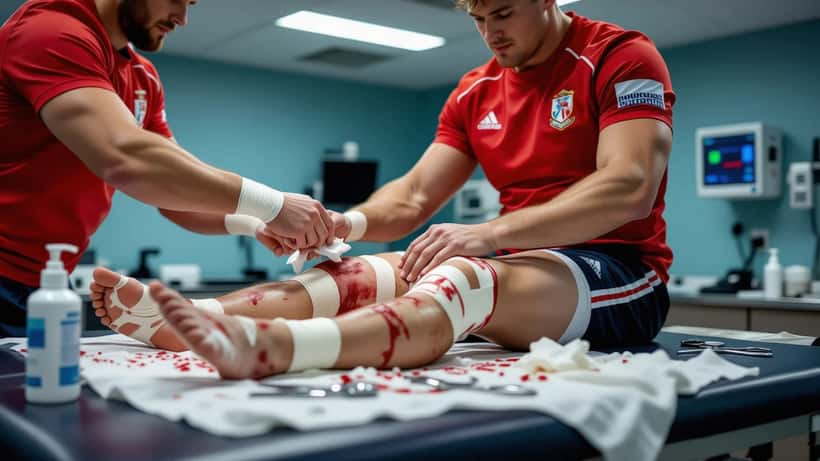
Leigh Leopards head into Friday's Super League clash at Craven Park without Josh Charnley and Lachlan Lam after both suffered deep leg lacerations during last Sunday's 38-12 win over Bradford. Each player required around ten stitches after being cut by opponents' boots, and coach Adrian Lam confirmed on Thursday that neither would be risked for the Round 15 fixture against Hull KR on June 19, 2026.
It is a familiar sight in professional rugby league: a player leaving the field with blood soaking through their sock, a club doctor deciding whether they can return. But the question Charnley and Lam's injuries raise — when does a sports laceration need professional medical attention rather than a home dressing? — is one that thousands of amateur players across the UK get wrong every weekend.
Why Stud Wounds Are More Serious Than They Look
Rugby league is one of Britain's most physically demanding team sports, and boot-stud wounds are among its most common injuries. According to sports medicine research, lacerations account for approximately 11.7% of all rugby injury diagnoses. A study on stud-related injuries found that 72% of rugby players surveyed had experienced at least one stud wound during their career — half occurring in the ruck and 27% during tackles.
What makes these wounds dangerous is not their surface appearance but what may lie beneath. A boot stud driven into a player's leg during contact can penetrate beyond the skin into muscle tissue, introducing bacteria from the playing surface and in some cases damaging tendons or blood vessels not immediately visible. Professional clubs understand this — which is why Leigh Leopards chose to rest two of their most important players rather than risk a wound reopening under Super League match intensity.
For Charnley and Lam, the concern is straightforward: ten stitches on a leg, placed just days before a fixture featuring scrums, tackles, and rucks, risk failing entirely. For amateur players facing a similar injury, the calculus is the same — but the medical support usually is not.
Warning Signs That Mean A&E, Not a Plaster
The NHS advises that minor cuts and grazes can be cleaned and dressed at home. However, several signs indicate a wound requires immediate professional assessment:
- Bleeding that does not stop after ten minutes of firm, direct pressure
- A wound that is deep, gaping, or has ragged irregular edges — these almost always require suturing
- Bone, tendon, or fatty tissue visible in the wound — go to A&E immediately
- Signs of infection within 24–72 hours: redness spreading beyond the wound margin, increasing pain, warmth, swelling, or yellow/green discharge
- Fever, chills, or shivering — potential signs of systemic infection requiring urgent treatment
- Numbness, tingling, or weakness in the affected limb — can indicate nerve involvement or the early stages of compartment syndrome
Compartment syndrome — where bleeding and swelling inside a sealed muscle compartment cut off blood supply to surrounding tissue — is rare but constitutes one of the most serious complications of a deep leg laceration. Symptoms include pain disproportionate to the wound size that worsens rather than improves, a tight or full feeling in the muscle, and in severe cases, pallor or numbness in the foot. If these signs appear after any contact sport leg injury, call 999 or go directly to A&E.
The Mistakes Amateur Players Make
Professional players like Charnley and Lam have immediate access to club doctors, physiotherapists, and specialist consultants. The Leigh Leopards medical team assessed wound depth, checked for underlying tissue involvement, sutured correctly, and issued a structured return-to-play protocol — then made the call not to risk it.
Amateur rugby league players rarely have access to those resources. Many attempt to continue playing with wounds that a professional medical team would classify as match-ending. Many delay seeking any treatment at all.
NHS data shows that infected soft tissue wounds are among the leading causes of unplanned GP visits and emergency department attendances among amateur sport participants. A wound that heals in five days with proper treatment can become a two-to-four-week problem once infection sets in — and in rare cases, a complication requiring hospitalisation.
The four most common mistakes amateur players make with stud lacerations are:
- Returning to match play before the wound is properly assessed
- Failing to clean the wound thoroughly before closure
- Ignoring early infection signs such as increasing rather than decreasing pain
- Returning to contact training before sutures are removed
NHS guidance notes that leg wound stitches are typically removed between seven and fourteen days after application. During that period, the wound should be kept dry and protected from further contact. Returning to sport with sutures in place — even under a bandage — significantly increases the risk of the wound failing.
When to Consult a Health Specialist
The practical guidance for any contact sport participant who sustains a stud wound is clear:
Apply direct pressure immediately and hold for at least ten minutes without lifting the dressing to check. If bleeding is heavy, the wound is deep, or anything beneath the skin surface is visible, go to A&E that same day — do not wait for a GP appointment. If you receive stitches, book a GP follow-up if there is any concern about healing progress.
Do not return to training until the wound is fully closed and stitches have been removed by a healthcare professional. If you are uncertain about your injury — its depth, whether it is healing correctly, or whether you can safely return to play — a Health specialist consultation through Expert Zoom can provide professional medical guidance without the wait.
Hull KR will face Leigh Leopards at Craven Park without two of their opponents' most potent attacking weapons. For the thousands of amateur players sustaining identical injuries every weekend across the north of England, the lesson is the same one professional clubs already apply: when a wound goes deeper than the surface, get it checked by someone qualified to assess what lies beneath.
YMYL disclaimer: This article provides general health information for educational purposes only. It does not constitute medical advice. If you have concerns about a specific injury, seek advice from a qualified healthcare professional or call NHS 111.
