 Abigail Clarke
On 22 April 2026, Hubert Hurkacz walked onto a Madrid clay court for the first time since his knee gave out during the 2025 season — and beat his opponent 6-3, 6-3. For a player who spent more than a month unable to move without pain, the victory at the Madrid Open was more than a first-round result. It was the conclusion of a seven-month rehabilitation journey that many sports medicine specialists say contains lessons every amateur athlete should understand.
The Injury That Ended Hurkacz's 2025 Season
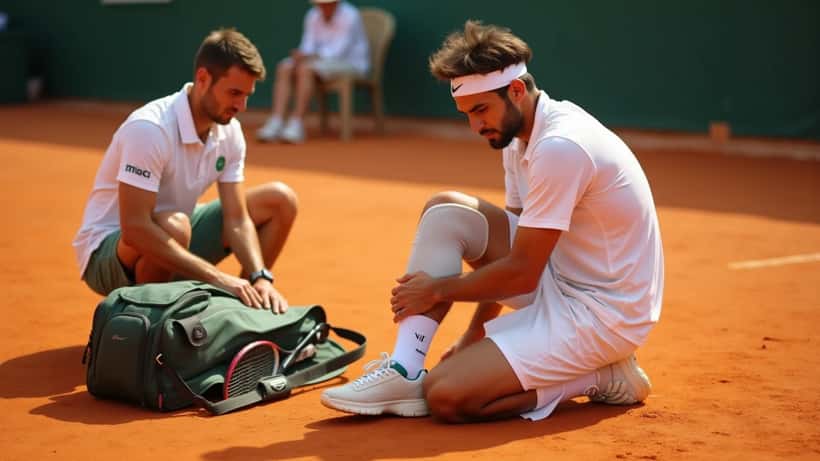
Hubert Hurkacz, 29, underwent arthroscopic knee surgery on his right knee in July 2025. The procedure forced him to shut down his entire season, missing the remainder of the year after the Australian Open. He went from being one of the world's top-10 tennis players to someone his coaches described as being unable to move at the worst point of his recovery.
The Polish world number 29 returned to the ATP Tour at the United Cup in January 2026 — more than seven months after surgery — and immediately delivered one of the competition's most memorable performances: spearheading Poland's title run with wins over Alexander Zverev and Taylor Fritz, both top-10 players at the time.
His 2026 season has been modest by his standards, at 5-7 heading into Madrid. But his first-round victory over Portuguese qualifier Jaime Faria on 22 April showed the physical foundation is solid — and his second-round match against Lorenzo Musetti on 24 April is a significant test of where his game and his knee now stand.
What Seven Months of Rehabilitation Actually Looks Like
Hurkacz's coaches described a recovery that involved more than a month of 10-to-12-hour days dedicated entirely to rehabilitation, fitness, and recovery work. His coach Nicolas Massu, reflecting on the comeback, noted: "Nothing is impossible if you maintain the work ethic."
For elite athletes, knee surgery rehabilitation follows a well-established sequence that sports medicine specialists identify as critical for amateur athletes too. The phases typically proceed as follows:
Weeks 1-6 (Protection phase): Reducing swelling, restoring range of motion, and beginning non-weight-bearing exercises. This phase is often rushed by amateur athletes who confuse the absence of pain with the presence of strength.
Weeks 6-12 (Strengthening phase): Rebuilding muscle mass around the knee — quadriceps, hamstrings, and glutes — which protect the joint under load. Hurkacz would have spent significant time in this phase given the demands tennis places on lateral movement.
Months 3-6 (Functional phase): Sport-specific movement, agility work, and return to on-court practice. The psychological dimension of this phase is significant: fear of re-injury is common and can cause compensatory movement patterns that create new problems if not addressed.
Months 6-12 (Return to competition): Graduated return to match play at progressively higher intensity. For recreational players, this phase is where most re-injuries occur, typically due to returning to full competition too quickly.
According to the NHS, knee surgery recovery timelines vary significantly depending on the procedure and individual health, but full return to high-impact sport typically requires several months of structured physiotherapy (NHS: Knee Surgery and Recovery).
The Mistakes Amateur Athletes Make That Professionals Don't
Hurkacz's return illustrates several principles that sports medicine specialists observe being consistently violated at amateur level in the UK.
Returning before the tissue is ready, not just before the pain stops. Arthroscopic knee surgery can leave a patient pain-free within weeks, but the repaired tissue takes months to develop the tensile strength needed for sport. Athletes who return when pain disappears — rather than when their physiotherapist confirms tissue readiness — face a significantly elevated re-injury risk.
Neglecting the psychological component. Kinesiophobia — fear of re-injury — affects an estimated 40 per cent of athletes returning from significant knee surgery, according to sports rehabilitation research. Hurkacz's extended rehabilitation included psychological components alongside physical training. Amateur athletes who focus only on the physical frequently develop protective movement patterns that actually increase knee stress over time.
Not rebuilding the full movement chain. A knee injury rarely affects only the knee. Compensatory patterns developed during injury — favouring one leg, altering running gait — affect the hip, lower back, and ankle. Rehabilitation that does not address the entire kinetic chain leads to secondary injuries once the athlete returns to full training load.
Skipping graduated loading. The return to sport must be gradual. Amateur club tennis players and recreational runners in particular often go from zero training straight to competitive match play. A sports medicine professional would design a graduated programme over several weeks, with objective markers — time on court, distance covered, lateral movement repetitions — before clearing full participation.
When You Should Consult a Sports Medicine Doctor After a Knee Injury
Not all knee injuries require surgery. Many respond well to conservative management. But certain presentations require professional assessment before rehabilitation decisions are made.
Seek a sports medicine consultation if you experience: persistent swelling beyond 48 hours after an injury; a sensation of the knee "giving way" under load; inability to bear weight immediately after impact; a clearly audible pop at the time of injury; or pain that worsens, rather than improves, after 72 hours of rest and ice.
In the UK, GP referral is the standard route to orthopaedic assessment, but waiting times can delay diagnosis by weeks. Private sports medicine specialists offer faster assessment and often more sport-specific rehabilitation planning than a general physiotherapy discharge. For amateur athletes who compete regularly, the cost of a delayed or incorrect diagnosis — in terms of time off sport and re-injury risk — typically exceeds the cost of a specialist consultation. Platforms like Expert Zoom connect you with qualified sports medicine professionals who understand both the injury and the sporting context.
What Hurkacz's Comeback Tells Amateur Athletes
Hurkacz's return to competition less than eight months after surgery, at a level sufficient to defeat professional opponents in straight sets, is not typical for a recreational athlete. Elite players have access to full-time physiotherapists, daily monitoring, sophisticated load management tools, and coaches who have overseen dozens of similar recoveries.
What is transferable is the principle, not the timeline. A structured, patient, professionally supervised rehabilitation programme — one that does not cut corners because you feel better — produces significantly better outcomes than a self-managed return based on pain levels alone. The temptation to return early is greatest when you feel fine. That is precisely when the risk of re-injury is highest.
For the millions of UK adults who play recreational sport and suffer knee injuries each year, Hurkacz's seven months of disciplined, expert-guided recovery is the model worth following — not a compressed version of it.
Disclaimer: This article provides general health information only. Knee injuries vary significantly in type and severity. Always consult a qualified sports medicine professional or GP before beginning or modifying a rehabilitation programme.
