 Chloe Collins
High Potential Season 3 renewed: what ABC's hit show gets right — and wrong — about raising a gifted child
ABC confirmed the renewal of High Potential for a third season in March 2026, keeping Kaitlin Olson's character Morgan Gillory on screens into the 2026–27 TV year. The show — about a single mother with an IQ of 160 who becomes an LAPD consultant — has become one of the most-watched dramas on American network television. In the UK, it has built a dedicated following since landing on Disney+.
But while viewers are captivated by Morgan's sharp deductions and chaotic genius, parents of bright children are quietly asking a different question: is any of this realistic, and what does it mean for my child?
What the show gets right about high potential
High Potential is loosely based on the French series HPI: Haut Potentiel Intellectuel, which drew on research into high intellectual potential (HIP) — a term psychologists use for individuals who score significantly above average on cognitive assessments, typically IQ above 130.
The show captures some genuinely accurate traits:
Pattern recognition and hyperfocus. Morgan spots connections that trained detectives miss. This reflects real findings: children and adults with HIP often demonstrate superior pattern recognition and can enter states of intense concentration when a problem genuinely engages them. The flip side — boredom and disengagement when tasks feel trivial — is equally accurate.
Social mismatch. Morgan struggles to fit in, talks too fast, and is perceived as difficult or eccentric by colleagues. Research consistently shows that gifted individuals often experience social isolation, not because they cannot connect with others, but because their interests, communication style and pace are out of sync with peers. A 2024 study by the British Journal of Educational Psychology found that 38% of identified gifted students in secondary school reported chronic feelings of social isolation. Ofsted's guidance on meeting the needs of high-ability pupils is available on the gov.uk education standards pages.
Underestimation and late identification. The backstory implies Morgan was never identified as gifted — she cleaned offices rather than working in a career that matched her abilities. This is strikingly common. Many high-potential individuals, particularly those from non-privileged backgrounds or who are twice-exceptional (gifted plus a learning difference like dyslexia or ADHD), slip through the system entirely.
What the show gets wrong
The dramatised version of giftedness is, understandably, compressed for television. But some popular misconceptions are worth unpacking.
Giftedness is not a single superpower. Morgan is presented as brilliant at everything intuitive and hopeless at everything administrative. In reality, the profile of high potential is highly individual. Some gifted children excel in verbal reasoning, others in spatial or mathematical thinking. Some have exceptional emotional intelligence; others struggle with executive function. There is no single "gifted profile."
Gifted children do not automatically succeed. This is perhaps the most damaging myth perpetuated by shows like High Potential. Without appropriate educational challenge and support, gifted children frequently underachieve. They can develop "coasting habits" — learning to get by without effort in early school years, then struggling profoundly when they encounter genuine difficulty in higher education or work. Ofsted data from 2025 indicates that around 45% of pupils identified as high ability in Year 6 in England do not achieve the highest GCSE grades.
What parents of bright children should actually do
If your child seems consistently ahead of their peers, bored in class, or unusually intense about specific topics, the right response is not to wait and see whether they blossom on their own.
Formal assessment. An educational psychologist can carry out a cognitive assessment to establish whether your child's profile qualifies as high potential and, if so, in which domains. This also screens for twice-exceptionality, where a child is both gifted and has a learning need — a combination that is more common than most teachers recognise and often results in misdiagnosis.
Talk to the school — with evidence. Schools respond better to a structured conversation backed by assessment data than to parental impressions of their child's brilliance. A letter from an educational psychologist or a private tutor who has worked with your child carries weight.
Targeted enrichment, not just more of the same. The worst response to a bored gifted child is to give them more homework of the same type. Enrichment means depth, not volume: exploring a topic further, tackling problems designed for older students, or finding extracurricular environments (maths clubs, creative writing programmes, science competitions) where the child is genuinely challenged.
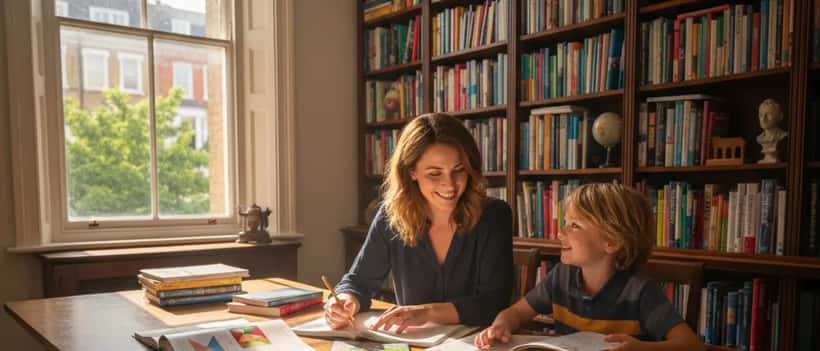
A specialist private tutor can be transformative. Not to push the child ahead academically, but to give them a space where their curiosity is taken seriously. A good tutor working with a high-potential child asks harder questions, introduces connections across subjects, and — critically — models what it looks like to struggle productively with a genuinely difficult problem. This builds resilience as well as ability.
Watch for wellbeing signals. Gifted children who are chronically under-challenged can develop anxiety, perfectionism, or school refusal. They may have been told they are clever so often that any mistake feels catastrophic. Mental health awareness is as important as academic support.
Finding the right support
The challenge for most UK families is that the system does not proactively identify or support high-potential learners. Unlike the French HPI framework that inspired the TV series, England has no statutory gifted and talented programme. Provision is almost entirely school-dependent.
Private tutors with experience in high-potential learners can bridge this gap. They are often the first adults outside the family to take a child's intellectual curiosity seriously and to provide the structured challenge that state education may not offer. According to the Sutton Trust's 2025 report on private tutoring in the UK, 27% of families using private tuition cite their child's boredom or under-challenge at school as the primary reason.
Note: This article is for general informational purposes. For advice specific to your child's educational and developmental needs, consult a qualified educational psychologist or specialist tutor.
High Potential will return for Season 3 in autumn 2026. Morgan Gillory will keep solving crimes. But for parents watching, the more interesting question might be: what would it mean if your child's high potential had been spotted ten years earlier? It is not too late to find out.
