 Sophie Robinson
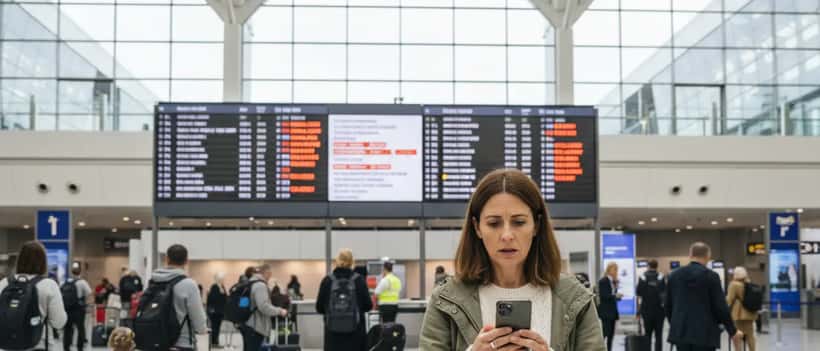
Heathrow Airport is once again at the centre of UK travel disruption as Easter 2026 approaches, with hundreds of delays and cancellations recorded throughout March. On 23 March alone, the UK's busiest airport recorded 399 disruptions — 379 delays and 20 cancellations — affecting tens of thousands of passengers during the peak spring travel season. If your Easter flight is delayed, cancelled or significantly changed, you have legal rights — and most passengers aren't using them.
What's happening at Heathrow this Easter
March 2026 has proved one of the most turbulent months for Heathrow in recent years. Earlier in the month, escalating Middle East tensions led to the closure of Gulf airspace, causing Heathrow to cancel or divert 24 of its 56 Middle East-bound flights on 2 March. The disruption cascaded through the network, delaying connecting flights across Europe and North America.
The 23 March figure of 399 disruptions came on top of ongoing operational pressures linked to Heathrow's £1.3 billion infrastructure investment programme — including a major refurbishment of Terminal 4. The airport handled a record 6.5 million passengers in January 2026, putting enormous strain on ground operations.
New routes launching this Easter weekend (including ITA Airways to Rome and PIA to Islamabad, both beginning 29 March) add further complexity to already stretched scheduling.
Your rights under UK261 when flights are disrupted
Following Brexit, the UK retained its own version of the EU's Regulation 261/2004, known as UK261. It protects passengers on flights departing from UK airports, or arriving in the UK on UK or EU carriers. If your Heathrow flight is delayed, cancelled or denied boarding, you may be entitled to:
If your flight is delayed by 3+ hours at arrival:
- Meals and refreshments (from 2 hours of delay)
- Hotel accommodation if you're stranded overnight
- Transport between the hotel and airport
- Financial compensation of £220–£520 depending on flight distance
If your flight is cancelled:
- A full refund or rebooking on the next available flight at no extra cost
- The above care rights (meals, accommodation)
- Compensation of £220–£520 unless the cancellation was caused by "extraordinary circumstances"
What counts as extraordinary circumstances?
This is where many passengers lose out. Airlines frequently cite extraordinary circumstances to avoid paying compensation — but not all disruptions qualify. Adverse weather, air traffic control strikes and genuine security threats can be classed as extraordinary. However, technical faults and staffing shortages typically do not qualify, according to the Civil Aviation Authority (CAA).
As the UK's aviation regulator, the Civil Aviation Authority provides clear guidance on passenger rights and a free complaints process if your airline refuses a valid claim.
How to make a claim: step by step
Step 1 — Document everything. Keep your boarding pass, booking confirmation and any communication from the airline. Photograph the departure board if your flight is delayed, and note the exact time of arrival at your destination.
Step 2 — Submit a formal complaint to the airline. Airlines are required to respond within a reasonable time. Write to their customer relations team — not the call centre — and reference UK261 explicitly. State the delay in hours, the flight distance and the compensation amount you are owed.
Step 3 — If the airline refuses, escalate. Heathrow passengers can escalate to an Alternative Dispute Resolution (ADR) scheme approved by the CAA: CEDR or Aviation ADR. These schemes are free for consumers and binding on airlines. You do not need a solicitor for most standard claims.
Step 4 — Consider legal advice for complex cases. If the value of your claim exceeds £500, involves consequential losses (hotel bookings, car hire, missed events), or the airline disputes liability on unusual grounds, a solicitor specialising in consumer or transport law can significantly improve your outcome.
Check your passenger rights and get expert guidance at Expert Zoom
Common mistakes that cost passengers their compensation
Passengers frequently lose valid claims by making avoidable errors:
- Accepting a voucher instead of a refund. You are entitled to a full cash refund. Vouchers can be refused.
- Failing to request care in writing. If the airline doesn't offer meals or accommodation, request it formally (email or text) and keep the record.
- Waiting too long to claim. Under the Limitation Act 1980, you have six years to bring a claim against a UK airline — but ADR schemes may have shorter windows. Act within 90 days of the disruption wherever possible.
- Assuming extraordinary circumstances apply. Don't accept this automatically. Ask the airline for written confirmation of the specific cause and whether it was within their control.
Is Easter 2026 a particularly risky time to fly from Heathrow?
Historically, Easter is one of the highest-risk periods for Heathrow disruptions. Staff ratios are stretched, weather can be unpredictable, and the combination of leisure and business traffic creates scheduling bottlenecks. The ongoing Terminal 4 works add a further variable.
If you are flying from Heathrow between 29 March and 6 April 2026, consider booking flexible fares, checking your travel insurance policy carefully, and registering your contact details with the airline so disruption notifications reach you directly.
Knowing your rights before you travel is the most effective form of protection. If things go wrong, act quickly and in writing — the law is on your side.
