 Emily Wang
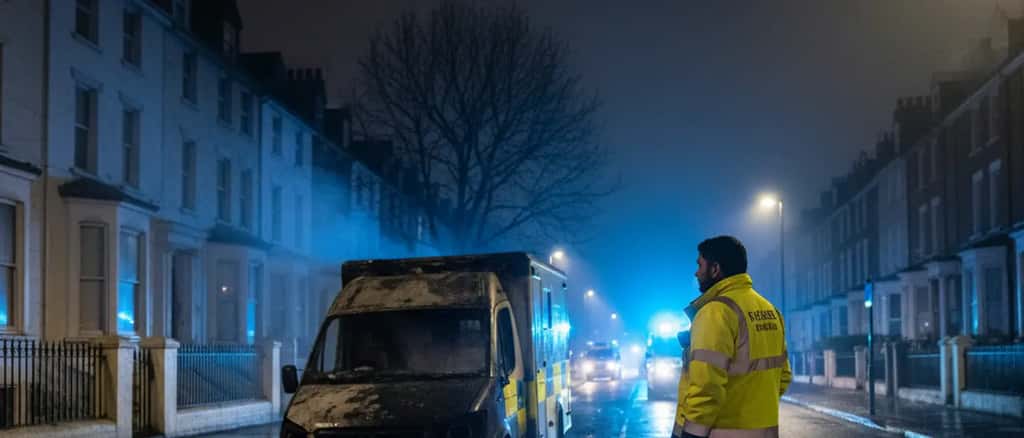
Four volunteer ambulances belonging to Hatzolah Northwest, a Jewish emergency medical service, were set ablaze outside a synagogue in London's Golders Green neighbourhood in the early hours of Monday, 23 March 2026. Security footage showed three masked individuals carrying gas canisters approaching the vehicles at 1:36 a.m. before deliberately igniting them. Police confirmed the incident is being treated as a suspected hate crime.
What Happened in Golders Green
The fire destroyed at least four vehicles belonging to Hatzolah, a volunteer organisation providing 24/7 rapid medical response across North West London. The ambulances were parked adjacent to Machzikei Hadath synagogue on Golders Green Road when the arson took place.
London Fire Brigade responded to the scene. Shomrim, a Jewish neighbourhood watch organisation, confirmed the vehicles were completely gutted. At the time of writing, no arrests had been made, and a Metropolitan Police investigation was underway.
Hatzolah Northwest provides life-saving cover to thousands of households in the area. The loss of four frontline vehicles represents a significant blow to the community's emergency capacity, particularly given NHS ambulance response time pressures in the capital.
The Legal Framework Around Hate Crime
In England and Wales, a hate crime is defined as any criminal offence motivated by hostility or prejudice towards a person's race, religion, sexual orientation, disability, or transgender identity. Arson itself carries a maximum life sentence under the Criminal Damage Act 1971 — and when aggravated by religious hostility, prosecutors can apply for enhanced sentencing under the Crime and Disorder Act 1998.
The suspects, if identified and convicted, could face sentences substantially longer than the baseline arson charge. Crown Prosecution Service guidance specifically allows religiously aggravated arson to be charged under the higher-tariff provisions when there is evidence of hostility towards a religious group.
YMYL disclaimer: This article contains general legal information for educational purposes. It does not constitute legal advice. If you or your organisation have been affected by a hate crime or need advice about legal rights following a criminal incident, consult a qualified solicitor.
What Rights Do Volunteer Organisations Have?
This incident raises an important question many community organisations rarely consider: what legal protections and remedies exist when charitable or volunteer-run services are targeted?
Civil claims against perpetrators. Beyond criminal prosecution, the organisation can bring a civil claim for damages against those responsible. This covers the cost of destroyed vehicles, operational losses, and reputational harm. The Hatzolah fleet is estimated to be worth tens of thousands of pounds.
Insurance and liability. Most charitable organisations hold specialist liability insurance, but policies differ considerably. A solicitor specialising in charity law or commercial insurance can advise on what is recoverable and whether a gap in cover exists. Following a major loss event like this, it is critical to document everything immediately — photographs, inventory, witness statements — before the scene is altered.
Hate crime reporting and victim support. Volunteer organisations that are targeted as religious entities can access support through Tell MAMA and the Community Security Trust (CST), both of which provide guidance on evidence collection, reporting pathways, and interfacing with the Crown Prosecution Service.
Seeking injunctions. Where there is an identified ongoing threat, organisations can apply to courts for injunctions to prevent further harassment or interference with their operations.
Why Legal Advice Matters After a Hate Crime
Many volunteer organisations assume that police action is sufficient and overlook their parallel civil rights. In practice, criminal proceedings can take months or years, and the organisation must continue to function in the meantime.
A specialist solicitor can help in several areas:
- Pursuing compensation through the Criminal Injuries Compensation Authority (CICA) or directly from perpetrators
- Advising on operational restructuring to reduce future vulnerability — for example, reviewing vehicle storage arrangements from a risk and liability standpoint
- Supporting public appeals and fundraising by ensuring compliance with Charity Commission rules on emergency crowdfunding
Within 48 hours of the Golders Green attack, fundraising campaigns had already emerged online to help replace the vehicles. Organisations launching such campaigns need to be aware of Gift Aid eligibility, Charity Commission reporting obligations, and any restrictions on how donated funds can be used.
Community Resilience and Legal Preparedness
The Golders Green arson attack has shocked communities across London and beyond. It also serves as a reminder that volunteer organisations — however trusted and community-rooted — are not immune to targeted attacks and should have legal preparedness measures in place.
A qualified solicitor can review an organisation's articles of association, insurance arrangements, data handling, and incident response protocols, all before a crisis occurs. This is no less important than having a physical emergency plan.
If your community group, charity, or volunteer organisation has been targeted by a hate incident or criminal act, Expert Zoom connects you with experienced solicitors available for online consultations — no waiting, no commute, expert legal guidance when you need it most.
Incidents such as those in Golders Green are not just tragedies for those directly affected. They are legal events with complex consequences that require professional guidance to navigate effectively.
Acting Quickly After an Incident
One of the most important pieces of legal advice following a hate crime is to act quickly. Limitation periods apply to civil claims, and evidence degrades rapidly. Organisations should:
- Preserve all evidence — footage, photographs, communication records, and eyewitness accounts
- Report immediately — to police with full details, requesting a formal hate crime reference number
- Notify insurers — any delay in reporting a loss event can jeopardise a claim
- Seek legal advice within days — not weeks — to understand all available options
The Golders Green attack will be remembered as one of the most serious acts of targeted antisemitic vandalism seen in London in recent years. But its legal aftermath will determine what justice looks like — and how resilient the affected community and its services can become.
