 Alice Howard
Scientists at Hokkaido University have revealed that giant octopuses up to 19 metres long dominated Earth's oceans 100 million years ago — a discovery published in Science on 9 April 2026 that is captivating children across the UK and sparking fresh interest in marine science.
The Discovery: A Real-Life Kraken
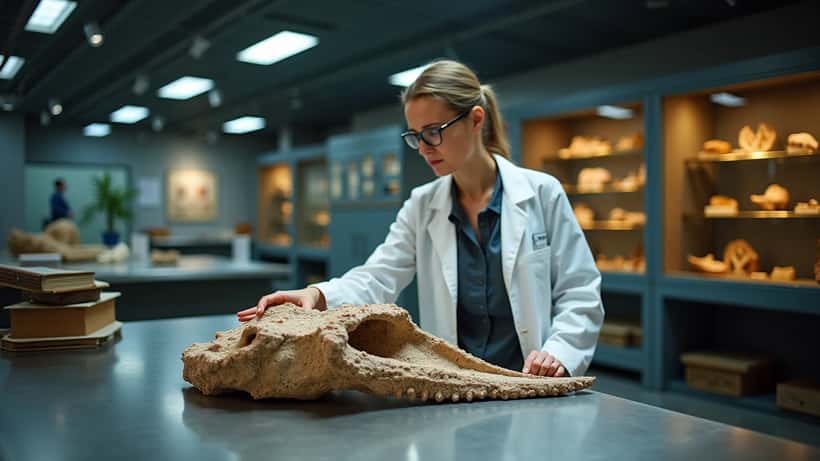
The research centres on fossils of Nanaimoteuthis haggarti, a Cretaceous-era cephalopod that was the largest known invertebrate predator of its time. At up to 19 metres in length — roughly the combined length of two London double-decker buses — these creatures possessed powerful lower jaws capable of crushing hard shells and even bones. According to the study published in Science, the animals occupied the very top of the marine food web during the Cretaceous period, rewriting what scientists previously understood about ancient ocean ecosystems.
The Natural History Museum confirmed that the fossil record shows these animals were far more dominant than anything we see today, with evidence of specialised hunting strategies that modern octopuses still share on a smaller scale. The story was covered by BBC Newsround the same week, bringing it directly into UK classrooms.
Why Children Are Fascinated — and Why That Matters
Whenever a discovery like this breaks through into mainstream news — and especially into children's programming — it creates a powerful but brief window of opportunity. Children ask questions at an intense rate: How big is 19 metres? How do we know it was a predator? Why did it disappear? Could it still exist somewhere?
These are not idle questions. They are the building blocks of scientific reasoning. According to the UK Department for Education's national curriculum guidelines on science at Key Stage 2 and Key Stage 3, students are expected to develop the ability to ask questions about the natural world and use evidence to construct explanations. A headline-grabbing fossil discovery is exactly the kind of hook that a skilled private tutor can turn into a month of meaningful learning.
How a Private Tutor Can Turn This Moment Into Deep Learning
If your child came home buzzing about the giant octopus, the right educational response is not simply to look it up together and move on. A qualified private tutor — particularly one who specialises in biology, earth science, or general science at KS2 through GCSE level — can use this discovery to teach several overlapping curriculum areas at once.
Geological time: 100 million years ago sits in the Cretaceous period, which itself spans roughly 79 million years. Understanding the scale of geological time — the difference between a million years and a billion years — is a skill that many students find deeply counterintuitive. A good tutor uses a physical timeline exercise to make these numbers feel real.
Adaptation and evolution: Nanaimoteuthis haggarti evolved its enormous size and specialised jaw structure because of selection pressure from its environment. Why did it go extinct? What changed? These questions lead naturally into discussions of mass extinction events, climate shifts, and the feedback loops that drive evolution — all of which appear in GCSE biology syllabi.
Evidence and inference: Palaeontology is fundamentally about making careful inferences from incomplete evidence. Fossils do not come with labels. Helping a child understand how scientists deduced the size, behaviour, and diet of an animal from fragmentary fossil remains is a powerful lesson in scientific method — a key element assessed in GCSE science exams.
Marine ecosystems: The discovery repositions the ancient ocean food web dramatically. A tutor can use it to introduce the concept of trophic levels, apex predators, and ecosystem balance — connecting a 100-million-year-old story directly to modern marine conservation concerns that are also on the curriculum.
From Curiosity to Confidence
The challenge with science education at home is often not a lack of interest but a lack of structure. Children are fascinated by giant octopuses right now. Within a fortnight, that curiosity will have faded unless it is channelled into something durable. A private tutor provides that structure: they can build a short project around the discovery, assign age-appropriate reading, design a simple experiment around buoyancy or animal camouflage, and set up a presentation for the child to deliver back as a confidence exercise.
Research published by the Education Endowment Foundation shows that high-quality tutoring can add the equivalent of five additional months of learning per year for students who receive it. The key is timing: engaging a tutor when a child is already motivated dramatically improves outcomes.
For parents of children who are particularly engaged by natural history, palaeontology, or marine biology, this is also a moment to explore specialist science clubs, natural history museum visits, and science Olympiad competitions — all areas where a knowledgeable tutor can provide guidance and preparation support.
The Bigger Picture: Science Literacy in the UK
The UK government's STEM strategy identifies science engagement at primary and early secondary level as critical to building the pipeline of future scientists, engineers, and researchers. Yet Ofsted reports consistently identify a gap between children's natural curiosity about science and their formal attainment in science exams.
Part of the problem is that the wonder of a giant prehistoric octopus never quite makes it into the classroom in an organised way. School timetables are tight, teachers are stretched, and the connections between today's headlines and next term's exam content are rarely drawn explicitly. That is precisely the gap that a qualified private tutor fills.
Whether your child is preparing for KS2 SATs, working toward GCSEs, or simply a natural science enthusiast who deserves more stretch and challenge than the standard curriculum provides, connecting this moment of excitement to structured learning is one of the most effective investments you can make.
What to Do Now
If your child is asking questions about prehistoric ocean life — or about science more broadly — this is the moment to act. A private tutor who specialises in science can assess where your child is currently, identify which curriculum gaps the giant octopus story can help fill, and design a short programme of sessions that builds genuine understanding rather than surface-level familiarity.
On Expert Zoom, you can connect with qualified private science tutors who work with children from Key Stage 2 through A-Level. Many offer a free introductory session so you can find the right match before committing.
The kraken was real. Your child's curiosity about it is real too. Make it count.
Disclaimer: Educational approaches should be tailored to each child's individual needs. Consult a qualified tutor or educational specialist before making significant changes to your child's learning programme.
