 Eleanor Stone
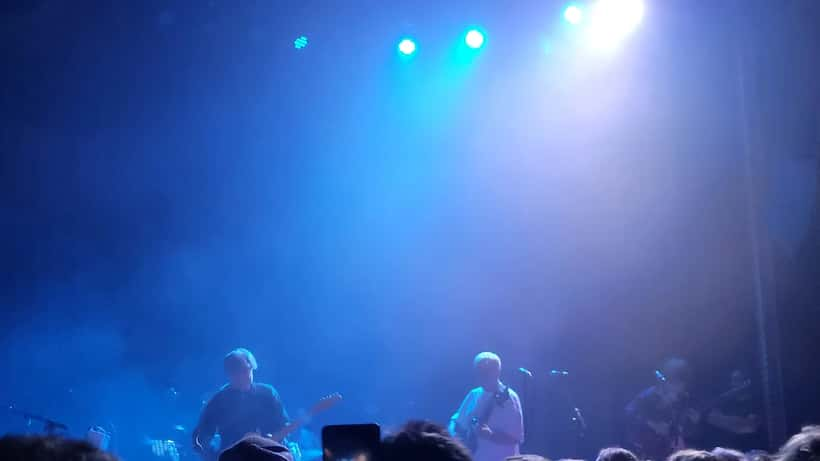
On 8 October 2026, Geordie Greep — the British frontman of Black Country, New Road and former face of black midi — stepped onto the stage at The Pearl in Vancouver two hours late, alone, without his band. Before playing a note, he addressed a matter that had little to do with music. Printed flyers had been distributed outside the venue by an unknown individual alleging rape. Greep denied the allegation publicly, stating from the stage: "I would never rape a woman." He acknowledged making someone "uncomfortable" at a house party but described it as a misread social situation — "I made a move, and it didn't come off." He offered refunds to any audience member who wished to leave and announced that the evening's proceeds would be donated to the Against Violence organisation in British Columbia. No formal police complaint had been reported as of the date of publication.
The incident raised a question with sharp relevance for a UK audience: when a public allegation is made without a formal complaint, without named parties, without evidence presented to any authority — what legal protections does UK law actually offer?
The Anatomy of an Anonymous Allegation
In England and Wales, defamation law is governed by the Defamation Act 2013, the most significant reform of the area in decades. Under its provisions, a claimant — the person whose reputation has been damaged — must demonstrate that a statement was published to a third party, identified them, and caused or was likely to cause "serious harm" to their reputation.
Anonymous flyers distributed outside a sold-out concert venue satisfy those criteria with uncomfortable ease. They reach hundreds of people in minutes, are photographed and shared across social media within hours, and carry connotations that no subsequent denial fully neutralises. The serious harm threshold is met not by any legal weight the allegation carries — there is none, absent a formal complaint — but by its social velocity.
A formal allegation to police triggers a defined investigative process with documented rights and obligations on both sides. An anonymous flyer has no such process. That asymmetry is precisely where specialist legal advice becomes essential, and where acting quickly — rather than waiting to "see what happens" — materially changes the outcome.
Accused Without Being Charged: The Rights Gap
The UK defamation framework attempts to balance two rights that frequently collide: the right to a reputation and the right to freedom of expression. For someone publicly accused without any formal complaint, that balance tilts uncomfortably.
An allegation on a flyer or a viral social media post is not a criminal charge. It carries none of the procedural protections that formal proceedings require — no presumption of innocence, no right to cross-examine, no requirement for evidence to any standard of proof. Yet reputationally, its impact on a public figure can be indistinguishable from a conviction.
A defamation and reputation management specialist advising a public figure in this position would typically recommend three immediate steps:
- Document everything without delay. Photograph flyers, screenshot posts, archive URLs, and record timestamps. This forms the evidential foundation for any future action and cannot be reconstructed after the fact.
- Avoid unadvised public statements. Greep's stage response — direct and intended to be transparent — carries inherent legal risk. A partial acknowledgement, however well-intentioned, can be reframed as a partial admission in a subsequent legal context.
- Seek specialist legal advice within 48 hours. Defamation claims in England and Wales are subject to a one-year limitation period under the Limitation Act 1980. That clock starts from the date of first publication — not from when you become aware of the content.
Industry Exposure: Morality Clauses and the Career Cost
For working musicians and other creative professionals, the financial stakes extend well beyond personal distress. Most contemporary touring contracts, record deals, licensing agreements, and festival booking terms include morality clauses — provisions that allow the contracting party to terminate if the artist's conduct brings them into "disrepute," regardless of whether any charges are ever filed or proven.
The Defamation Act 2013 provides a "honest opinion" defence — but that defence applies to opinions, not to statements of fact. A flyer asserting that a named individual committed rape is a statement of fact. If false, it is potentially actionable under defamation law. The practical obstacle is identification: anonymous defendants make civil litigation harder, though court orders can compel social media platforms and print vendors to disclose identities in appropriate cases.
More recent legislation has added a faster administrative route alongside the courts — a development that has changed the strategic calculus for anyone in this position. See also: Jared Leto's BBC Documentary and the Career Fallout: What UK Employment Law Says About Morality Clauses
When Anonymous Accusations Go Digital: A Manchester Musician's Scenario
Consider a realistic scenario rooted in the UK context. Alex is a 29-year-old session musician from Manchester with a growing social media following of 22,000 and a steady income from corporate bookings, festival slots, and session work. In October 2026, an anonymous Instagram account shares a screenshot alleging sexual misconduct at a music industry event two years earlier. The post contains no complaint reference number, no institutional corroboration, and no identified witness. Within 72 hours it has been reposted 1,400 times. Alex loses a confirmed £6,500 corporate booking the following morning, and two festival appearances worth approximately £3,200 are quietly withdrawn.
If Alex takes no immediate legal action: the losses compound through informal blacklisting. Bookers in the UK music industry are risk-averse and rarely communicate their reasons for not re-engaging an artist. Based on comparable cases tracked by UK entertainment law firms, a mid-tier musician facing an anonymous online allegation that is not actively challenged can experience income shortfalls of £40,000–£80,000 annually within six to twelve months of the initial post.
If Alex acts within 48 hours: the position changes significantly. A cease-and-desist letter drafted by a specialist defamation solicitor costs approximately £750–£1,500 in England and Wales. If the anonymous poster is identified — which a court order can compel in cases involving serious criminal allegations — and the statement is shown to be false, a High Court defamation claim can recover damages, secure an injunction removing the content, and require a published correction. In UK cases involving false allegations of serious sexual misconduct, court awards have ranged from £50,000 to over £185,000.
The if/then logic is clear: if the allegation is false and the source can be identified, legal remedies can recover both quantifiable financial losses and reputational damage. If the source remains anonymous, the Online Safety Act 2023 now provides an administrative route to compel platform takedowns — faster and considerably cheaper than initiating High Court proceedings.
What the Online Safety Act 2023 Changes
The Online Safety Act 2023, which came into operational effect for major platforms in early 2025, materially expanded the options available to targets of anonymous digital allegations. Platforms now bear defined legal obligations to maintain accessible reporting mechanisms and to act on content that falls under specified harms — which includes false statements of criminal conduct directed at identifiable individuals.
A regulated platform that fails to respond appropriately to a reported false criminal allegation faces enforcement action from Ofcom, the UK communications regulator. This legislative layer does not replace the Defamation Act 2013; it supplements it. A qualified solicitor can now pursue a platform takedown demand in parallel with — or as a faster precursor to — a formal defamation claim. In most cases where the allegation has only recently been published, the platform route is the appropriate first step: it is quicker to execute, lower in cost, and does not foreclose any subsequent legal action.
The Practical Priority List
If you or someone you know is facing anonymous public allegations in the UK without a formal complaint having been filed, the immediate priorities are consistent regardless of the specific facts:
- Preserve all evidence immediately — screenshots, photographs, archived URLs with timestamps
- Avoid any public response without legal sign-off, however reasonable it feels in the moment
- Contact a solicitor specialising in defamation and media law within 48 hours of becoming aware of the allegation
- Submit a formal report to the relevant platform under the Online Safety Act 2023 as a concurrent first-response measure
- Begin documenting every financial loss attributable to cancellations, withdrawn bookings, or lost opportunities — this documentation becomes the basis for any damages claim
A qualified legal professional can assess whether the serious harm threshold under the Defamation Act 2013 has been met, advise on the realistic prospects of identifying an anonymous source through court disclosure orders, and structure a response that protects rather than worsens your position.
Disclaimer: This article is for general informational purposes only and does not constitute legal advice. If you are dealing with a defamation matter or anonymous allegations, consult a qualified solicitor.
