 James Harrison
Between 10 and 15 June 2026, six military aircraft crashed across five countries in five days — killing 37 people and forcing a global reckoning with ageing fleets, overstretched maintenance crews, and the sheer physical risks of fast-jet flying. From California to Kashmir, the world watched communities wake up to the sound and shockwave of aircraft going down. The question many UK homeowners are now quietly asking: what happens when that aircraft goes down near my home?
The question homeowners near UK air bases are now asking
For millions of residents living within range of RAF stations — from Lakenheath and Mildenhall in Suffolk to Lossiemouth in Moray — this is no longer a theoretical concern. When a military jet crashes within a kilometre of residential property, the blast overpressure, shock wave, fuel fire, and debris scatter can cause structural damage ranging from cracked render to compromised load-bearing walls.
The Air Accidents Investigation Branch (AAIB), which investigates civil and certain military aviation accidents in the UK, notes that structural damage from aircraft impacts depends on several variables: the aircraft's weight, fuel load at the moment of impact, speed, angle of descent, and proximity to buildings. A Eurofighter Typhoon weighs approximately 23,500 kg fully loaded and carries up to 4,000 litres of JP-8 fuel. At low altitude, impact generates a pressure wave measurable up to 600 metres away.
What does a pressure wave actually do to a British home?
Most modern British homes are built to withstand wind loads of around 0.5 to 0.7 kilonewtons per square metre (kN/m²), per Part A structural calculations under the Building Regulations 2010. A fuel-air explosion at close range can briefly generate overpressures many times higher — enough to:
- Shatter or crack double-glazed sealed units
- Dislodge roof tiles and flashings
- Fracture render and masonry on exposed elevations
- Stress or shift timber roof trusses
- Cause movement in chimney stacks and party walls
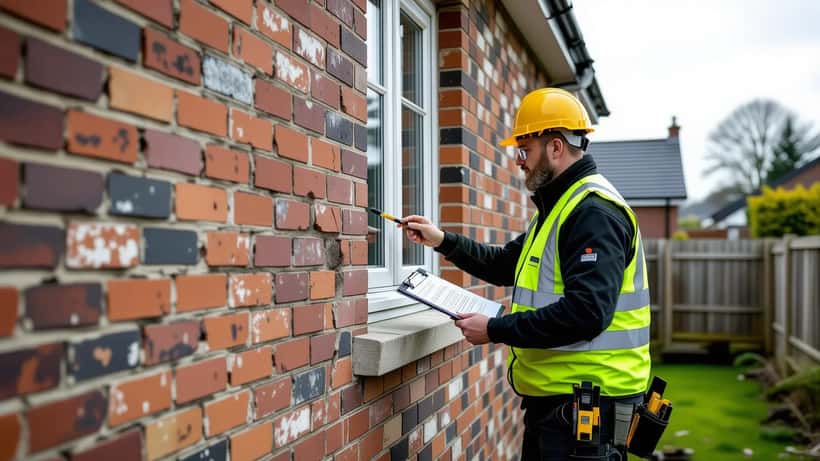
Less visible damage is often the most dangerous. A hairline crack in a load-bearing masonry wall may be invisible to the untrained eye, yet indicate that structural integrity has been compromised. Similarly, a chimney stack that looks intact from the ground may have lost mortar joints at the crown, creating a significant falling hazard.
What you can check yourself — and what only a professional can confirm
There are immediate checks a homeowner can safely make without entering unsafe areas:
- Look for cracked or blown window panes — a visible indicator of overpressure exposure
- Check external render for horizontal cracking at window-lintel level
- Inspect the loft space from the hatch for any visible timber displacement or tile movement
- Examine chimney stacks from ground level with binoculars
- Check whether doors and windows open and close properly — distortion is a sign of frame movement
However, the following require a professional structural inspection:
- Masonry wall crack depth and pattern — diagonal step-cracking in brickwork is particularly significant and can indicate foundation or structural wall movement
- Foundation integrity — ground vibration from a nearby impact can disturb clay soils beneath strip foundations
- Roof truss geometry — a visual inspection from the hatch may miss racking forces that have shifted rafter connections
- Internal plaster cracking at ceiling junctions, which can indicate structural floor movement above
This is exactly the scenario where connecting with a chartered structural engineer or RICS-registered building surveyor — through a platform like Expert Zoom — can save months of uncertainty and thousands in under-compensated claims.
If a Typhoon went down 400 metres from your house: a concrete scenario
Picture a Eurofighter Typhoon on a routine training sortie from RAF Lossiemouth developing an engine failure at low altitude on 14 June 2026 — in the heart of the June wave — and impacting an uninhabited hillside approximately 400 metres from a row of 1980s-built detached homes in a village in Moray. The aircraft was carrying an estimated 2,500 litres of fuel at impact.
For homeowners in that row, the timeline would unfold like this:
Within 24 hours: The MOD's Defence Infrastructure Organisation cordons the area. Police advise residents not to re-enter until preliminary safety checks are complete.
24–72 hours: Residents find cracked double-glazing (replacement cost: approximately £250–£900 per sealed unit), displaced roof tiles (£400–£2,000 depending on roof area and tile type), and cracked external render (£800–£3,500 for partial re-rendering).
Week 1–2: A structural engineer visits and identifies two properties with diagonal cracking in the rear masonry wall — consistent with transient lateral loading. The engineer recommends monitoring strips and further investigation. Cost of a full structural survey: £600–£1,500 per property.
Months 1–6: The homeowners discover that standard home insurance excludes "damage caused by military aircraft" under a standard war-risks exclusion clause. They must claim directly against the MOD. Under section 2 of the Crown Proceedings Act 1947, the Crown can be held liable in tort for property damage caused by negligent acts of its servants — including military pilots and maintenance personnel.
If the crash was due to a maintenance failure rather than pilot error, the claims process is slower: typical MOD compensation for property damage takes 6–18 months to resolve through the Claims Handling Unit. Total cost for those two properties could reach £15,000–£40,000 each before structural reinstatement is complete — a figure that a professional survey report is essential to substantiate.
The key rule: if there are no precise cost figures from an independent structural engineer in your evidence bundle, the MOD's Claims Handling Unit will use its own lower assessments. A properly documented survey can be the difference between a settlement that covers full reinstatement and one that falls £10,000 short.
How to find the right expert after a military aircraft incident
Not every surveyor is equipped to assess impact-related structural damage. When seeking professional help, look for:
- A Chartered Structural Engineer (MIStructE or CEng) who can issue a formal Structural Condition Report
- A RICS-registered Building Surveyor (MRICS or FRICS) for a Building Survey that distinguishes pre-existing settlement cracks from new event-related cracking
- A Loss Assessor (independent of your insurer) if you need professional advocacy in a compensation claim
When instructing a professional, specifically ask for a report that documents the inspection date relative to the incident, photographs all visible damage against a scale reference, and explicitly distinguishes new cracking from pre-existing settlement patterns. This documentation is critical whether you are pursuing a claim against the MOD, your insurer, or both.
YMYL disclaimer: this article provides general information only and does not constitute legal or structural engineering advice. Always consult a qualified professional for your specific situation.
Why this matters now — and will continue to
The June 2026 wave of military aviation incidents was not an anomaly. A Scripps News investigation found that severe non-combat military aviation mishaps — Class A incidents involving loss of aircraft or fatalities — rose from 45 in FY2025 to over 50 by July 2026 across major NATO air forces. Across NATO member nations, the pressure to maintain operational tempo with increasingly aged platforms — many Typhoons entered service in the 1990s — creates systemic maintenance stress that is not resolved by political pledges alone.
For UK homeowners within range of RAF operational stations, the question is not whether a military aircraft incident will occur nearby, but when. Knowing which five things to check immediately, understanding why a professional structural survey is non-negotiable, and knowing that MOD compensation claims under the Crown Proceedings Act exist — all of this is knowledge worth having before the event, not scrambling to acquire in the 48 hours after.
