 Rebecca Shaw
The UK government confirmed on 12 April 2026 that golden eagles will be reintroduced to England for the first time in nearly 200 years, backed by £1 million in new government funding. The announcement has thrilled conservationists — and sent sheep farmers and rural pet owners scrambling for answers about what this actually means for their animals.
What Has Just Been Announced?
Environment Secretary Emma Reynolds revealed that the charity Restoring Upland Nature (RUN), working alongside Forestry England, will lead a programme to establish breeding golden eagles in northern England. Young eagles — aged six to eight weeks — could be released as early as 2027, with breeding populations expected to take a decade or more to fully establish.
A Forestry England feasibility study, published to coincide with the announcement, identified eight potential "recovery zones" across upland northern England, including areas within and around the Lake District. The last confirmed golden eagle living in England died in 2016 in the Lake District, marking the end of a presence that had already been functionally extinct since around 1850.
The project draws heavily from the success of the South of Scotland Golden Eagle Project, which grew a population from just three or four pairs in 2018 to more than 50 individuals — a model the RUN charity hopes to replicate south of the border.
What Are Farmers and Landowners Actually Worried About?
The announcement has not been universally welcomed. In February 2026, more than 70 farmers gathered at Junction 36 Auction Centre to hear about the planned reintroduction and voice concerns about what it might mean for their livestock.
The National Farmers Union (NFU) has been direct about its position. Richard Bramley, chair of the NFU's environment forum, called on the government to put in place a framework to "help minimise impact, risks and any unintended consequences." NFU Cymru's deputy president described golden eagles as representing "a threat to livestock farmers, so particularly those farming sheep, when you've got small animals on the ground."
The reality, according to wildlife biologists, is more nuanced. Ornithological research consistently shows that golden eagles rarely take anything larger than a young lamb, and there is no documented evidence of eagles taking adult sheep. Evidence from Ireland, where over 200 golden eagles have been reintroduced, suggests that farmer concerns often ease after the birds are established and actual livestock losses prove minimal. A smaller release on the Isle of Wight also recorded zero livestock predation.
That said, the anxiety is real and understandable. Farming in northern England is already operating on tight margins, and any additional predation pressure — even statistically small — matters at the individual farm level.
What About Domestic Pets and Small Animals?
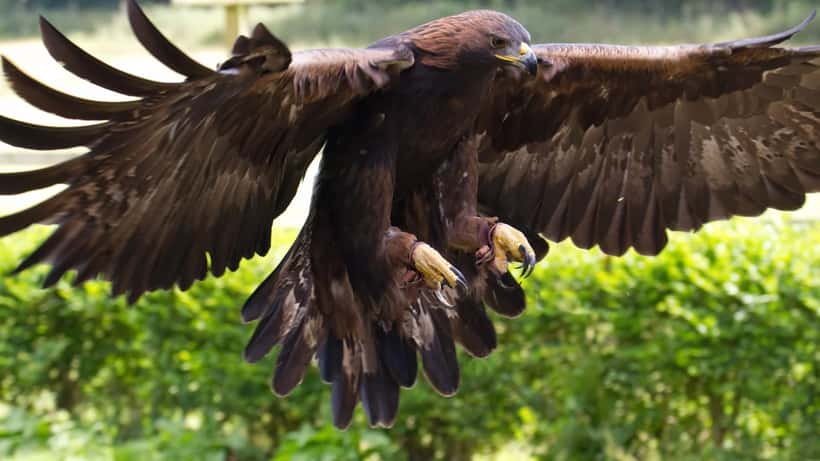
This is the question that tends to go unasked in the broader conservation debate, but it is directly relevant to anyone living in or visiting the upland recovery zones. Golden eagles are large birds of prey with a wingspan that can reach 2.2 metres and talons designed to grip and carry prey.
In the wild, golden eagles in Scotland are known to take rabbits, hares, mountain hares, grouse, and occasionally young deer or fox cubs. Domestic cats, small dogs, and rabbits kept in outdoor runs in rural upland areas could theoretically attract the attention of a territorial eagle.
According to ornithological data published by the RSPB and Natural England, attacks on domestic pets by golden eagles are exceptionally rare — but not impossible. The risk is heavily concentrated in areas directly adjacent to nesting sites and most acute during the breeding season (February to August) when parent birds are hunting intensively to feed chicks.
For rural pet owners, the practical advice from vets working in areas with established eagle populations — such as parts of the Scottish Highlands — is consistent: do not leave small animals unattended in open areas during the breeding season, particularly if you are within one of the designated recovery zones.
If your animal is injured in an eagle interaction, or shows signs of stress after a bird-of-prey incident, seek veterinary advice promptly. Talons can cause puncture wounds that appear minor but carry significant infection risk. A vet can assess whether antibiotic cover is needed and whether the animal requires further monitoring.
When Should You Contact a Vet?
If you live in or near a golden eagle recovery zone — primarily northern England, including parts of Cumbria, Yorkshire, and Northumberland — there are specific signs to watch for in livestock and pets:
- Unexplained injuries, particularly puncture wounds or lacerations on the back or shoulders of small animals
- Signs of shock or acute stress in outdoor animals following a bird-of-prey encounter
- Young lambs found dead with injuries consistent with aerial predation
In all these cases, prompt veterinary assessment is the right move. A vet can document the injury properly — something that matters if compensation claims under future government frameworks come into play. The government has not yet announced a livestock compensation scheme, but NFU lobbying makes this a likely development as the programme progresses.
For farmers with questions about biosecurity measures, welfare implications, or documentation protocols during the reintroduction period, consulting a vet with rural practice experience is valuable. They can advise on appropriate pen designs to protect vulnerable young livestock, timing of outdoor grazing relative to eagle breeding seasons, and monitoring protocols.
Looking Ahead
The reintroduction of golden eagles to England represents a genuine conservation milestone. The UK's commitment to reversing biodiversity loss — enshrined in the Environment Act 2021 and tracked by Natural England — makes species reintroduction programmes a central pillar of environmental policy for the coming decade.
For most people in England, the golden eagle will remain a distant and thrilling presence — a flash of bronze wings over a distant ridge. For farmers, rural landowners, and pet owners in the recovery zones, it brings a genuine and practical need to understand what living alongside an apex predator actually means. Connecting with local veterinary expertise is the best place to start.
