 Andrew Wright
The UK's electric vehicle transition is "at risk of stalling," government advisors warned on 7 April 2026 — even as new EV registrations hit a record 22.6% of all new car sales in March. The problem is not sales volume. It is everything that happens after you drive off the forecourt.
Record Sales, But a Confidence Crisis
March 2026 was the UK's strongest month ever for EV registrations: 86,120 vehicles — 22.6% of all new car sales. By the end of January 2026, there were nearly 2 million fully electric cars on UK roads, up sharply from previous years.
Yet driver satisfaction is collapsing. According to data cited by government advisors, the likelihood of EV owners recommending their vehicle to others dropped from 82% to 56% over the past year. That is a 26-percentage-point fall in driver confidence, even as the headline sales numbers climb.
What is going wrong? The answer is largely found in the post-purchase experience — and that is where mechanics and vehicle technicians come in.
The Hidden Tax on Public Charging
One of the most concrete frustrations for EV drivers is cost — specifically, a tax disparity that penalises those who cannot charge at home. Drivers who use public charge points pay 20% VAT on their electricity. Drivers who charge at home pay only 5%. According to analysis published in April 2026 by the Office for Zero Emission Vehicles, this disparity costs the EV sector an estimated £85 million in additional charges in 2026 alone.
Roughly 80% of EV charging still happens at home. But for the 20% of drivers who rely on public infrastructure — those in flats, those without private driveways, those in rural areas with limited home installation options — this tax adds up. It is one of several systemic issues that the government's own advisors say must be resolved for the transition to succeed.
What Your Mechanic Needs You to Know
The EV surge is transforming the automotive servicing industry. Many traditional garages are not yet equipped to handle electric vehicles, and the knowledge gap is real.
Here are the facts UK drivers should understand before taking their EV to any workshop:
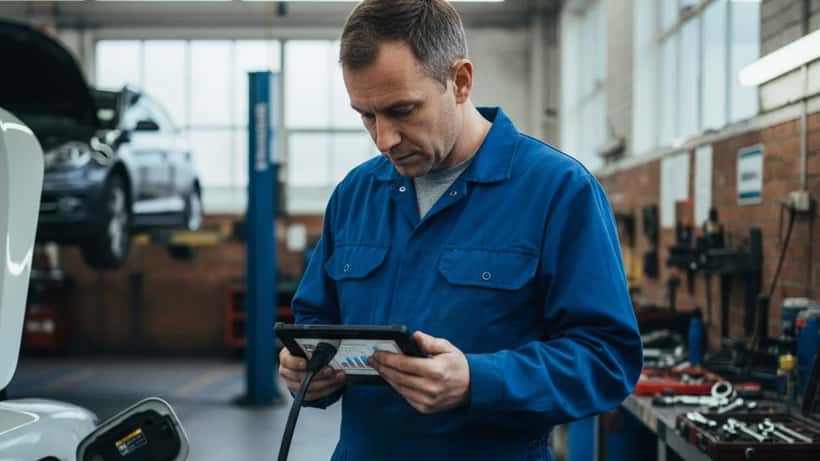
Battery diagnostics require specialist equipment. Standard OBD-II scanners used for petrol and diesel cars cannot fully read EV battery management systems. A qualified EV technician uses manufacturer-specific diagnostic software to assess battery health, charging efficiency, and cell degradation. If your garage cannot do this, find one that can.
Brake fluid still needs changing. One of the most persistent myths about EVs is that they are almost maintenance-free. While EV powertrains do have fewer moving parts, brake fluid, coolant, cabin air filters, and tyres still require regular attention — and in some cases more frequently, because the heavier weight of EV batteries accelerates tyre wear.
Not all tyres are created equal. EVs are heavier than comparable petrol vehicles, meaning standard tyres wear faster. EV-rated tyres (marked with a low rolling resistance specification) are recommended by manufacturers and, importantly, by independent mechanics who have worked on EVs in real-world UK conditions.
Warranty and repair rights matter. Under UK consumer law, a vehicle manufacturer's warranty does not remove your statutory rights to repair or replacement under the Consumer Rights Act 2015. If your EV develops a fault — including a battery fault — within six years of purchase, you may have legal recourse even after the manufacturer warranty expires.
As of 1 April 2026, the government also increased the Workplace Charging Scheme grant from £350 to £500 per socket — a signal that charging infrastructure investment is continuing. For business owners considering fleet electrification, now is a practical moment to consult an EV specialist about installation requirements and cost.
Finding an EV-Qualified Mechanic
The Institute of the Motor Industry (IMI) in the UK certifies EV-qualified technicians at Levels 2, 3, and 4. Level 4 is required to work on high-voltage EV components — including batteries and charging systems. When selecting a garage for your electric vehicle, it is worth asking whether their technicians hold IMI EV qualifications.
For diagnostics, battery health checks, or unusual electrical faults, a specialist EV mechanic consultation can save you significant cost compared to going directly to a main dealer. Expert Zoom connects drivers with independent EV-qualified mechanics who can advise on servicing, fault diagnosis, and charging infrastructure across the UK.
You can find qualified EV repair specialists at Expert Zoom's electric vehicle repair consultation page.
What to Do Right Now
- Know your maintenance schedule. Ask your manufacturer or a specialist mechanic for an EV-specific service checklist — it differs from petrol and diesel vehicles.
- Check your mechanic's qualifications. Verify IMI EV certification before allowing any high-voltage work.
- Understand your consumer rights. The Consumer Rights Act 2015 protects you regardless of warranty terms.
- Consider workplace charging if you are an employer. The increased Workplace Charging Scheme grant (£500 per socket from April 2026) improves the business case for fleet EV adoption.
The headline numbers on UK EV sales look strong. But the real story of 2026 is whether the support infrastructure — mechanical, legal, and financial — can keep pace. For drivers already behind the wheel of an electric car, getting the right advice now is far cheaper than discovering a problem later.
