 Daniel Davies
Northern Ireland's electric vehicle charging infrastructure has reached a critical juncture in 2026, with Stormont under renewed pressure to accelerate the rollout as grid policy reforms finally take effect. The coincidence of Edwin Poots serving as Stormont Speaker while the EV market he helped launch as Environment Minister back in 2010 matures has drawn fresh attention to how far the province has come, and how far it still has to go.
From 2010 Vision to 2026 Reality
Edwin Poots occupied the Environment Minister's office in October 2010 when Northern Ireland signed its landmark agreement with the Renault-Nissan Alliance to progress electric vehicle infrastructure. At that time, the prospect of mass EV adoption seemed distant. Fast forward sixteen years and Poots now occupies the Speaker's chair at Stormont, presiding over an Assembly that must confront the practical consequences of that early ambition.
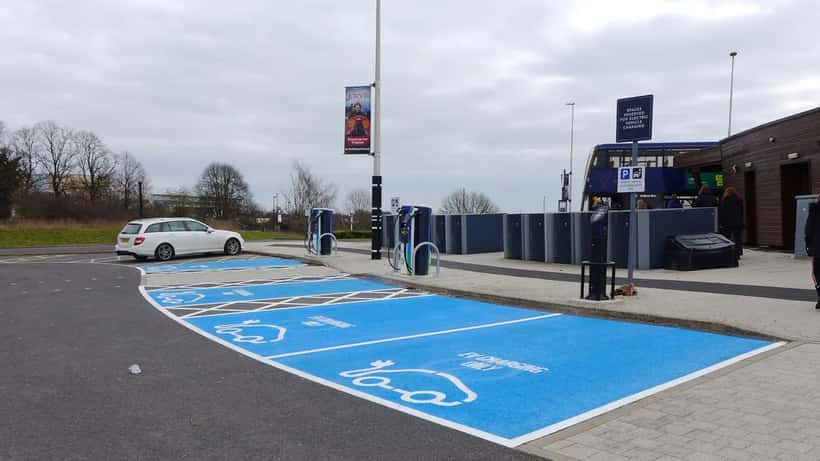
The statistics tell a story of gradual but uneven progress. Northern Ireland has seen significant momentum since pay-to-charge was introduced in April 2023, with multiple ultra-rapid charging hubs now operational across the province. Tesla opened an eight-bay V4 Supercharger hub at Sprucefield Shopping Centre in Lisburn during 2025, while Ionity launched a six-bay 350kW facility on the A4 at Dungannon. Weev, Maxol Recharge, ePower and Gridserve have all announced or constructed sites.
Yet the overall network remains sparse compared with Great Britain. Rural areas in particular suffer from charging deserts, forcing EV owners to plan journeys around available infrastructure rather than driving with the confidence enjoyed by their counterparts in England or Scotland.
Grid Reform Arrives in Spring 2026
The most significant structural change for EV infrastructure in Northern Ireland has been the socialisation of grid reinforcement costs, implemented by the Utility Regulator in spring 2026. Previously, charge point operators connecting to the distribution network often faced crippling upfront costs for grid upgrades. These expenses could render otherwise viable charging hubs economically unviable, particularly in rural locations where grid capacity was limited.
The new regulatory framework spreads these reinforcement costs across all network users, bringing Northern Ireland broadly into line with Great Britain and the Republic of Ireland. Charge point operators now pay connection costs comparable to their competitors across the Irish Sea, removing a major barrier to investment.
However, the reform carries unintended consequences. Multiple charge point operators reportedly delayed applications in anticipation of lower costs, creating a temporary lull in new projects. Now that the new regime is active, industry observers anticipate a flood of connection requests that could overwhelm NIE Networks, the distribution network operator. Bottlenecks in quoting and construction may slow the rollout of ultra-rapid hubs during the second half of 2026.
What Homeowners Need to Know About EV Charger Installation
For Northern Ireland homeowners considering the switch to electric vehicles, the charging question begins at home. Domestic installations represent the most convenient and cost-effective charging solution for the majority of drivers, provided the property's electrical supply can support the additional load.
A standard 7kW home charger will replenish most EV batteries overnight, adding approximately 30 miles of range per hour of charging. For households with higher mileage requirements or larger battery vehicles, 11kW or 22kW units offer faster charging, though these require a three-phase electricity supply that many older Northern Ireland properties lack.
The installation process begins with a survey by a qualified electrician registered with a competent person scheme. The survey assesses the property's electrical capacity, identifies the optimal charger location, and determines whether the main fuse or consumer unit requires upgrading. In Northern Ireland, NIE Networks manages the distribution grid, and properties requiring a main fuse upgrade must request this through their electricity supplier.
Planning and Regulatory Considerations
Most domestic EV charger installations in Northern Ireland fall within permitted development rights, meaning planning permission is not required. However, properties in conservation areas, listed buildings or areas of outstanding natural beauty may face additional restrictions. Installations that alter the external appearance of a property, such as surface-mounted cable runs on front elevations, sometimes trigger planning requirements.
A significant precedent was established in September 2025 when planners determined that a charging hub development in Dungannon qualified as permitted development. The decision confirmed that charge point operators qualify as "electricity undertakers" under planning legislation, reducing red tape for off-street charging hubs at existing car parks. This ruling benefits both commercial operators and residential developments with shared parking.
Building regulations also apply to EV charger installations. The installer must certify compliance with Part P electrical safety requirements and ensure that earthing arrangements meet current standards. A certificate of compliance must be issued upon completion.
Costs, Grants and Return on Investment
The typical cost of a home EV charger installation in Northern Ireland ranges from £800 to £1,500, depending on the charger model, cable run length and any necessary electrical upgrades. The UK government's Electric Vehicle Homecharge Scheme previously offered grants of up to £350, but this closed to most homeowners in 2022. Apartment residents and landlords remain eligible under revised criteria.
Businesses and landlords can access the Workplace Charging Scheme, which provides support for installing charge points at commercial premises. For rural businesses in particular, offering EV charging can attract passing trade while future-proofing the property against declining demand for petrol and diesel vehicles.
The return on investment calculation extends beyond fuel savings. EVs currently benefit from lower vehicle excise duty, favourable company car tax rates and exemption from clean air zone charges that may be introduced in Belfast and other urban centres. Maintenance costs are typically lower due to fewer moving parts and regenerative braking systems that reduce wear on brake components.
When to Consult an Expert
EV charger installation is not a DIY project. The combination of high electrical currents, complex earthing requirements and warranty conditions means that professional installation is mandatory for most units. A qualified electrician will ensure the installation complies with all relevant regulations and does not invalidate the vehicle or charger warranty.
For properties with older electrical installations, expert consultation becomes particularly important. Northern Ireland's housing stock includes many period properties with outdated wiring that cannot safely support EV charging without substantial upgrades. An experienced installer can advise on the most cost-effective approach, which may include load management systems that balance EV charging against other household demands.
Commercial installations and multi-unit residential developments require additional expertise. These projects must consider future demand, load balancing across multiple chargers, and potential integration with solar panels or battery storage systems. A specialist EV charging consultant can design systems that accommodate growth without requiring expensive retrofits.
The Road Ahead for Northern Ireland
Stormont's energy strategy commits Northern Ireland to substantial emissions reductions by 2030. Transport decarbonisation sits at the centre of this challenge, with EV adoption rates needing to accelerate dramatically. The grid reforms implemented in spring 2026 remove one major obstacle, but delivery depends on NIE Networks managing the anticipated surge in connection requests.
For individual homeowners, the decision to install an EV charger represents both a practical investment and a contribution to the province's environmental goals. With the right expert guidance, the transition to electric motoring can be straightforward, cost-effective and future-proofed against further policy changes.
