 Sophia Hamilton
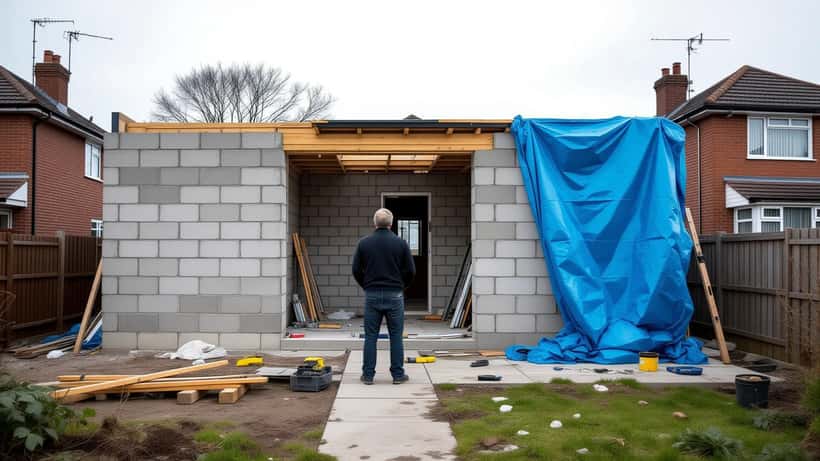
As DIY SOS returns to BBC One for Series 35 on Tuesday 22 September 2026, millions of viewers will watch Nick Knowles and his team of volunteers transform the lives of families in crisis. The opening episode, "Nell's Next Chapter", follows a family adapting their home for wheelchair user Nell, who was born with a rare bone condition. The second episode, "A New Beginning for Georgie", airs 29 September and hits closer to a legal reality facing thousands of UK homeowners: Georgie and her three children are left trying to complete an unfinished home after the sudden death of her husband Chris — a property stranded mid-build, with no contractor and no clear legal path forward.
DIY SOS Series 35 and the renovation crisis it reflects
For 27 years, DIY SOS has reflected something real about Britain's housing stock — ageing, underfunded, and often held together by community goodwill rather than professional craftsmanship. Series 35 arrives at a moment when the UK construction sector is under exceptional strain.
In the 12 months to June 2026, 3,805 construction companies in England and Wales became insolvent, according to data published by Construction Magazine UK. Construction now accounts for 17% of all company insolvencies — the single largest sector in the country. These are not abstract statistics. Behind each insolvency is at least one homeowner left with a half-finished project, a disputed deposit, and a legal situation they may not know how to navigate.
The skills shortage compounds the problem. A 2026 industry survey found that 22% of UK builders have cancelled jobs entirely due to the unavailability of skilled tradespeople. Meanwhile, private housing repair, maintenance and improvement output is forecast to fall 8% in 2026 as mortgage-squeezed homeowners defer spending — leaving a sector already in distress managing fewer, higher-stakes projects with thinner margins and greater risk of abandonment.
Georgie's unfinished home on DIY SOS is, in legal terms, one of thousands. The difference is that she had a TV crew.
What the law says when your contractor leaves work unfinished
When a builder abandons a project — whether through insolvency, personal circumstances, or a straightforward refusal to return — UK homeowners have more legal protection than many realise. The key is knowing which protections exist and acting quickly enough to use them.
Under the Consumer Rights Act 2015, any contract for building services in England and Wales must be performed with reasonable care and skill, within a reasonable time, and at a reasonable price if no price was agreed. These are implied terms: a contractor cannot exclude them in a contract, however the small print is worded. If work is left incomplete or below the standard a reasonable person would expect, you are entitled to demand completion, request a price reduction, or recover the cost of having the work finished by another contractor.
The Supply of Goods and Services Act 1982 reinforces this framework, and neither piece of legislation requires a written contract to apply — they cover verbal agreements too. The burden of proof, however, falls heavily on documentation.
If a contractor stops work without agreement:
- Write to them immediately, setting out the problem and giving a reasonable deadline — typically 14 days — to return and complete. Use email or recorded post. The written record is your foundation for any future claim.
- Photograph and video everything, timestamped, before any further work is done.
- Stop all further payments until work is completed or a resolution agreed.
- Obtain written quotes from replacement contractors before commissioning them. This establishes the cost of completing the build and is essential evidence in any court claim.
For disputes up to £10,000, the Small Claims Court is the standard route — relatively accessible and designed to be used without a solicitor. For larger projects — extensions, full renovations, structural alterations — the County Court or, in rare cases, the High Court may be appropriate. In either case, a solicitor specialising in construction disputes can advise on the merits of a claim before you commit to the cost of proceedings.
When insolvency removes the contractor from the picture entirely
The scenario in "A New Beginning for Georgie" raises a harder legal question: what happens when the contractor is no longer legally able to fulfil their obligations — through death, dissolution, or insolvency — rather than simply unwilling?
When a sole trader dies, their contractual obligations form part of their estate. Pursuing a claim against an estate is possible in principle, but it is slow, complex, and often disproportionate in cost for smaller renovation projects. When a limited company becomes insolvent, it enters administration and its assets are distributed to creditors according to a strict hierarchy; homeowners with incomplete builds typically rank behind secured creditors and HMRC, which means recovery can be minimal.
Two protections are worth knowing:
Section 75 of the Consumer Credit Act 1974: if you paid a deposit of more than £100 by credit card — and the total contract value exceeded £100 — your credit card provider is jointly and severally liable for any breach of contract or misrepresentation by the contractor. This applies to the deposit payment itself, not just the portion on the card. For a project where a contractor has become insolvent, this can mean recovering a deposit directly from your bank, which is substantially faster than going through insolvency proceedings.
Trade body membership: contractors registered with the Federation of Master Builders, TrustMark, or NICEIC (for electrical work) offer access to dispute resolution services and, in some cases, deposit protection or work warranties. Checking trade body membership before signing any contract costs nothing and provides a practical dispute resolution route that does not require court proceedings.
These are mechanisms that most homeowners only discover after something goes wrong. A single legal consultation — before commissioning replacement work — can clarify which apply in any given situation.
What this looks like in practice: a concrete case
Consider a homeowner in the West Midlands who engaged a sole-trader builder in February 2026 for a rear kitchen extension, agreed at a total price of £42,000 including VAT. The contract — a brief written agreement, not a formal JCT standard form — required a 25% deposit (£10,500) on signing and a stage payment of £12,000 on completion of the structural shell.
Both payments were made. The structural shell was completed in April 2026. In May, the contractor stopped attending site, citing ongoing supply problems, and by June had ceased responding to calls and messages entirely. The homeowner was left with £22,500 paid, an unroofed extension shell, and no clear path to completion.
If the contractor is alive and traceable: a solicitor drafts a letter before claim, giving 14 days to respond. The homeowner obtains three written quotes for the remaining work — the cheapest comes in at £28,000, creating a potential claim for the £5,500 cost overrun plus documented losses from the delay (temporary kitchen facilities, four months of work-from-home disruption). The total claim approaches £9,000 — within small claims jurisdiction for the main cost overrun, though a county court claim may be worth considering for the full losses.
If the £10,500 deposit was paid by credit card: the homeowner files a Section 75 claim with their credit card issuer for the deposit, arguing breach of contract. The card provider must investigate and, if the claim is upheld, refund the deposit directly. This is independent of any court proceedings and can resolve within weeks.
If the contractor has become insolvent: the homeowner registers as a creditor with the appointed insolvency practitioner, files the claim with supporting documentation, and consults a solicitor to assess realistic recovery prospects. If the company had no assets beyond tools and a van, the claim may yield little — but early legal advice may reveal assets that were overlooked, or insurance policies the contractor held that could respond to the claim.
The specific numbers above are illustrative, but the principle is consistent: homeowners who document the position carefully, seek legal advice before taking further action, and understand which protections apply to their payments are substantially better positioned than those who simply commission a replacement contractor and hope the original dispute resolves itself.
A legal specialist in construction disputes can help you understand your position in a single hour-long consultation — often more valuable, in cases like these, than weeks of informal negotiation.
DIY SOS cannot come for everyone — but help is available
The power of DIY SOS lies in its humanity. When professional systems fail families, communities step in. But for every family lucky enough to have a BBC film crew and 200 volunteers on their doorstep, there are thousands navigating the legal aftermath of unfinished renovations without any structural support.
As the UK construction insolvency rate continues to rise in 2026, understanding your rights as a homeowner — and knowing when to involve a solicitor — is increasingly not optional. The Consumer Rights Act 2015 provides real protection. Section 75 provides financial recovery routes. Trade body dispute resolution provides alternatives to court. But none of these work without prompt action and correct documentation from the outset.
If your renovation has stalled, your contractor has gone silent, or you are facing the prospect of completing someone else's unfinished work, the first step is a conversation with a specialist. See Expert Zoom's guide to home improvement disputes and tradespeople advice for more context on what to expect when building work goes wrong.
This article provides general legal information based on English and Welsh law as it stands in September 2026. It does not constitute legal advice. For advice specific to your situation, please consult a qualified solicitor.
