 Rebecca Taylor
Snooker legend Dennis Taylor is backing Zhao Xintong to break the 49-year Crucible Curse at the 2026 World Snooker Championship — and the entire sporting world is watching. But behind the drama of long sessions under the Sheffield spotlights, another story rarely makes the headlines: the physical toll of elite snooker on eyes, back, and posture — and what professional sports medicine has to say about it.
Dennis Taylor's Famous Glasses: More Than a Fashion Statement
Dennis Taylor, 1985 world champion and now a renowned pundit, is backing defending champion Zhao Xintong for this year's title at the Crucible Theatre in Sheffield. Taylor's prediction: Zhao will be the first player since the Crucible era began in 1977 to successfully defend the title — a feat no one has managed in 49 years.
Taylor himself became iconic partly for his oversized upside-down glasses — a medically adapted solution for his specific vision needs at the snooker table. The glasses allowed him to sight the cue ball accurately without tilting his head at an unusual angle. It was an early example of sports medicine adapted for a precision sport.
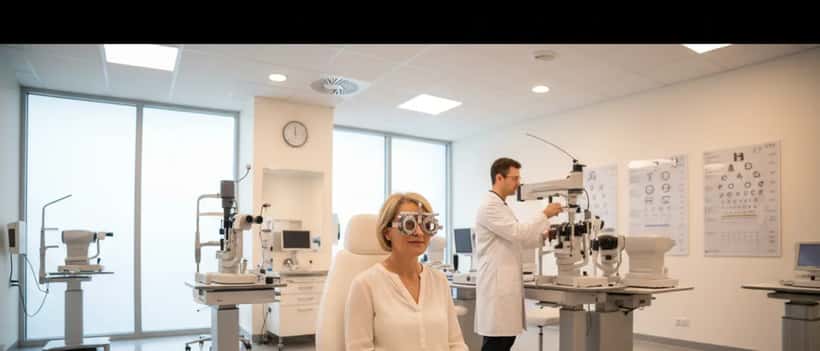
Today, eye health remains one of the most underappreciated performance factors in professional snooker — and in everyday office and screen-based work alike.
What Elite Snooker Reveals About Vision and Posture
Professional snooker players spend hundreds of hours each year crouching over a table, tracking a white ball moving at speed, under artificial lighting, in the same repeated posture. According to sports medicine specialists, this creates a specific cluster of risks:
Eye strain from close-focus precision: Lining up a snooker shot requires sustained near-focus concentration. The ciliary muscles in the eye contract to adjust lens shape — and sustained contraction, hour after hour, can cause digital eye strain symptoms: blurred vision, headaches, and dry eyes.
Artificial lighting and flicker: Professional venues use high-intensity studio lighting to enable broadcast. According to the UK's National Health Service, prolonged exposure to bright artificial lighting without adequate breaks contributes significantly to eye fatigue, known as computer vision syndrome — a condition just as relevant to screen workers as snooker players.
Postural stress: The snooker crouch position places sustained load on the lumbar spine and neck. Dennis Taylor has spoken publicly about back issues during his career. Players like Ronnie O'Sullivan have made no secret of the physical demands the sport places on the body. A sports medicine doctor can assess whether recreational players or professionals have developed compensatory patterns that increase injury risk.
The Crucible Under the Microscope
The 2026 World Snooker Championship begins in late April. Zhao Xintong, fresh from his dominant 18-12 victory in last year's final, faces the psychological challenge of the Crucible Curse alongside the physical challenge of a gruelling two-week, high-pressure tournament.
Best-of-35-frame matches — the format used in the final — can last over twelve hours across two sessions. Players compete over up to 17 days. In 2026, the tournament schedule has been adjusted to allow more recovery time between sessions, a direct response to player welfare concerns raised in previous years.
The physical and mental demands of elite snooker are now recognised by bodies like World Snooker Tour as requiring proper management. Several top players, including Judd Trump and Mark Allen (both on Taylor's radar for 2026), work with full-time physiotherapists and vision specialists.
Eye Health for Everyone: The Snooker Lesson Applied to Everyday Life
You do not need to be a world-class snooker player to experience the same eye and posture issues. If you:
- spend more than four hours per day on screens
- work in artificial or fluorescent lighting for extended periods
- notice headaches, blurred vision, or dry eyes regularly
- have a job involving fine visual precision (design, engineering, laboratory work)
…then the physical risks are broadly comparable to those facing a professional snooker player. The difference is that snooker players have access to full medical support teams. Most office workers do not.
When to See a Health Specialist
The NHS advises adults to have regular eye examinations every two years, or more frequently if symptoms arise. However, many people wait until symptoms become significant before seeking help. Signs that warrant a prompt consultation include:
- Persistent headaches after visual tasks
- Difficulty focusing between near and distant objects
- Increasing sensitivity to light
- Eye redness or irritation lasting more than a few days
- Neck or upper back pain that coincides with intensive screen use
A GP can refer you for specialist optometry or sports medicine assessment. On ExpertZoom, you can connect with health specialists who assess vision-related symptoms and postural issues — whether your concern is snooker-inspired or desk-job induced.
The Crucible Curse and Your Eyes
Whether Zhao Xintong can defy 49 years of snooker history at Sheffield's Crucible is a question only April will answer. But Dennis Taylor's legendary glasses remind us of something timeless: precision performance — on the snooker table or at a computer screen — demands proper care for the instruments doing the work.
Do not wait for the Crucible Curse to strike your own vision. A health specialist can help before problems become chronic.
This article contains general health information and does not constitute medical advice. Consult a qualified healthcare professional for personal health concerns.
