 David Taylor
A Fox News appearance by former US Central Command official Admiral Robert Harward went viral this week — not for what he said about US-Iran tensions, but for how he looked. Viewers zoomed in on his neck, jawline, and blinking patterns under studio lighting and concluded, en masse, that he was wearing a silicone mask or was, in their words, "an alien in disguise." The clips spread rapidly across UK social media, with thousands of users sharing frame-by-frame analyses of what they claimed were visible "seams."
There is no evidence of any mask. What viewers likely saw was a combination of heavy foundation make-up under high-intensity broadcast lighting, video compression artefacts from streaming, and the uncanny valley effect that studio cameras sometimes create. But the incident is a revealing case study in a pressing problem for 2026: how ordinary people — and businesses — are increasingly unable to tell what's real in video.
Why Human Perception Fails With Studio Video
The human brain is not calibrated to assess authenticity in broadcast-quality video. We evolved to detect deception through subtle facial micro-expressions at close range. Studio cameras, compression codecs, lighting rigs, and display screens introduce layers of signal distortion that our threat-detection instincts misread as "something is wrong."
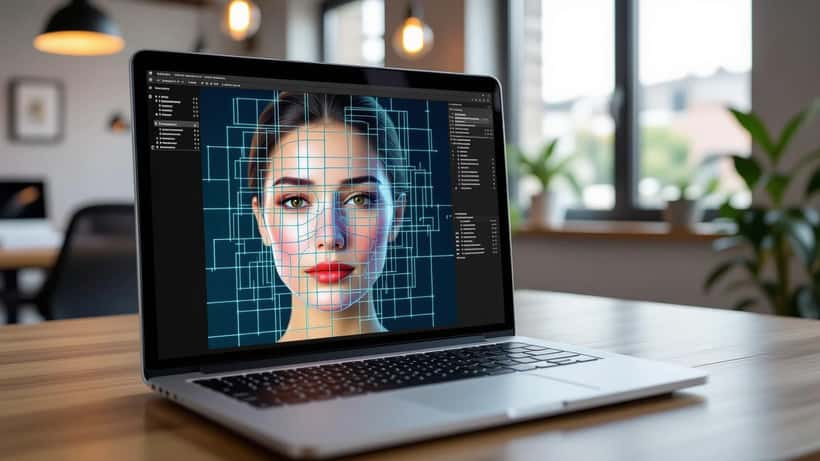
This is not a minor technical footnote — it is an exploitable vulnerability. Deepfake technology, which uses AI to synthesise convincing video of real people saying or doing things they never did, has improved to the point where it is now accessible to non-specialists via free and low-cost online tools. A 2025 report from Europol noted that deepfake-enabled fraud was among the fastest-growing categories of financial crime in Europe.
The "mask" conspiracy surrounding Harward shows how primed people are to doubt video authenticity — but the alarming flip side is that the same cognitive susceptibility makes genuine deepfakes more dangerous, not less.
How Deepfake Technology Actually Works
Modern deepfake video is generated using Generative Adversarial Networks (GANs) or diffusion model architectures — two AI approaches where a generator creates synthetic media and a discriminator checks its realism, iteratively improving the output. The result, with sufficient training data, is video that is indistinguishable from real footage to the naked eye.
The technical tells that experts look for include:
- Temporal inconsistencies: unnatural blinking rates, inconsistent head movements between frames
- Boundary artefacts: soft edges around the hair, neck, and ears where the generated face meets real video
- Lighting mismatches: the deepfake subject's face lit differently from the background environment
- Physiological signals: video that lacks the subtle pulse-driven colour variation (rPPG signal) detectable in genuine human skin on camera
These detection methods are themselves in an arms race with generating technology. What works today may not work in twelve months.
The Business Threat: Deepfake Fraud in 2026
For UK businesses, the deepfake risk is no longer theoretical. Verified incidents in 2024-2026 include:
- An employee transferring £20 million after receiving a video call that appeared to show their company's chief financial officer instructing the transfer (Hong Kong incident, widely reported in UK business press)
- Law firms receiving deepfake video "evidence" submitted as part of civil dispute proceedings
- HR departments processing deepfake video interviews for job roles that did not exist, as part of identity and payroll fraud schemes
The common thread: deepfakes exploit trust in video as a verification medium. We have, for decades, treated video as more reliable than text or audio. That assumption is no longer safe.
How IT Security Experts Are Responding
The professional response to deepfake threats in business environments involves multiple layers:
Verification protocols: Any high-value instruction — wire transfers, contract execution, access grants — delivered via video or audio call should require independent verification through a previously established second channel (a phone call to a known number, not one given in the suspect call).
Deepfake detection tools: Several NCSC-recognised vendors offer AI-powered detection software that analyses video streams for manipulation indicators. These tools are not infallible, but they raise the threshold for successful attack considerably.
Staff awareness training: The most effective control is people who know to be sceptical. IT security professionals can design and deliver awareness programmes tailored to the specific deepfake scenarios relevant to a business — finance teams, HR, and legal functions are typically highest risk.
Digital provenance standards: The Content Authenticity Initiative (CAI) and C2PA (Coalition for Content Provenance and Authenticity) standards provide cryptographic signing for media files, establishing a verifiable chain of custody from camera to display. As these become adopted in broadcast and legal contexts, they will provide a baseline for authentic media verification.
According to the National Cyber Security Centre's guidance on artificial intelligence, organisations should treat AI-enabled threats — including synthetic media — as part of their standard threat modelling, not as a specialist concern for large enterprises only.
What the Harward Clip Actually Tells Us
The Robert Harward viral moment matters not because he was wearing a mask — he wasn't — but because millions of people watched the same video and arrived at radically different conclusions about its authenticity. In a world where deepfake technology can produce convincing synthesis, that cognitive instability is dangerous.
Businesses that assume their teams can reliably detect manipulated video are taking a risk they cannot currently quantify. An IT security expert can audit your organisation's current exposure to deepfake-enabled fraud, identify where your verification protocols have gaps, and design proportionate controls before an incident occurs — rather than after it.
The conspiracy theorists got the Harward clip wrong. But they weren't wrong to ask the question. In 2026, asking "is this video real?" is no longer paranoia. It's essential due diligence.
This article is for informational purposes only. For cybersecurity guidance tailored to your organisation, consult a qualified IT security professional.
