 James Harrison
With the World Series of Darts Finals 2026 reaching its climax in Amsterdam tonight — and Luke Littler's shock quarter-final exit at the hands of Jonny Clayton making headlines across the UK — search trends are spiking for something unexpected: how to build a proper dartboard room at home. Millions of UK fans watching the semi-finals and final on ITV4 and ITVX this evening will feel that familiar impulse fire up — and home improvement experts say most of them will make the same costly mistakes when they act on it.
From Amsterdam to Your Living Room: Why Tonight's Finals Spark a DIY Rush
The World Series of Darts Finals, held at AFAS Live in Amsterdam from 17 to 20 September 2026, carries a total prize fund of £450,000, with tonight's winner taking home £100,000. Littler, the 2024 champion who many tipped for an unprecedented PDC major clean sweep this year, fell to Jonny Clayton in the quarter-finals — leaving Jonny Clayton, Gerwyn Price, Ross Smith, and Gian van Veen to battle for the title in tonight's semi-finals and final.
For hundreds of thousands of UK viewers tuned in at home, watching professionals land 180s and double-twelves with clinical precision reliably sparks an age-old impulse: "I could do that." And in 2026, they are acting on it in record numbers.
Home improvement searches around dartboard installation have risen sharply across the UK following every major PDC event this year. But according to certified home improvement consultants, the enthusiasm almost always outpaces the preparation — and the consequences can be expensive.
What Home Improvement Experts Say About Getting the Setup Right
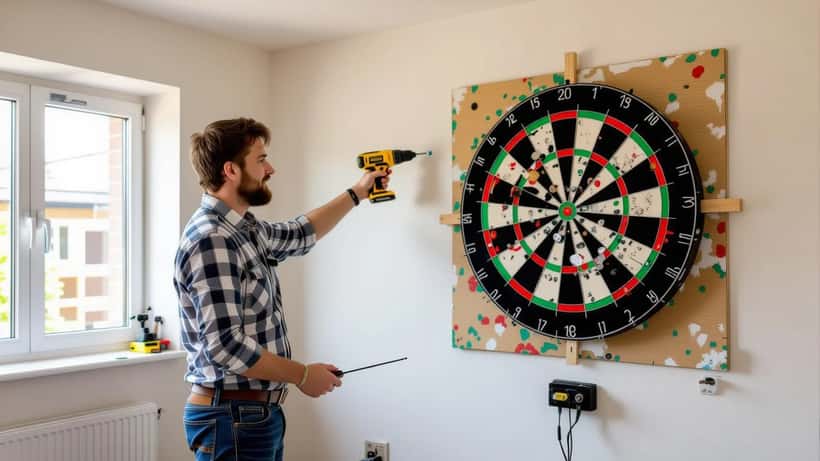
Professional dartboard installation is deceptively technical. Unlike hanging a picture frame, a dartboard setup involves regulated measurements, structural wall considerations, and safety factors that most YouTube tutorials and flat-pack guides skip entirely.
The most common mistake is getting the height wrong. The World Darts Federation official regulations specify 1.73 metres from the floor to the centre of the bullseye. Get that wrong by even five centimetres and the muscle memory built watching the pros play will actively work against your own throw. The throwing distance — known as the oche — is equally critical: 2.37 metres from the face of the dartboard horizontally, or 2.93 metres measured diagonally from the bullseye centre. These numbers are not arbitrary; they are the official measurements adopted by every professional venue from Blackpool's Winter Gardens to tonight's AFAS Live.
Beyond measurements, experts consistently flag three structural concerns that surprise first-time installers.
Wall type is decisive. A dartboard mounted on a hollow stud partition wall will transmit vibration to adjacent rooms and cause mounting fixings to fail progressively. Solid masonry walls, or wall-mounted cabinets with reinforced backboards fixed into noggins, are the correct approach. Identifying which type of wall you have before buying any equipment saves the most common and expensive error in dartboard installation.
Surrounds are not optional extras. Professional-grade sisal surrounds or hinged cabinet doors protect your plasterwork from errant darts. A single dart embedded in the wall and yanked out can cause damage costing between £80 and £250 to repair properly, depending on wall finish and whether replastering and repainting are required.
Lighting position changes gameplay. Overhead lights cast shadows across the dartboard that create subtle optical distortions affecting aim. Professional setups use dedicated ring lights or strip lights positioned above and to the sides of the board to eliminate shadows. An expert can assess your room's existing light sources and recommend the optimal rig, typically costing between £40 and £150 fully installed.
Official Measurements Every UK Installation Must Meet
Here are the full official measurements your setup needs to replicate professional conditions at home:
- Bullseye height: 1.73 metres (5 feet 8 inches) from floor to centre of bull
- Throwing distance (horizontal): 2.37 metres (7 feet 9.25 inches) from the face of the board
- Throwing distance (diagonal): 2.93 metres (9 feet 7.375 inches) from bullseye centre to oche line
- Board diameter: 45.1 centimetres (standard steel-tip)
- Recommended surround diameter: 60–80 centimetres minimum
- Recommended room depth: 4 metres minimum for comfortable throw and retrieval
These figures are non-negotiable for anyone who wants their home practice to translate to genuine competitive improvement — and essential for anyone planning to host friends for proper matches.
Case Study: When a Box Room Conversion Goes Wrong
Consider a situation that home improvement consultants field regularly in the weeks after major darts tournaments. A 41-year-old fan in Wolverhampton — a composite of dozens of similar cases — decided in July 2026 to convert his 3.4 metre × 2.7 metre spare box room into a dedicated darts space after watching the PDC World Matchplay. He self-installed using a guide found online.
The result: his dartboard was mounted at 1.66 metres — seven centimetres below regulation height. His oche tape was placed at 2.20 metres rather than the required 2.37. His board sat on hollow stud partition wall with no surround and no additional fixings into the noggins.
Within eight weeks he had:
- Four dart punctures in the plasterboard beyond the board's edge
- A mounting bracket pulling away from the studs
- A noise complaint from the adjacent bedroom
The cost to fix this properly: A certified home improvement expert quoted £380 for work that included proper masonry anchoring behind the stud wall, a professional-grade sisal surround installation, repositioning the board to the correct 1.73-metre regulation height, and correctly marking the oche at 2.37 metres.
The if/then logic: If you mount a dartboard on a hollow partition wall without a surround and without verified regulation measurements, the likelihood of spending more fixing the mistakes than you would have spent getting expert advice upfront is extremely high. The break-even point is clear: a pre-installation consultation with a certified home improvement specialist typically costs between £60 and £90. That single session would have saved the Wolverhampton case £290 in remediation costs — plus eight weeks of substandard play on a board set at the wrong height and distance.
For broader context, a complete box room conversion to a dedicated darts space — including wall treatment, lighting, surround, and proper oche marking — typically costs between £250 and £900 in the UK, depending on wall type and fittings. A consultation-led installation sits reliably at the lower end of that range. A self-install followed by remediation almost invariably hits the upper end.
Practical Implications: What to Do Before You Buy the Board
With tonight's World Series of Darts Finals final set to inspire another wave of dartboard enquiries, home improvement experts recommend a consistent pre-purchase checklist:
Measure your room first. Confirm you have at minimum 4 metres of depth and at least 2 metres of clear width. A cramped setup creates real safety risks — a dart deflecting off the wire and travelling at speed in a confined space is a genuine hazard.
Identify your wall material. Tap the intended mounting wall firmly: a hollow sound indicates stud partition; a solid sound indicates masonry. Each type requires fundamentally different fixings and backing. Misidentifying wall type is the single most common cause of dartboard mount failure.
Budget for the surround from the start. Quality sisal surrounds start at approximately £25 for basic models and reach £120 for professional-grade options with integrated lighting rims. They are not cosmetic — they are structural protection for your walls.
Plan lighting before installation. Retrofitting lighting around a mounted board is awkward and often disturbs the fixing points. Assessing your room's lighting in the same visit as your installation appointment costs nothing extra and prevents a second call-out.
For anyone considering a larger conversion — a garage darts room, a basement games space, or a dedicated shed setup — a specialist can advise on flooring choices that minimise noise transfer to adjacent rooms, acoustic lining options for shared walls, and the most cost-effective approach for your specific property type. For insights on creating safe and well-configured home entertainment spaces more broadly, this guide on home event setup safety considerations covers the same principle applied to big-screen sports viewing.
Your Move Before the PDC World Championship
The 2026 PDC World Darts Championship begins at Alexandra Palace, London, in December. That gives anyone inspired by tonight's World Series of Darts Finals final just under three months to install a regulation home setup and build genuine technique before the sport's most prestigious event airs.
A single session with a certified home improvement consultant through Expert Zoom will confirm whether your intended space is viable, identify structural considerations before any money is spent on equipment, and provide a precise installation specification matched to your room — ensuring that what you build at home matches the professional conditions you are watching on ITV4 tonight.
The £100,000 on offer in Amsterdam tonight is out of reach. Getting the measurements exactly right in your spare room is not — but it does require expert guidance.
