 Mark Roberts
Fire crews from Northamptonshire Fire and Rescue Service were called to a significant blaze at a recycling business on Gretton Brook Road, Corby, on the afternoon of 10 August 2026. A huge explosion shook nearby streets, and a column of thick, dark smoke rose high enough to be visible from Kettering, Irchester, and reportedly as far as Peterborough. North Northamptonshire Council urged all residents in the surrounding area to close their windows and doors as an immediate precaution.
Once the road reopened and the smoke began to thin, thousands of Corby residents were left with a question most have never had to consider before: did that industrial smoke actually damage my home — and how would I even know?
What made this fire different from an ordinary house fire
The Gretton Brook Road site involved a metal recycling and waste processing business. That detail matters enormously for nearby homeowners. Industrial recycling fires are not the same as wood smoke or domestic chimney fires. When metals, plastics, rubber components, coatings, and oils combust together, they release a complex cocktail of particulate matter, volatile organic compounds (VOCs), and potentially heavy metal residues — far more chemically aggressive than the smoke from a bonfire in a neighbour's garden.
PM2.5 particulate matter — the ultrafine particles most associated with health and property concerns — can travel several kilometres from the source at concentrations that would register as hazardous on air quality monitors. According to the Northamptonshire Fire and Rescue Service, residents in a wide radius around large industrial fires should treat the smoke plume as a serious environmental event, not simply a nuisance.
That distinction changes what homeowners need to do next.
The questions Corby residents are asking right now
Did smoke get inside my home even with windows closed?
Possibly yes. Modern UK homes are not airtight. Fine smoke particles can enter through roof voids, tumble dryer vents, extractor fan ducts, gaps around window frames, and eaves spaces even when all main windows are shut. Closing windows within a few minutes of noticing smoke reduces infiltration significantly but rarely eliminates it entirely. For homes with mechanical ventilation systems that were running during the fire — drawing air from outside — internal contamination is much more likely.
Is that lingering chemical smell harmless?
A persistent acrid or chemical odour — especially in loft spaces, under kitchen extraction units, or behind fitted appliances — is a reliable indicator that combustion by-products have penetrated beyond surface layers. This kind of smell, which differs from a simple smoky odour, typically indicates VOC absorption in porous materials such as plasterwork, insulation, or unsealed timber. It should not be ignored.
Will my insurer pay for an assessment?
It depends on your policy. Many standard UK home insurance policies include cover for "proximity to fire" events or "accidental contamination." The key requirement is evidence: a clear documented link between the Gretton Brook Road fire and your property's exposure. Screenshots of the council's warning, local news reports of the smoke cloud, and a time-stamped note of when you noticed the smell will all support a claim. The insurer cannot dismiss contamination from a documented, widely reported public emergency event without explanation under FCA rules on fair claims handling.
Does my heating or ventilation need checking?
This is the most commonly overlooked issue after any large nearby fire. Forced-air central heating systems, MVHR (Mechanical Ventilation with Heat Recovery) units, and kitchen extraction systems can accumulate soot and VOC residues inside their ductwork. Running contaminated ductwork redistributes particles through your home continuously until the system is cleaned.
What industrial smoke actually leaves behind in a property
Professional building surveyors and fire restoration contractors who assess smoke-affected properties identify the same recurring problems after industrial fire events:
Surface soot deposits: Oily, dark particulate that adheres to walls, ceilings, and horizontal surfaces. A critical point: if this is wiped or cleaned before a professional assessment, the oily matrix in industrial soot spreads it deeper into porous materials. Specialists use dry-sponging techniques before any wet cleaning to prevent this. DIY cleaning at this stage can turn a manageable remediation job into a far more extensive one.
Soft furnishing odour absorption: Carpets, curtains, upholstered furniture, and mattresses absorb VOCs rapidly. After industrial fires specifically, this can be a permanent condition without professional ozone treatment or specialist deodorisation. Standard domestic cleaning products will not remove VOC-bonded odours.
Loft insulation contamination: Fibreglass and mineral wool insulation — used in the vast majority of UK homes built before 2000, which includes much of Corby's housing stock — is highly porous and vulnerable to smoke particle infiltration through eaves gaps and roof voids. Contaminated insulation is not always visibly obvious but can degrade thermal performance over time and harbour VOCs that off-gas into living spaces below.
Ventilation system ductwork: As noted above, any mechanical system drawing external air during the fire should be professionally inspected before further use.
Window seal degradation: Prolonged exposure to chemically complex smoke can affect the rubber gaskets on double-glazed units, particularly older installations. Degraded seals accelerate moisture infiltration and condensation over the following months.
A concrete scenario: what this means for a Corby homeowner
Consider a homeowner on Danesholme Road — approximately 800 metres from Gretton Brook Road — who had a kitchen window open when the smoke cloud reached them around 2.30pm on 10 August. They closed it within eight minutes of first smelling smoke, but their tumble dryer vent runs directly from the kitchen to the outside wall facing the direction of the fire and was cycling during the event.
If the tumble dryer was drawing air through an external vent during the fire, contaminated air was actively pulled into the interior for the duration of the cycle. A professional duct inspection and decontamination for a standard UK property in this scenario costs between £350 and £800 depending on duct length and configuration.
If no HVAC or ductwork was involved and only surface soot is present in the kitchen and adjacent hallway, a professional smoke damage assessment and surface treatment by a certified restoration contractor typically costs between £250 and £600 for a mid-sized three-bedroom property. Many insurers will cover this in full under their contamination provisions once the cause is documented.
If the homeowner waits more than 72 hours before commissioning a professional assessment, oily soot from industrial smoke begins to chemically bond to porous surfaces — plaster, untreated timber, grout, and soft finishes. What costs £400 to remediate at 24 hours may cost between £1,500 and £3,000 at two weeks, as surface treatment is no longer sufficient and deeper decontamination becomes necessary.
The 72-hour window is the single most important number for affected Corby residents.
When to call a building or restoration professional
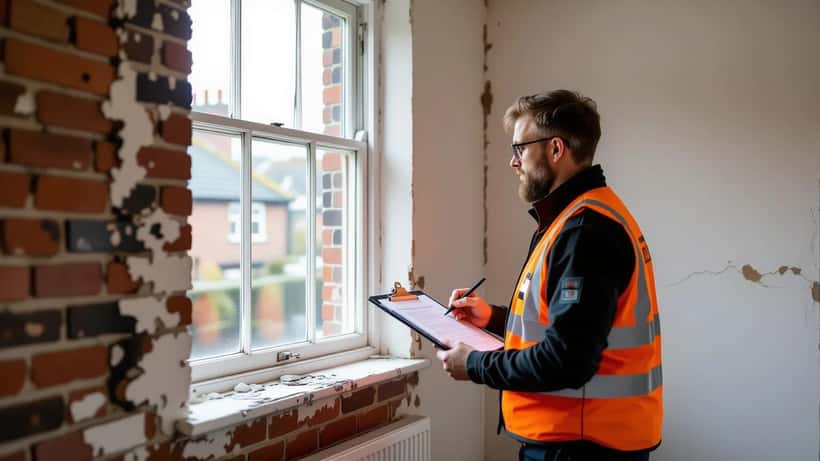
Home improvement professionals — specifically RICS-accredited building surveyors and certified fire restoration contractors — can provide a written damage assessment that satisfies both insurer requirements and future property sale disclosure obligations. For any property within roughly one kilometre of the Gretton Brook Road fire, a professional inspection is worth considering if any of the following apply:
- You noticed a chemical or acrid burning smell indoors during or after the fire
- You had an extractor fan, MVHR unit, or tumble dryer running while the smoke was visible
- You can see any darkening, sooty film, or residue on light-coloured indoor surfaces
- Your loft has accessible eaves (common in Corby's pre-2000 housing)
- You are a landlord: under the Homes (Fitness for Human Habitation) Act 2018, you have a legal obligation to ensure your property is free from hazards — including chemical contamination — that may affect your tenants' health
A professional written assessment also protects you in a future sale. Undisclosed fire proximity events that caused damage — even minor — can become grounds for post-sale disputes under UK property law. A clean surveyor's report costs you between £250 and £500 and eliminates that risk entirely.
If you are a Corby resident who was caught in the Gretton Brook Road smoke cloud on 10 August 2026, speaking to a home improvement specialist can give you a clear-eyed assessment of what your property needs — and whether your insurer should be picking up the bill. For homeowners also concerned about the insurance claim process after a nearby fire, our guide to RAF Fairford smoke damage insurance claims walks through the documentation steps in detail.
For further guidance on fire incidents in the county, Northamptonshire Fire and Rescue Service publishes press releases and resident guidance following significant events at northantsfire.gov.uk.
This article is for general informational purposes. For advice specific to your property, insurance policy, or legal situation following the Corby fire, consult a qualified building surveyor, fire restoration specialist, or solicitor.
