 Rhys Morgan
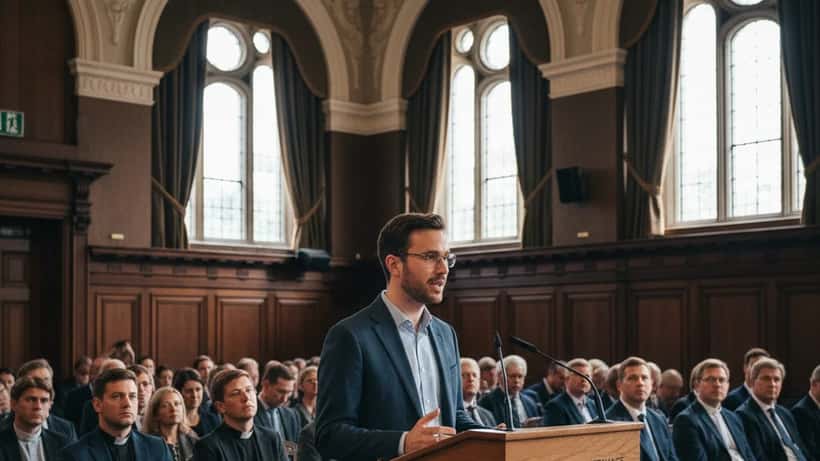
On 25 May 2026, Christopher Olah — co-founder of Anthropic, one of the world's leading AI safety companies — stood before an audience at the Vatican and said something that very few technology executives would say publicly: the development of artificial intelligence cannot be left to technology companies alone. Speaking at the presentation of Pope Leo XIV's encyclical on artificial intelligence, Olah urged religious leaders, governments, and civil society to take a much more active role in shaping how AI evolves. He warned that job displacement from AI could happen "at very large scale" and called the need to support displaced workers "a moral imperative of historic proportions."
The speech made global headlines. For UK businesses that use, deploy, or develop AI systems, it carries a specific and urgent message: the era of self-regulation in AI is ending, and the organisations best prepared for what comes next are those that start now.
Who Is Christopher Olah and Why Does His View Matter?
Christopher Olah is not a policy commentator or a critic from outside the industry — he is one of its architects. At Anthropic, he has spent years working on mechanistic interpretability: the scientific effort to understand what is actually happening inside large language models. He noted at the Vatican that he has engaged with more than 15 religions on questions raised by AI.
His credibility on this subject is hard to overstate. When Olah says that "every frontier AI lab operates inside a set of incentives and constraints that can sometimes conflict with doing the right thing," he is speaking from the inside. And when he highlights three specific areas requiring urgent attention — widespread job displacement, equitable global access to AI benefits, and the opacity of complex AI systems — he is identifying the exact points where regulation is most likely to land.
3 AI Governance Questions Every UK Business Must Answer
Olah's Vatican intervention is a signal, not just a statement. Here are the three questions UK business leaders need to be asking their teams right now.
1. Do we know what our AI systems are actually doing?
Olah's third area of concern — the interpretability of increasingly complex AI systems — is directly relevant to businesses deploying AI in customer-facing or decision-making roles. If you cannot explain how your AI system reached a particular output, you may already be in breach of existing obligations under the UK GDPR, which requires that automated decisions be explainable to affected individuals.
The UK Information Commissioner's Office has published guidance on automated decision-making and AI transparency. Organisations using AI in areas such as credit scoring, hiring, insurance pricing, or content moderation should review whether their systems are interpretable enough to satisfy subject access requests and the right to an explanation.
2. Are our employees prepared for AI displacement?
Olah's warning about large-scale job displacement is not hypothetical — it is already happening in sectors from legal research to financial analysis to customer service. UK employment law does not yet have specific provisions for AI-driven redundancy, but tribunals are increasingly being asked to consider whether dismissals linked to AI implementation were fair.
Businesses planning significant AI-driven changes to roles or headcounts should be thinking now about consultation obligations under the Trade Union and Labour Relations (Consolidation) Act 1992 and the duty to consider alternative employment. Proactive investment in retraining — acknowledged as important by Olah — also protects businesses from reputational and legal risk associated with poorly managed transitions.
3. Are we ready for external AI regulation?
The UK AI Act equivalent — currently in the form of the government's AI Opportunities Action Plan and sector-specific guidance from regulators including the FCA, ICO, and CMA — is fragmentary but moving fast. The EU AI Act is already in force for organisations that do business in Europe, and its extraterritorial reach affects many UK companies.
Olah's call for oversight from outside Big Tech is not just an ethical position — it is a preview of the legislative direction of travel. Businesses that begin building AI governance frameworks now, before mandatory requirements arrive, will be better positioned to demonstrate compliance and earn regulator confidence.
What Olah's Vatican Speech Means for UK IT Strategy
The Vatican setting was deliberate. Olah and Anthropic are making an argument that AI governance is not merely a technical or commercial matter — it is a question of shared human values. The involvement of religious institutions, governments, and civil society alongside technology companies is presented not as obstruction but as necessary correction.
For UK IT directors, compliance officers, and business leaders, the practical implication is straightforward: build your AI governance posture around the assumption that external oversight is coming, because it is. Voluntary codes of conduct and internal ethics boards are a start, but they are not sufficient.
According to the UK Government's AI Safety Institute, the institute's mandate includes evaluating advanced AI models for safety and supporting international cooperation on AI standards. This is the institutional framework within which UK businesses will increasingly operate.
When Should UK Businesses Seek Expert IT Guidance?
If your organisation uses AI to make decisions that affect individuals — employment, lending, insurance, healthcare — now is the time to commission an AI governance audit. An independent IT consultant or technology lawyer can help you:
- Map the AI systems your organisation uses and assess their interpretability
- Identify gaps between your current practices and existing legal obligations
- Build a roadmap for compliance with incoming regulation
- Establish an internal governance framework that can adapt to external oversight
The speech Christopher Olah gave at the Vatican on 25 May 2026 will be cited for years as an inflection point. The organisations that act on its implications in the weeks that follow will be better placed than those that wait for legislation to force their hand.
For further context on AI's broader business implications, see our analysis of what AGI means for UK businesses.
Disclaimer: This article provides general information and does not constitute legal or regulatory advice. Organisations with specific AI compliance concerns should consult a qualified IT specialist or solicitor with expertise in technology law.
