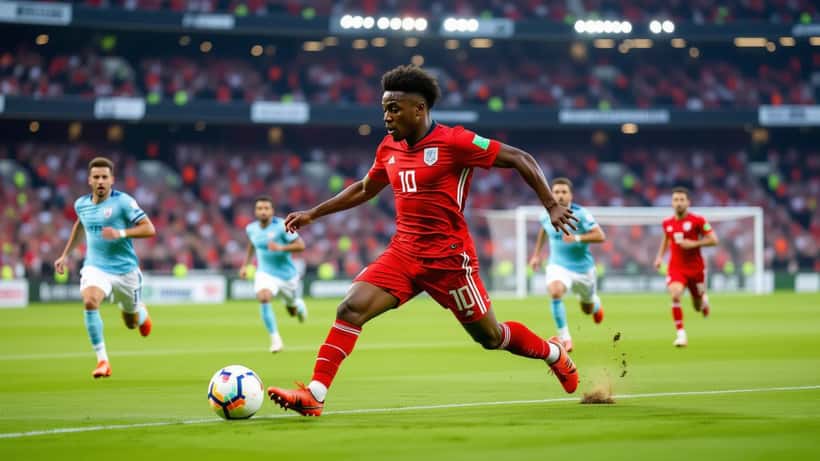
In the summer of 2026, few young footballers are attracting as much search interest as Chemsdine Talbi. The 21-year-old Sunderland winger has gone from a promising prospect at Club Brugge to a Premier League regular and Morocco international in little more than a year. His rise is not just a story of goals and transfer fees; it is a case study in how elite talent is identified, developed and managed by specialists behind the scenes.
Talbi was born on 9 May 2005 and came through the celebrated youth academy of Club Brugge in Belgium. He made his first-team debut in March 2023 and, by the 2024-25 season, had forced his way into regular contention. Across 44 appearances for Brugge, he scored seven goals and provided five assists, but it was his performance in the UEFA Champions League knockout playoff against Atalanta that truly announced him. Talbi scored twice in the second leg in Bergamo, helping Brugge win 3-1 on the night and 5-2 on aggregate. In doing so, he became the youngest Belgian goalscorer in Champions League knockout history at the age of 19.
That display triggered interest from some of Europe’s largest clubs. Sunderland, newly returned to the Premier League, moved decisively. On 9 July 2025, the Black Cats announced the signing of Talbi on a five-year contract running until June 2030, with reported fees ranging between €20 million and €23 million plus add-ons. Sunderland’s sporting director Kristjaan Speakman described the deal as part of a project built around young, hungry players, and Talbi was handed the number 7 shirt.
The 2025-26 Premier League season has tested his adaptability. Talbi has featured in 28 league matches, starting 16 of them, and has clocked around 1,561 minutes of football. His direct goal contributions stand at four goals and one assist, with a FotMob average rating of 6.55. Among the highlights are a dramatic late winner against Chelsea in October, a deflected long-range strike that earned Sunderland a point against Liverpool in December, and a goalmouth scramble finish in a 2-2 draw with Newcastle in March 2026.
Those numbers only tell part of the story. Talbi is primarily a right winger who is comfortable on either flank and capable of playing in central attacking roles. Scouts consistently praise his close control, one-on-one dribbling and willingness to run in behind defences. At 1.75 metres and roughly 65 kg, he relies on agility and acceleration rather than physical dominance, a profile that requires careful conditioning and positional coaching to flourish in English football.
His international career has developed in parallel. Although eligible for Belgium, Talbi opted to represent Morocco and was called into the squad for the 2025 Africa Cup of Nations, held in Morocco from December 2025 to January 2026. Morocco reached the final, where Senegal withdrew mid-match; the title was later awarded to Morocco as a 3-0 victory. In May 2026, Talbi was named in Morocco’s squad for the FIFA World Cup, giving him a global stage at the age of 21.
The trajectory raises a wider question: how does a teenager turn a handful of Champions League minutes into a Premier League starting place and a World Cup call-up within 18 months? The answer usually involves a network of experts. Clubs now employ full-time analysts to model playing styles, physiotherapists to manage workloads, nutritionists to support rapid physical development and agents or career advisers to time moves for maximum playing opportunity. Talbi’s decision to leave Brugge for Sunderland, for example, looks less like a simple step up in league prestige and more like a calculated career move: guaranteed minutes in a competitive league, a development-focused dressing room and a clear pathway to regular first-team football.
For fans, the lesson is that modern football is increasingly a specialist sport off the pitch as well as on it. Parents of young players, amateur coaches and even curious supporters can learn from the same principles: identify a player’s core strengths, expose them to the right level of competition, protect them from injury and seek expert advice before major decisions. A football analyst can break down why Talbi’s dribbling style suits wide areas, a performance coach can explain how his conditioning has changed since moving to England, and a career mentor can outline why game time at 19 and 20 matters more than a glamour club’s bench.
Injury management has already played a role in Talbi’s first Premier League campaign. A muscle problem in late May 2026 briefly sidelined him, with an expected return around mid-June. As of early July, he is back in training and Sunderland’s next scheduled friendly is against York City on 18 July 2026. How he is reintegrated into match fitness over pre-season will be another test of the club’s sports-science department.
Looking ahead, the 2026-27 season could define whether Talbi becomes a consistent Premier League contributor or merely a flash in the pan. Sunderland’s recruitment strategy suggests they see him as a long-term asset, and Morocco’s trust in him at international level indicates they expect him to compete for a starting role for years to come. If he can improve his end product, decision-making in the final third and defensive contribution, his market value could rise sharply.
In the meantime, his name trending in search engines is a reminder that expertise underpins every breakthrough. Whether it is the scout who spotted him in Brugge’s academy, the data team who modelled his fit for Sunderland’s system, or the medical staff managing his load, Talbi’s progress in 2026 is a team effort. Anyone looking to make smarter decisions in their own field can take the same approach: find the right expert, ask the right questions, and treat development as a continuous process rather than a single lucky break.
