 Alistair Finch
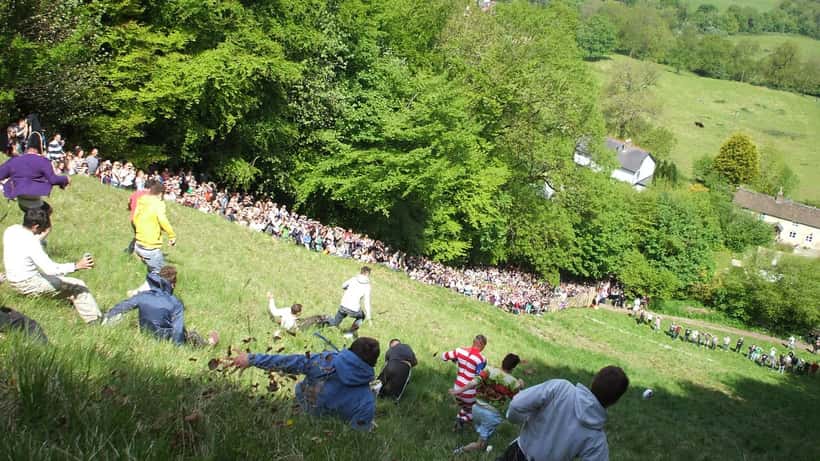
The Cooper's Hill Cheese-Rolling and Wake is taking place today, 25 May 2026, on Spring Bank Holiday Monday. Starting at noon, competitors are hurling themselves down a near-vertical Gloucestershire hillside chasing a 7–9lb Double Gloucester cheese wheel that can reach speeds of 70 miles per hour. This year, as every year, South Western Ambulance Service NHS Foundation Trust has deployed an air ambulance and five land units in standby on site. Thirty to forty people will be treated before the day ends. And here is the legal and practical reality that almost no one on that hill understands: if you are seriously injured today, there is no organiser to sue, no insurer to call, and no duty-of-care claim to make.
The Event Nobody Officially Runs
Cooper's Hill Cheese Rolling has no official organiser. Its management committee disbanded years ago. The Tewkesbury Borough Council Safety Advisory Group has formally declared the event "unsafe" year after year, and a multi-agency statement — signed by Gloucestershire Constabulary, South Western Ambulance Service, Gloucestershire Fire and Rescue, and Tewkesbury Borough Council — makes clear that standard safety documentation has not been submitted and authorities cannot guarantee crowd safety.
The event's cheese is supplied by Smart's Traditional Gloucester Cheese. Competitors are caught at the bottom by a group of local rugby players who take up positions voluntarily. There are no stewards, no crowd management infrastructure, and no safety plan. The hill is privately owned by Gloucestershire County Council, which has stated repeatedly that it lacks legal power to prevent the event.
Signs posted across the hill state plainly that participants compete entirely at their own risk.
What This Means for Injury Claims
Under English law, event organisers owe a duty of care to participants and spectators under the Occupiers' Liability Act 1957. Where no organiser exists, no duty can be pinned to an individual or body in the traditional way.
This is not entirely without remedy, but the paths are narrow:
Land occupier liability: Gloucestershire County Council owns the hill. If a spectator or competitor suffers an injury caused by a defect in the land itself — a hidden hole, a detached rock ledge, a structural failure — the occupier may carry liability. The test is whether the council knew or ought to have known about the specific hazard. A solicitor would assess whether any pre-event inspection records exist.
Fellow competitor negligence: If another competitor directly caused your injury through reckless or deliberate conduct — deliberately pushing, for instance — you may have a claim in negligence against that individual. This would require identifying the specific person, obtaining witness evidence, and demonstrating conduct that went beyond the inherent risk you accepted by attending.
Emergency services: You have no claim against the NHS or ambulance service simply because they could not reach you quickly enough on the hill. Emergency services are not legally liable for the consequences of delays caused by terrain, crowd size, or lack of site access planning — circumstances routinely documented at this event.
The fundamental legal position is this: by attending Cooper's Hill Cheese Rolling and choosing to participate or stand in designated spectator areas, you are accepting a known and well-publicised risk. A published medical case study in the National Institutes of Health's PMC archive — covering 25 injuries from a single year of the event — documents ankle fractures, concussions, dislocations, and torn ligaments as routine outcomes.
Injuries to Expect and When to Seek Medical Help
St John Ambulance withdrew first aid cover from the event in 2012 on the grounds it could not guarantee a duty of care. The rugby "catchers" at the bottom are not medically trained. NHS ambulances on standby face significant access challenges given the terrain and crowd volumes.
Common injuries at cheese rolling fall into categories a GP or emergency specialist would classify as follows:
Minor but painful: bruising, abrasions, muscle strains, superficial lacerations. These can typically be managed with rest, ice, compression, elevation (the RICE protocol), and over-the-counter pain relief. No emergency presentation is needed.
Moderate — seek GP or urgent care: suspected fractures without severe deformity, joint sprains where weight-bearing is painful but possible, suspected concussion with no loss of consciousness. Same-day urgent care (not A&E) is appropriate.
Serious — call 999 or go to A&E immediately: suspected spinal injury, loss of consciousness (even briefly), suspected fracture with visible deformity, inability to bear weight at all, severe headache following a head impact, numbness or tingling in limbs after a fall. Do not attempt to move someone with a suspected spinal injury. Shout for help; the catchers and bystanders at the bottom of the hill are often first to attend.
Spectator-specific risk: the cheese wheel has struck spectators in previous years. If you are hit by a projectile travelling at speed, treat any head impact as a concussion risk regardless of immediate symptoms.
The NHS Cost Burden
Each year, Gloucestershire NHS trusts absorb the cost of treating 30+ patients from a single unofficial event. The multi-agency safety advisory group has noted that deploying ambulances on standby at Cooper's Hill reduces emergency coverage for the rest of Gloucestershire during the event window.
A similar pattern occurs at other high-risk informal sporting events, as documented in the medical literature around extreme sport injuries. The difference at cheese rolling is the complete absence of any formal safety framework.
What Legal Experts Recommend
If you have attended today's event or plan to attend in future years, a solicitor or personal injury adviser would offer the following practical guidance:
- Document everything: if you are injured, photograph the scene and note names of witnesses immediately. In the absence of an organiser's incident report, this is your only evidence trail.
- Report to police if another person caused your injury: a police report establishes the factual record for any future civil claim.
- Preserve medical records: request a copy of any ambulance or A&E attendance record. NHS records are admissible in civil proceedings.
- Act within three years: personal injury claims in England must be brought within three years of the injury date. This limitation applies even in cases against land occupiers.
- Accept the reality of limited options: for most injuries sustained at Cooper's Hill, there is no viable claim. The event's structure — or rather its lack of one — was designed, whether intentionally or not, to externalise all liability onto participants.
Today's cheese rolling will end, as it always does, with injuries, hospital trips, and a new set of viral videos. Knowing your legal position before you run does not make the hill any safer. But it means you will not be surprised by the aftermath.
Legal disclaimer: This article is for informational purposes only and does not constitute legal advice. For advice specific to your situation, consult a qualified solicitor.
