 Grace Davies
Cameron Menzies won Players Championship 23 on Monday, beating Cristo Reyes 8-5 in the final to claim his first PDC ranking title of 2026, according to Sky Sports. The 37-year-old Scot sealed the £15,000 top prize at the Mattioli Arena and, in the process, confirmed his place at the Betfred World Matchplay in Blackpool later this month. It was a striking turnaround for a player who needed surgery after his World Championship exit at Alexandra Palace in January.
What most fans watching the flights land in the treble 20 will not have considered is the visual machinery behind every dart. A player standing 2.37 metres from a board just 45.7 centimetres wide is asking his eyes to resolve millimetre differences under bright stage lighting, in front of a moving crowd, hundreds of times a night. Menzies' comeback is a reminder that precision sport is, first and foremost, a test of vision — and that eyesight is something most adults quietly neglect until it starts to fail.
Why darts is an eye test disguised as a bar game
Throwing a dart accurately depends on far more than a steady arm. It relies on visual acuity to sharpen the target, on depth perception to judge distance, and on the ability to shift focus rapidly between the dart in the hand and the segment on the board. Sports vision specialists describe this as dynamic, close-to-mid-range focusing under pressure — the same skill set that separates elite marksmen and snooker players from talented amateurs.
For a 37-year-old like Menzies, there is an added factor. From the early-to-mid forties, most people begin to develop presbyopia, the gradual stiffening of the eye's lens that makes near focus harder. It is the reason so many adults suddenly hold menus at arm's length. For a precision athlete, even a small drift in focusing speed can turn a match-winning finish into a narrow miss — which is why professional players are increasingly conscious of their eye health long before they hit 40.
The signs adults ignore for years
The problem for ordinary players is that vision decline is slow and easy to explain away. Squinting at the oche, struggling under artificial light, headaches after an evening on the board, or finding that the outer scoring ring blurs at distance are all things people put down to tiredness. In reality they can be early markers of uncorrected refractive error, dry eye or the first stages of presbyopia.
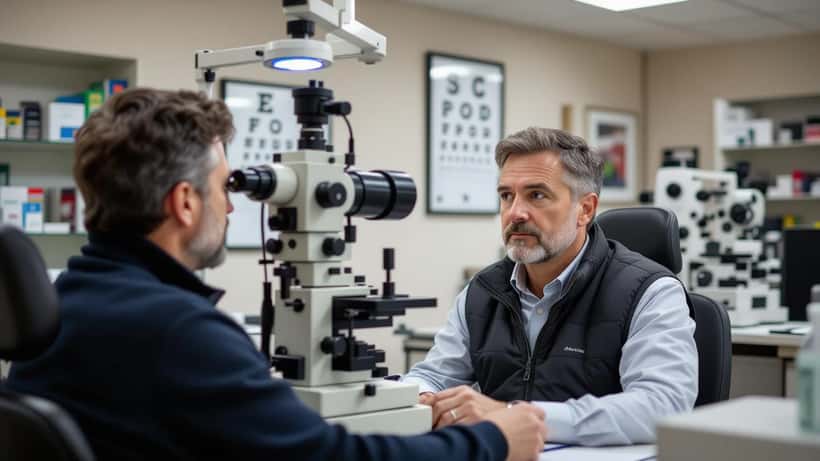
The NHS advises that most adults should have an eye test at least every two years, and sooner if your vision changes (NHS opticians). A routine sight test does more than check whether you need glasses. Optometrists also look for early signs of glaucoma, cataracts, diabetic changes and high blood pressure — conditions that often show no symptoms until sight is already affected. Some groups, including people over 60 and those with diabetes, qualify for free NHS-funded tests.
An expert view for the weekend player
You do not need a stage and a walk-on song to benefit from a professional eye assessment. An optometrist can measure not just how sharply you see a static letter chart, but how well your eyes work together, how quickly they change focus, and whether your prescription is subtly out of date. For anyone who plays darts, shoots, drives at night or spends long hours at a screen, that functional picture matters more than a single number on a prescription.
If you have noticed any change, a qualified optometrist is the right first port of call rather than reaching for off-the-shelf reading glasses. Ready-made readers correct for a single average distance and can mask an uneven prescription between the two eyes, leaving you straining without realising it. A tailored assessment identifies exactly what your eyes need — and flags anything that requires referral to an ophthalmologist.
The practical checklist most specialists suggest is simple. Book a test if it has been more than two years since your last one. Go sooner if you are getting frequent headaches, if text or targets blur at distance, if you struggle to adapt between bright and dim light, or if you have a family history of glaucoma. And treat any sudden change — flashes, floaters, a curtain across your vision or abrupt loss of sight — as an emergency, not something to sleep on.
The bigger picture behind a comeback
Menzies' win in July 2026 is a sports story, but the lesson underneath it is a health one. Elite performers protect the tools that make them elite, and for a darts player the most important tool sits behind the eyes. The average player will never throw a nine-darter, yet the same biology governs how clearly they see the board on a Friday night and, more importantly, how well they will read a road sign or a medication label in twenty years' time.
Vision is one of the few areas of health where a short, painless, widely available check can catch serious problems early — and where far too many adults still wait until something goes wrong. If a professional's razor-sharp eyesight is what carried him back to a Blackpool stage, it is a fair prompt for the rest of us to book the appointment we have been putting off.
This article is for general information only and does not constitute medical advice. If you have concerns about your eyesight or a sudden change in vision, consult a registered optometrist or your GP. In the case of sudden sight loss, flashes or floaters, seek urgent medical attention.
Related reading: the hidden injuries of precision darts and what Gerwyn Price's fitness transformation reveals.
