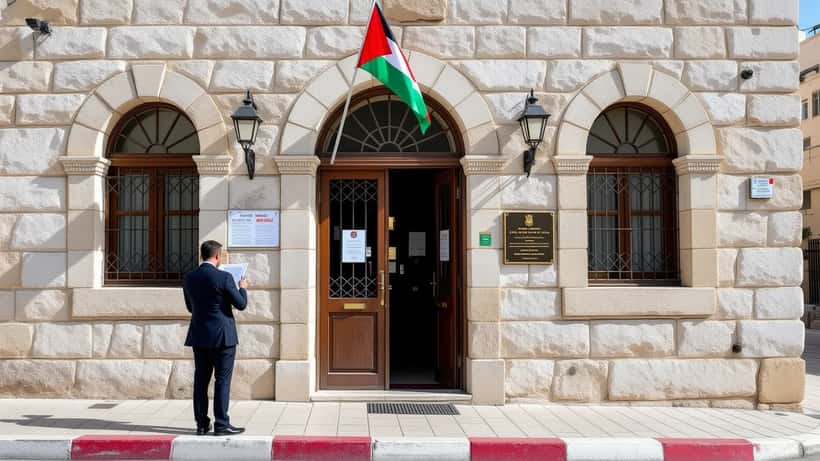
On 8 September 2026, Israel gave the United Kingdom 30 days to close its Consulate General in East Jerusalem — ending 188 years of unbroken British diplomatic presence at the site. The expulsion order came after London announced plans to block imports from Israeli settlements in the West Bank, a measure that Israel's Foreign Minister Gideon Saar described as an "unfriendly act." British diplomats at the consulate will lose their accreditation on 8 October 2026, leaving UK nationals across Jerusalem, the West Bank, and Gaza without their primary consular cover.
What triggered the closure — and why it is legally complex
The UK's decision to restrict settlement imports was part of a coordinated move with France and Canada, all three countries announcing the measures within days of each other in early September 2026. Israel's response went beyond the consulate itself: 12 British politicians were barred from entering the country, British officials at a Gaza coordination centre were told to leave, and a joint programme training Palestinian security forces in the West Bank was immediately suspended.
The Consulate General in East Jerusalem is not the UK's embassy to Israel — that mission, in Tel Aviv, remains open. The Jerusalem post served a legally distinct role: representing the United Kingdom to the Palestinian Authority and providing consular protection to British nationals in Jerusalem, the West Bank, and Gaza. Since the UK formally recognised the State of Palestine on 21 September 2025, the Jerusalem consulate had taken on an even more prominent diplomatic function.
The dispute raises genuinely novel questions of international law. Under the Vienna Convention on Consular Relations (1963), a consulate can only operate with the consent of the receiving state. Israel argues that, as the occupying power in the West Bank, it has the authority to withdraw that consent. Britain has pushed back, arguing that the consulate's legal basis predates the modern Israeli state and cannot simply be revoked unilaterally. As of late September 2026, the Union Jack was still flying above the building in Sheikh Jarrah, with fewer than ten days left before the deadline.
The Foreign, Commonwealth and Development Office estimates that around 4,000 British nationals are registered as living in the Palestinian territories — a figure that understates the real number, since many nationals living abroad never formally register.
What this means for UK nationals on the ground
The closure creates a practical gap in consular cover that is not resolved simply by pointing to the Tel Aviv embassy. Under Article 36 of the Vienna Convention on Consular Relations, any UK national detained abroad has the right to have the nearest British consulate notified "without delay." But with no consulate accredited to operate in the West Bank, enforcing that right becomes procedurally unclear.
The Tel Aviv embassy covers UK nationals in Israel, but it has no established access or accreditation in the Palestinian territories. A consular officer travelling from Tel Aviv to Ramallah faces Israeli-controlled checkpoints where entry can be delayed or denied. The journey — typically 90 minutes under normal conditions — can stretch to four hours or longer depending on checkpoint queues and security restrictions.
Beyond detention scenarios, consular services cover a range of everyday emergencies: issuing emergency travel documents when a passport is lost or stolen, conducting welfare checks, notifying families of hospitalisation, registering births and deaths abroad, and liaising with local authorities in legal disputes. All of these services will become significantly harder to access after 8 October 2026. UK nationals caught in the Lebanon conflict in 2026 faced similar gaps in consular access before emergency arrangements were put in place, and the Jerusalem closure raises comparable practical concerns at much shorter notice.
A concrete scenario: when contracts assume a consulate that no longer exists
Consider a British couple — both humanitarian aid workers — who signed a 12-month contract with an international NGO based in Jenin in August 2026, a month before the closure was announced. Their contract runs until August 2027. In January 2027, one of them is seriously injured in a road traffic accident and admitted to a hospital in Nablus. Their employer's medical insurance policy covers inpatient costs up to £50,000, but the policy's repatriation clause requires written confirmation from a British consular official before a medical evacuation flight can be authorised.
With the Jerusalem consulate closed, the Tel Aviv embassy would need to send an officer into the West Bank. Under current checkpoint conditions, that journey takes four to eight hours — and access is not guaranteed. If the patient's condition requires evacuation within 24 hours, missing that window could mean costs escalating beyond the £50,000 policy ceiling, with no consular intermediary available to negotiate with local hospitals or insurers.
This is the core legal exposure: insurance policies, employment contracts, and tenancy agreements that reference "consular support" as a procedural backstop were drafted under the assumption the consulate would still be operating. If you signed a contract in this category before September 2026, a legal review of the relevant clauses is now advisable before the 8 October deadline.
What a legal expert can help you address
The closure has implications that extend well beyond the immediate diplomatic row. It affects the practical enforceability of legal documents, insurance claims, and employment rights for UK nationals who are already living or working in situ. A solicitor with expertise in international private law or expat legal rights can help in several concrete ways.
First, they can review existing contracts — employment, tenancy, and services agreements — to identify clauses that assume consular involvement and advise on how those clauses can be redrawn or supplemented with alternative emergency mechanisms. Second, they can help establish a power of attorney designating a trusted person in the UK who can act on your behalf in emergencies, reducing (though not eliminating) your dependence on physical consular access. Third, if you are employed by a UK organisation operating in the West Bank under a UK employment contract, your employer may have duties of care that require them to provide alternative emergency arrangements; a solicitor can advise whether your employer is meeting those obligations and what recourse you have if they are not.
The FCDO's official guidance on support for British nationals abroad sets out the limits of what consular services can and cannot provide — reading it carefully before any contract renewal or travel decision in the region is strongly recommended.
Steps to take before 8 October 2026
If you are a UK national currently living or working in the West Bank, East Jerusalem, or Gaza, there are practical steps to take before the deadline passes.
Register with the FCDO via the UK government's online registration system if you have not already done so. This costs nothing and means consular staff can reach you in an emergency, even at reduced capacity from Tel Aviv. Review any insurance policies for clauses that depend on consular involvement and contact your broker to update or clarify the terms before the closure date. Check your employment contract for force majeure or emergency clauses that reference consular support and ask your employer what alternative arrangements they are putting in place.
Creating or updating a power of attorney naming a UK-based person with authority to act on your behalf is one of the most practical steps you can take to reduce your dependence on in-person consular access. Note the Tel Aviv embassy's emergency contact number and keep a realistic estimate of current travel times from your location to the checkpoint nearest the embassy.
If your situation involves contractual clauses that reference consular services — or if you are in the process of renewing a contract that will run beyond October 2026 — consulting a legal expert now, rather than after a problem arises, is the most effective way to protect your position.
This article is for informational purposes only and does not constitute legal advice. If you are a UK national affected by the closure of the British Consulate General in Jerusalem, seek independent legal advice specific to your circumstances.
