 Eleanor Stone
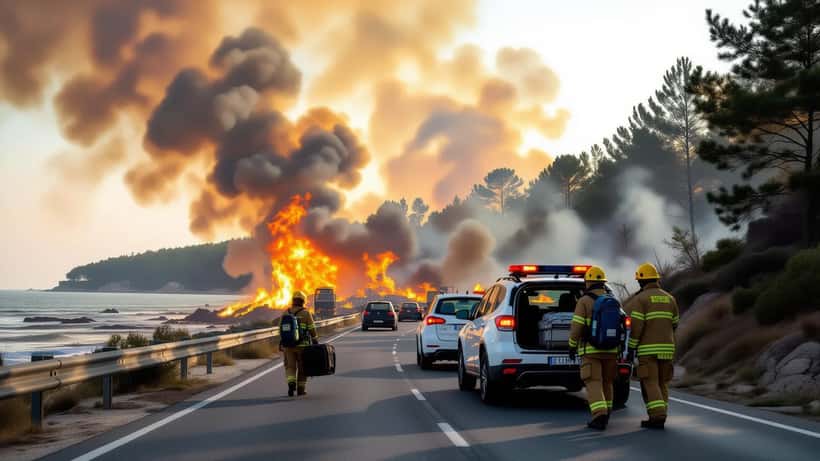
Wildfires swept through the Gironde department surrounding Bordeaux on 25 July 2026, forcing more than 220,000 evacuations across France as flames consumed at least 3,400 hectares around the Arcachon Basin and Cap Ferret peninsula — one of the most popular summer destinations for British tourists in Europe. The UK's Foreign, Commonwealth and Development Office issued urgent guidance naming Saumos, Le Porge and Lège-Cap-Ferret as directly affected zones. With Bordeaux airport still operational but access routes severed and campsites cleared overnight, tens of thousands of UK holidaymakers are now facing an urgent question that no one thinks about at the booking stage: how much of your holiday money can you actually recover?
A Region at the Heart of Britain's Summer
The Gironde is no peripheral destination for British travellers. The Bordeaux region draws hundreds of thousands of UK visitors each summer, attracted by Atlantic beaches, the Médoc wine country, and the sprawling campsite resorts along the Landes coast. July and August alone account for the peak of British bookings — meaning the timing of this wildfire event, at the height of the school summer holidays, has placed the maximum possible number of UK families directly in the line of disruption.
The fires were driven by a prolonged drought and a heat wave that pushed July temperatures in the Gironde to an average of 32°C — almost 6°C above the historical July norm, according to reporting by CNBC on 26 July 2026. French authorities deployed hundreds of firefighters and aerial tanker aircraft, but were still working on 26 July to prevent the blaze from reaching the outskirts of Bordeaux city itself. The Cap Ferret peninsula and the northern Arcachon Basin bore the brunt of the initial advance, with more than 20,000 residents and tourists evacuated from an area already ravaged by fires in 2022.
For travellers already in the region — or booked to fly in the coming days — the disruption falls into three distinct legal situations, each governed by different rules. Which category you fall into determines whether your rights are strong, limited, or almost non-existent.
Why Wildfires Are a Legal Grey Zone for Holidaymakers
The core complexity here is how travel law classifies natural disasters. Under both EU-derived rules retained in UK law and the updated Package Travel Regulations, wildfires are categorised as "unavoidable and extraordinary circumstances." The same classification covers earthquakes, volcanic eruptions and acts of terrorism — events beyond any party's control. This matters enormously to your claim.
For airlines, the "extraordinary circumstances" label means that if a flight is cancelled or significantly delayed because of wildfire disruption at the airport, the carrier owes you a full fare refund — but it does not owe you the standard EC261/2004 compensation payment (normally £220–£520 per passenger depending on route length). The airline is not at fault, so no penalty applies. You recover your costs, but not the additional compensation.
For package holiday operators, the framework is more protective — but only if your booking qualifies as a genuine "package" under UK law. A package means at least two of the following booked as a single contract with a single seller: transport, accommodation, or a significant tourist service. Booking flights and hotels separately through different providers leaves you in a far weaker position, relying largely on travel insurance rather than guaranteed statutory rights.
What the Package Travel Regulations 2026 Actually Guarantee
The Package Travel and Linked Travel Arrangements (Amendment) Regulations 2026, which came into force on 1 January 2026, set out the minimum standards all UK-sold package organisers must meet when "significant proportions of the travel services cannot be provided as agreed."
Under Regulation 13, if a tour operator cannot perform the booked package because a destination has become inaccessible or unsafe, they must offer the traveller one of the following — in this order of preference:
- An alternative holiday of equivalent or higher quality at no extra cost
- A lower-quality alternative with a price reduction, if the traveller agrees
- A full refund of all sums paid, within 14 days of the cancellation
This statutory right applies regardless of whether the FCDO has formally issued advice against travel to the specific area. If the campsite, villa or hotel has been physically evacuated by French authorities, the operator cannot deliver the service — Regulation 13 is triggered automatically. The FCDO advisory becomes relevant for the insurance dimension: once an against-travel notice exists for a specific zone, most standard travel insurance policies allow you to claim a cancellation before departure, even if the operator has not yet formally cancelled.
The £3,200 Bordeaux Package: A Concrete Case
Consider a family of four who booked a 10-night package holiday through a UK-registered tour operator: return flights from Gatwick to Bordeaux-Mérignac, a campsite villa near Lège-Cap-Ferret for £2,600, plus a guided Médoc wine-tour excursion priced at £200 — a total package cost of £3,200. They fly out on 23 July 2026 and receive an official evacuation notice for their campsite on the night of 25 July, three days into the holiday.
Under the Package Travel Regulations 2026, here is what their legal position looks like — in concrete numbers:
- Unused accommodation (7 of 10 nights): The operator cannot provide the accommodation element. The family is entitled to a proportionate refund for the seven unused nights — roughly £1,820 based on the accommodation's share of the total package price, if no equivalent alternative can be sourced.
- Repatriation: If the evacuation prevents the family from completing the trip, the organiser must arrange return flights at no extra cost, even if the original return was scheduled five days later. If they have to buy emergency flights independently, those costs are reclaimable from the operator.
- The excursion: If the wine tour was included in the package contract, it is covered by Regulation 13. If they booked it separately through a local provider after arriving, it falls outside the package and requires a separate claim — likely relying on the individual provider's terms.
- The critical rule: If the operator's first response is to offer a replacement holiday or a credit voucher rather than a cash refund, the family is not obliged to accept. The Regulations guarantee a cash refund. Accepting a voucher requires the customer's explicit written consent — anything short of that is not a valid discharge of the operator's liability.
The practical trap many families fall into: operators email a generic "we'll rebook you for next year" offer that sounds helpful but quietly attempts to convert a cash entitlement into a future booking credit. If you receive such an email, reply in writing asking the operator to confirm your Regulation 13 refund entitlement explicitly.
If You Booked Flights and Accommodation Separately
Without a package, each element of your trip is governed by its own terms and conditions — and your statutory protections are narrower. For flights, if Bordeaux airport closes or the airline cancels, you are entitled to a full refund under retained EC261/2004 rules. If the airport remains open but you choose not to travel, you are entirely dependent on your travel insurance policy.
For accommodation booked directly — through Airbnb, a gîte owner or an independent hotel — French cancellation terms apply. Many Gironde holiday properties operate strict non-refundable policies in July and August. If the property has been officially evacuated by French prefecture authorities, you have a strong argument under French civil law (force majeure) that the contract has been frustrated. However, recovering the money in practice typically requires written proof of the evacuation order and may ultimately require a formal complaint process. Keep every official document you receive.
The UK Civil Aviation Authority's consumer travel advice for Summer 2026 specifically advises separately-booked travellers to contact their insurer immediately upon any government travel advisory and to document all communications with accommodation providers, noting the date of any evacuation notice.
Three Steps to Protect Your Money Now
Check FCDO guidance every morning. The France travel advisory is updated in real time at gov.uk/foreign-travel-advice/france. The moment advice against non-essential travel to Gironde is issued, the majority of travel insurance policies allow you to make a cancellation claim — even before your operator acts.
Contact your tour operator in writing, not by phone. Use email or messaging apps so you have a timestamped record. Ask explicitly: "Has my package been materially affected? Are you cancelling? What is the Regulation 13 refund you are offering?" A verbal reassurance is not a legal commitment.
Gather evidence if you are on the ground. Photograph any official evacuation signage or police cordons, save any SMS alerts from French emergency services, and keep all receipts for emergency expenditure — alternative accommodation, taxis, emergency food. These costs are reclaimable from your tour operator or insurer if your holiday has been disrupted.
If your operator refuses a valid cash refund, you can escalate to the Competition and Markets Authority or, for ABTA-registered operators, to ABTA's dedicated dispute resolution scheme. A consumer solicitor can help you formalise a claim — particularly worthwhile when the package cost runs to several thousand pounds.
For further guidance on what a wildfire evacuation means for your insurance claim, see our earlier analysis of UK wildfire evacuation insurance rights.
This article is for general information purposes only and does not constitute legal advice. If you need advice specific to your situation, consult a qualified solicitor.
