 Chloe Collins
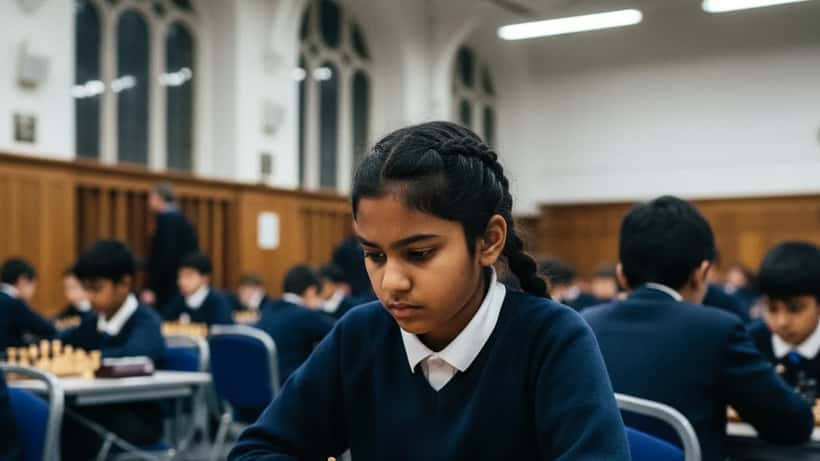
At just 11 years old, Bodhana Sivanandan from north London has become England's top-ranked female chess player — a feat that has captured the attention of educators, parents, and neuroscientists alike. In the April 2026 FIDE ratings, she reached a classical rating of 2366, displacing four-time British Women's Champion Lan Yao to become the number one English female player and breaking into the world's top 100 women for the first time.
The Story Behind the Prodigy
Bodhana was born on 7 March 2015 and grew up in Harrow, north London, with her family originally from Tamil Nadu, India. Her journey into chess began during the Covid lockdown when her father discovered an old chessboard he had been about to throw away. What followed was an extraordinary trajectory of competitive achievement that has astonished the international chess world.
By age ten, she had become the youngest chess player ever to earn a Woman Grandmaster norm. In August 2025, she defeated International Grandmaster Peter Wells at the British Chess Championship — the youngest girl ever to defeat a grandmaster at a national championship. In October 2025, she beat former Women's World Chess Champion Mariya Muzychuk at the European Chess Club Cup. Now, according to FIDE's April 2026 ratings list, her 98-point rating gain in a single month stands as the largest single-month increase recorded by any player in either the Open or Women's Top 100.
Why Chess Is Trending in 2026
Chess has been experiencing a surge in popularity across the UK since the pandemic years, when online platforms like Chess.com saw record registrations. The 2026 FIDE Candidates Tournament is currently underway, with GM Javokhir Sindarov dominating the field with a record 6/7 score through the first half. Meanwhile, Bodhana's rise has reignited national conversations about children's cognitive development and the role of structured, skilled-based learning.
Former Prime Minister Rishi Sunak publicly congratulated Bodhana, calling her achievement "an inspiration to children across the country." Schools across London have since reported increased interest in chess clubs, with several local councils exploring after-school programmes.
What Brain Science Says About Chess and Learning
Bodhana's story is compelling not only because of her results, but because of what chess reveals about how children learn. Cognitive neuroscientists have long studied chess as a model of complex problem-solving under time pressure. According to research published in the journal Educational Psychology Review, regular chess practice in children aged 7–12 is associated with measurable improvements in:
- Working memory: holding multiple positions in mind simultaneously builds the same neural pathways used for mathematics and reading comprehension
- Pattern recognition: identifying threats and opportunities on a chessboard trains rapid visual-spatial processing
- Executive function: planning three to five moves ahead strengthens impulse control and the ability to evaluate competing priorities — skills directly transferable to academic work
A 2024 study across Italian primary schools found that children receiving two hours of chess instruction per week showed a 20% improvement in maths scores compared to a control group over one academic year.
The Role of the Expert Coach
Bodhana did not develop her skills in isolation. Behind every chess prodigy is typically a network of dedicated coaches, parents, and mentors who can identify talent early and create the right conditions for it to flourish. Her progress accelerated once she began working with experienced coaches who could analyse her games at a competitive level.
This is where many families with talented children hit a wall. School chess clubs are valuable for introduction and enjoyment, but they rarely provide the structured, personalised feedback that accelerates development. A private chess tutor or specialist coach offers something qualitatively different: tailored feedback on specific weaknesses, guidance on openings suited to the child's playing style, and psychological preparation for tournament pressure.
The question for parents is not just "should my child learn chess?" but "how do I find someone qualified to help them improve beyond the basics?"
When to Seek Expert Help
There are clear signals that a child may benefit from one-to-one coaching beyond their current environment:
- They have exhausted local competition. If your child regularly wins at school or club level without being stretched, they are likely ready for a higher-level teacher.
- They have hit a rating plateau. In competitive chess, players often stall at a particular rating band until a coach identifies the specific technical or psychological gaps holding them back.
- They are losing motivation. Frustration without understanding why you lose is one of the quickest ways to disengage young players. An expert can turn losses into concrete learning moments.
- They show unusual pattern recognition. Some children naturally see the board differently. Early identification and structured nurturing of this ability can define a playing career.
The right tutor does not simply play games with the child. They review completed games analytically, set targeted puzzles, introduce endgame theory, and build confidence through progressive competition management.
The Broader Lesson for Parents
Bodhana Sivanandan's achievement is exceptional, but the principles that drove it are accessible. Chess is one of the few competitive activities where children can genuinely measure their progress in real time, receive immediate feedback on every decision, and build skills that transfer directly into academic performance.
Whether or not your child aspires to a grandmaster title, chess coaching at the right level can build the analytical habits that improve performance across STEM subjects, humanities, and beyond. The UK currently has a shortfall of qualified chess coaches relative to demand — a gap that professional tutor platforms are beginning to address.
Note for parents: If your child has a medical, psychological, or educational question related to learning development, always consult a qualified specialist. This article is informational in nature and does not constitute professional educational advice.
A Moment That Belongs to Every Child
When Bodhana Sivanandan sat down opposite Mariya Muzychuk — a former Women's World Chess Champion — and won, she demonstrated something important: talent recognised early, nurtured correctly, and given the right expert guidance can produce results that redefine what is possible. England now has its youngest-ever female number one. The question for parents and educators watching is not just how to celebrate her — but how to ensure the next Bodhana gets the same chance.
On ExpertZoom, you can find qualified chess tutors and private learning specialists who work with children from beginner to advanced competitive levels across the UK.
