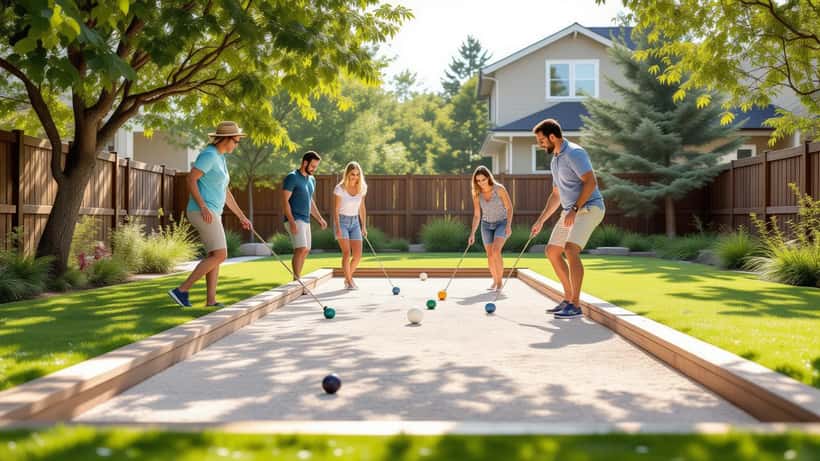
Bocce is enjoying a quiet renaissance across Britain in 2026. Once confined to Italian parish clubs and Mediterranean holiday snapshots, the ancient ball sport is now turning up in pub gardens, corporate team-building events, and even compact urban courtyards. The reason is simple: it is inexpensive, genuinely social, and playable by almost any age group. What started as a post-pandemic hunger for low-contact outdoor pastimes has matured into a sustained cultural trend, with online searches for bocce rules, court setups, and beginner tips running well above seasonal averages.
The modern game descends from Roman lawn-bowling traditions and has been codified in Italy for centuries. At its heart, bocce is a contest of precision. Two teams—usually singles, pairs, or fours—take turns rolling weighted balls toward a smaller target ball called the pallino. The side whose balls finish closest to the pallino once all balls have been thrown scores points. Frames continue until one team reaches a predetermined total, most commonly 12 or 15 points. That simplicity is part of the appeal, but it also hides real depth in strategy, surface reading, and touch.
A standard bocce court measures roughly 27 metres by 3.5 metres, though recreational players routinely halve that length. The surface should be flat, level, and free of debris; crushed stone, decomposed granite, or a well-maintained lawn all work. Serious competitors prefer a harder, faster surface because it rewards finesse and makes reading the roll easier. In 2026, a growing number of British homeowners are installing semi-permanent backyard courts using timber frames and compacted stone dust, a trend mirrored by pubs that want to keep patrons outdoors for longer.
Equipment has also evolved. Traditional resin or metal balls remain the norm, but manufacturers now offer lighter composite sets aimed at younger players and mixed-age groups. The key specification is diameter: adult tournament balls are typically 107 millimetres and weigh just under a kilogram. Beginners should avoid cheap, hollow plastic sets because they bounce unpredictably and teach bad habits. A good set of four balls per team, plus a pallino, can last for years if stored out of direct sunlight.
Opening the frame matters more than newcomers assume. The team that throws the pallino chooses the starting position and therefore controls the initial challenge: close to the pallino or defensive and distant? Once the first ball is down, every subsequent roll is a reply to that positioning. Aggressive players may try to knock an opponent's ball away—called a spock or raffa shot in some rule sets—while conservative players prefer to crowd the pallino and block the path. Reading the court's camber and speed before committing to either approach separates casual players from competent ones.
Etiquette and rules vary slightly between the Italian Raffa Volo federation style, French pétanque-influenced variations, and the more open rules common in British social leagues. Most disputes in garden games come down to measurement, which is why competitive matches use a tape measure and social games increasingly rely on smartphone camera angles to settle close calls. The golden rule everywhere is to wait until a ball has stopped moving before delivering the next; stepping onto the court while balls are in play can invalidate a shot.
For beginners, the fastest route to enjoyment is to limit frame length at first. Shorter courts reduce the premium on raw power and emphasise accuracy. Practice a consistent underarm delivery with a slight backspin; it gives better control on harder surfaces and reduces the chance of a ball rolling too far past the pallino. Play to seven points rather than fifteen until everyone understands scoring, and rotate partners regularly so weaker players learn from more experienced teammates.
The social side of bocce deserves as much credit as the tactical side for its 2026 comeback. Games unfold slowly enough for conversation, making the sport a natural bridge between generations. Families can play together without anyone feeling sidelined, and mixed-ability teams remain competitive because a single accurate roll can undo a string of poor ones. This low barrier to inclusion is why community centres and care homes have begun adding bocce sessions to their activity calendars alongside more familiar options such as bingo and gentle exercise classes.
Health benefits, while modest, are real. A typical session involves walking, bending, light throwing, and prolonged standing, all of which support mobility and balance without high impact. The mental workload is equally valuable: estimating distances, planning sequences, and adjusting for surface conditions keep players engaged in ways that passive screen time cannot replicate. For older adults in particular, bocce offers a rare combination of gentle activity and genuine social contact, both of which are strongly linked to wellbeing.
From an expert perspective, 2026 is an interesting inflection point. The sport's accessibility is driving participation, but that same accessibility risks diluting standards as commercial venues rush to install substandard courts. Anyone thinking of adding bocce to a hospitality space or community centre should invest in proper dimensions and surface compaction. A lumpy 10-metre strip marked out on grass is fun for one afternoon; a level, framed court with consistent bounce transforms the experience and encourages repeat play.
Looking ahead, expect bocce to keep expanding into unexpected spaces. Workplace wellness programmes, retirement communities, and school break-time rotations are all natural fits because the game combines gentle physical activity with tactical thinking. Unlike many trend sports, it requires no special clothing, no expensive memberships, and no peak athletic condition. That broad accessibility is why the 2026 bocce revival looks less like a fleeting fad and more like a durable shift in how people choose to spend time together outdoors.
