 Harriet Price
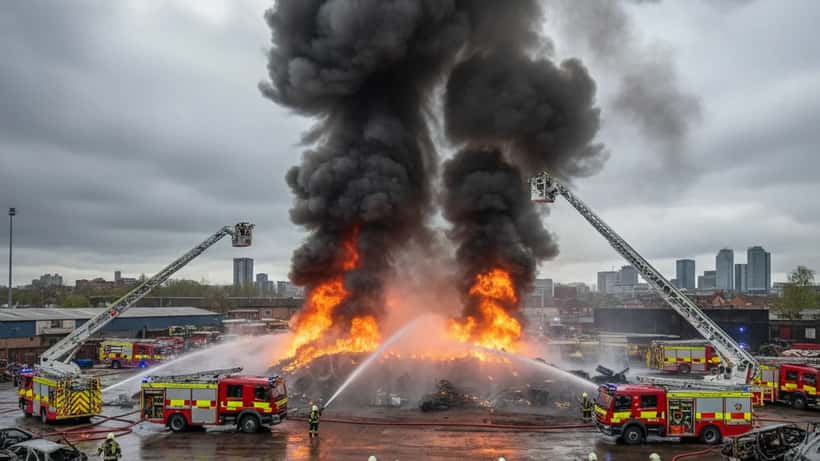
A massive fire broke out this morning at a metal scrapyard in Kings Norton, Birmingham, deploying 60 firefighters across 12 fire stations and prompting road closures and public safety warnings. The blaze at Alexanders Wharf on Lifford Lane — one of the largest industrial fires in the West Midlands this year — raises urgent questions for business owners, landlords, and tenants about property rights and insurance obligations after fire damage.
What Happened: Birmingham Scrapyard Fire, April 1, 2026
At approximately 10:30 BST, West Midlands Fire Service was called to a large fire at a metal scrapyard on Lifford Lane, Kings Norton. Twelve fire engines and a hydraulic aerial platform responded, drawing crews from stations including Kings Norton, Bournbrook, Northfield, Highgate, Smethwick, Aston, Aldridge, Erdington, Handsworth, West Bromwich, and Haden Cross.
All individuals at the site were accounted for, with no reported injuries. The fire produced a significant smoke plume visible across south Birmingham, and residents in surrounding streets were advised by West Midlands Fire Service to keep all windows and doors closed. Roads around Lifford Lane were closed, with police and ambulance services also present.
The incident follows a pattern of large industrial fires in Birmingham in early 2026 — including a severe blaze at a five-storey building on Constitution Hill in January that injured one person and required eight fire crews for more than eight hours.
Who Bears Liability After an Industrial Fire?
When fire destroys or damages a commercial property, the question of who pays — and who is responsible for what — is rarely straightforward. The answer depends on the cause of the fire, the terms of any lease or tenancy agreement, and whether adequate insurance was in place.
For business owners operating from leased premises: Under most commercial leases in England and Wales, the landlord is responsible for insuring the building structure, while the tenant is responsible for insuring their own contents, stock, and business interruption losses. If a fire breaks out due to the tenant's negligence or unsafe practices, the landlord's insurer may seek to recover costs against the tenant through subrogation.
For property owners: If the fire originated on your land and spread to neighbouring properties, you may face civil liability claims from affected neighbours — even if the fire was accidental. The legal test in English law comes from the rule in Rylands v Fletcher and subsequent nuisance cases: if you accumulate something on your land that is likely to do damage if it escapes (including fire), you may be liable for the consequences.
For employees and workers at the site: Employees injured during a fire event may have claims under employer liability insurance, regardless of the fire's cause. Workers who were evacuated and cannot work during a forced closure are generally entitled to be paid for any authorised absence if the closure was caused by circumstances outside their control.
Disclaimer: This article is for general information only and does not constitute legal advice. Individual circumstances vary — consult a qualified solicitor for guidance specific to your situation.
What Your Insurance Policy Actually Covers — And What It Might Not
Large industrial fires often expose gaps between what property owners believe is covered and what their insurer will actually pay. Common issues include:
Underinsurance: Many commercial properties are insured at figures that reflect purchase price rather than rebuild cost. According to the British Insurance Brokers' Association, a significant proportion of commercial properties in the UK are underinsured by 40% or more — meaning that in the event of a total loss, the payout may not cover reconstruction.
Business interruption clauses: Standard business interruption cover typically applies when a business cannot trade due to damage at the insured premises. However, some policies contain exclusions for fires originating from adjacent or adjoining sites — a detail that can catch property owners off guard when a neighbouring fire forces them to close.
Environmental liability: Metal scrapyards and industrial sites often hold hazardous materials. If a fire releases pollutants that contaminate soil, water courses, or neighbouring properties, environmental liability claims can arise separately from the property damage claims. Not all commercial policies include this cover.
Unoccupied property clauses: If a commercial unit was vacant or unoccupied at the time of the fire, many insurers apply reduced cover or impose additional conditions. Verifying your policy terms before a fire happens — not after — is essential.
Your Rights If Fire Forces a Business Closure
If your business is forced to close as a result of fire — whether the fire affected your premises directly or a nearby site — you have several immediate steps to take:
- Notify your insurer within 24-48 hours. Most commercial policies require prompt notification. Delays can give insurers grounds to reduce or decline the claim.
- Document everything before any clearance or remediation work. Photographs, video, inventory lists, and invoices are critical to a successful claim.
- Do not admit liability to anyone — including the fire service, other property owners, or neighbours — without taking legal advice first.
- Seek legal advice if a third party makes a claim against you. A solicitor specialising in property or commercial law can assess your exposure before you respond.
- Check your business interruption cover. If you cannot trade, a solicitor or insurance specialist can help you maximise the amount you recover, including loss of profit, increased working costs, and additional expenses.
For businesses and property owners in Birmingham and across the UK, Expert Zoom connects you with verified solicitors and legal specialists who handle commercial property and fire damage cases.
How to Prepare Before It Happens
The Kings Norton fire is a reminder that industrial and commercial fire risk is not abstract. According to government fire statistics published by the Home Office, there are over 20,000 non-residential fires in England every year — many involving industrial premises.
Proactive steps include reviewing your commercial insurance annually, ensuring rebuild valuations are accurate, confirming that business interruption cover includes off-site incidents, and understanding your lease's fire liability clauses before signing. If your business operates from premises near industrial sites, it is worth speaking to a legal or insurance expert about your specific risk exposure now — before a fire forces the conversation.
