 Amelia Davies
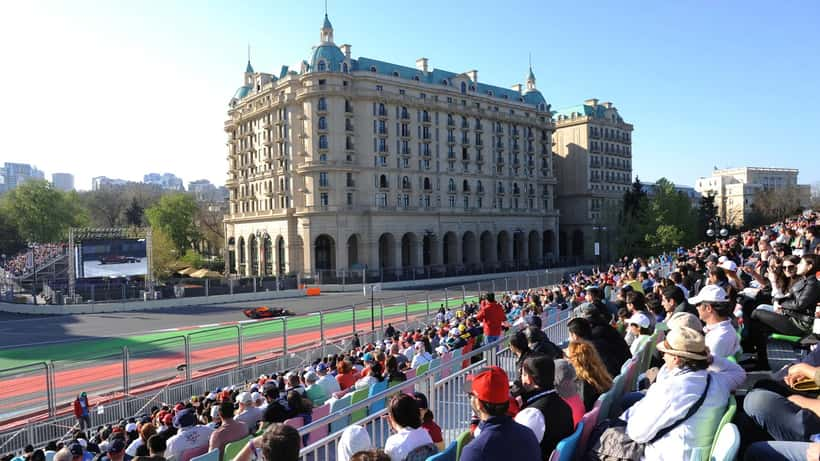
The 2026 Azerbaijan Grand Prix runs today — Saturday, 26 September — for the first time in Baku's Formula 1 history. A decision made not by the FIA or Formula 1 Management, but by the Azerbaijani government, pushed the race from its traditional Sunday slot to Saturday. For most F1 fans, that means a lunchtime race rather than an afternoon one. For UK businesses that built contracts around a Sunday event, it may mean something considerably more expensive.
Why Is the 2026 Azerbaijan Grand Prix on a Saturday?
Azerbaijan's national Remembrance Day falls on 27 September each year. Established by presidential decree in December 2020 — weeks after the ceasefire that ended the Second Nagorno-Karabakh War, known in Azerbaijan as the Patriotic War — the date commemorates approximately 2,900 Azerbaijani soldiers who died in the conflict. Under Azerbaijani law, 27 September is a day of national mourning, and major public events of a celebratory nature are restricted.
In 2026, the standard Formula 1 weekend structure would have placed the Grand Prix on Sunday, 27 September — directly on Remembrance Day. Azerbaijan's government and race promoters formally requested that Formula 1 move the race one day earlier. F1 agreed. The weekend was restructured: Free Practices 1 and 2 on Thursday, FP3 and Qualifying on Friday, and the race itself on Saturday, 26 September. Lights out in Baku is 15:00 local time — 12:00 BST.
Crucially, this is not a Sprint format experiment. It is not driven by broadcasting revenues, audience metrics, or commercial strategy. It is a sovereign accommodation — a host nation exercising its legal authority over its own national calendar. Under the Law Reform (Frustrated Contracts) Act 1943, when circumstances beyond both parties' control alter the nature of what was contracted for, the ordinary rules of breach may not apply — and businesses relying on standard refund expectations may be in for a surprise.
Sovereign Acts vs Commercial Contracts: The Legal Framework
The distinction between a government-driven schedule change and a commercially driven one matters profoundly in English contract law. It determines whether a disrupted party has a breach of contract claim, a force majeure claim, or — in some circumstances — no claim at all.
Force majeure in English law is not implied by courts. Unlike many continental legal systems, English law requires force majeure to be explicitly written into a contract as a clause. If your corporate hospitality agreement or sponsorship contract contains a force majeure clause listing "governmental action," "national laws," or "host country regulation," the operator changing the schedule may be entirely shielded from liability. You contracted; they delivered — on a different day for a legally protected reason.
Frustration, under the 1943 Act, applies when circumstances beyond both parties' control make contractual performance something fundamentally different from what was agreed. A court must decide whether Saturday's race in Baku was fundamentally different from Sunday's. For a fan who simply wanted to watch Formula 1, probably not. For a business that structured its entire client entertainment programme around a Sunday — with flights, accommodation, and commercial objectives specifically tied to that day of the week — the legal picture is far less settled.
It is worth noting that F1 contract clauses are frequently misunderstood by buyers across all levels of the sport — and corporate hospitality agreements are no exception. What appears to be a standard booking confirmation often contains far-reaching variation rights buried in the general conditions.
Why This Case Differs from Standard Event Cancellation
Most UK consumers are familiar with their rights when an event is cancelled outright — refunds are typically mandated under the Consumer Rights Act 2015 and venue-specific terms. But a schedule shift of one day is a fundamentally different legal situation.
Formula 1 has cancelled races before. The 2020 and 2021 Australian Grand Prix were both cancelled due to public health restrictions; the 2011 Bahrain Grand Prix was cancelled due to civil unrest. In those cases, full cancellation triggered clear refund obligations under existing terms or consumer protection legislation.
A date shift — particularly one driven by sovereign reasons rather than safety — creates a murkier legal position. The event still happened. The service was theoretically delivered. Whether it was the same service you contracted for depends on how precisely your contract defined what it was selling. The Azerbaijan GP is unusual only because the sovereign reason — a national day of mourning — is so publicly documented. Most such changes happen quietly, buried in amended terms and conditions, with no Google Trends spike to alert businesses that their contractual footing has shifted.
This principle extends far beyond motorsport. Music festival relocations, international trade events moved around diplomatic calendars, and political summit venue changes all generate the same legal ambiguity for any business that built a commercial programme around a specific date in a specific country.
When £19,200 Becomes a Contract Dispute: A Concrete Case
Consider a UK-based technology consultancy that secured two four-person corporate hospitality packages for the 2026 Azerbaijan Grand Prix — eight places at £2,400 each, totalling £19,200 — with the commercial objective of hosting key clients over the traditional Sunday race. The contracts specified "race day hospitality, Azerbaijan Grand Prix 2026."
Separately, the firm booked return flights from Heathrow for all eight guests at £450 per person (£3,600 total) — departing Thursday evening, arriving Baku Friday morning, returning Monday. The Sunday race timing aligned precisely with clients' diaries: weekday commitments stayed intact.
When the race moved to Saturday, the financial and operational impact was immediate:
- Three clients cancelled attendance entirely, citing Saturday unavailability
- Rebooking flights to accommodate the revised Thursday–Saturday travel window cost an additional £1,200
- The firm attended with five of its eight contracted guests
- Three vacant hospitality places — paid for at £2,400 each — generated £7,200 in unrecoverable expenditure
- One operator provided a partial refund of £600 for one unoccupied place after a formal written request
Net quantifiable loss: £8,400.
Now apply the legal if/then framework:
- If the contract said "race day hospitality, Azerbaijan GP 2026" without specifying Sunday: the operator likely has no liability. Race day occurred as contracted — on a different day of the week, but on race day nonetheless.
- If the contract explicitly referenced "Sunday, 27 September 2026": the schedule change is a unilateral material variation the buyer did not consent to. The firm has a strong claim for the difference in commercial value received, and potentially for consequential costs including rebooking fees.
- If the contract contained a force majeure clause covering governmental decisions: the operator is shielded. The firm's legal options are significantly reduced.
- If no force majeure clause existed and the contract referenced a specific date: the firm may have a contractual claim worth up to £8,400 — but must act before the limitation clock expires.
These four outcomes are separated only by the specific language in a contract most buyers signed in under two minutes, without legal review.
What to Do If the Schedule Change Affected Your Contract
If you hold a corporate hospitality agreement, sponsorship deal, or event-tied commercial contract linked to the 2026 Azerbaijan Grand Prix, and the Saturday move caused measurable financial loss, take these four steps now:
1. Review the contract language precisely. Does it say "race day," "Sunday," or a specific date? Check for force majeure clauses, "venue or date amendment" provisions, and any definitions section that explains what "event" means in the context of the agreement.
2. Quantify and document every loss. Include hard costs (unused hospitality places, rebooking fees, cancelled accommodation) and quantifiable commercial losses (unfulfilled client commitments, lost deal value from meetings that could not take place). Keep every invoice, confirmation, and communication related to the change.
3. Issue a formal letter before action. Under England and Wales Pre-Action Protocols, a letter before claim is required before litigation. It is also frequently sufficient to trigger settlement — many event operators will negotiate rather than face court proceedings over a clear contractual ambiguity.
4. Consult a specialist commercial solicitor. Contracts involving international events, sovereign decisions, and force majeure sit at the intersection of commercial, international, and consumer law. A specialist can assess within an hour whether your situation supports a viable claim and what quantum is realistic.
The limitation period for contractual claims in England is six years from the date of breach under the Limitation Act 1980. For contracts tied to today's race date of 26 September 2026, that clock starts now.
This article provides general legal information for educational purposes only and does not constitute legal advice. For guidance specific to your situation, consult a qualified solicitor.
