 Sophie Robinson
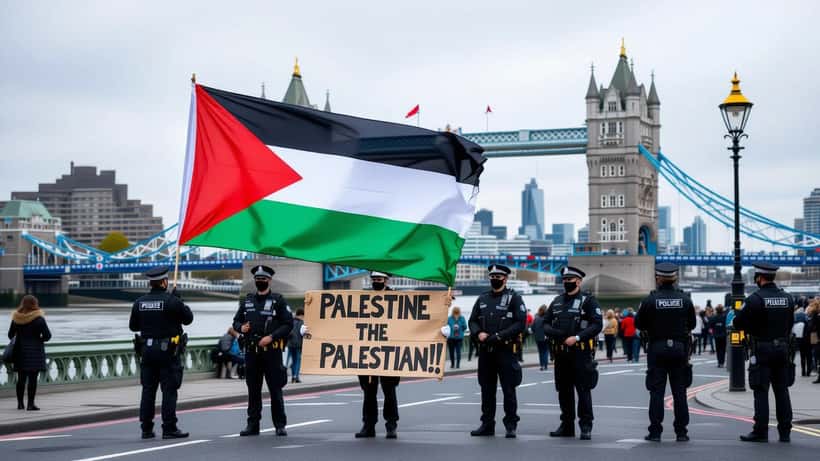
Al Jazeera broadcast footage on 12 July 2026 of activists unfurling a giant Palestinian flag across London's Tower Bridge, demanding the release of gravely ill Gaza hospital director Dr Hussam Abu Safia. The images travelled the world within hours. What many viewers did not realise is that, in Britain today, standing on a bridge with the wrong banner can end in an arrest under counter-terrorism law — not public-order law. The gap between what feels like ordinary protest and what now counts as a criminal offence has never been wider, and most people only discover it after the handcuffs are on.
Since the direct-action group Palestine Action was proscribed on 5 July 2025 under the Terrorism Act 2000, more than 2,000 people have been arrested for expressing support for it — at least 2,489 by mid-2026, according to figures reported across the UK press, the overwhelming majority for nothing more than holding a handwritten sign. The result is roughly 700 cases now working their way through an already overstretched criminal justice system. If you plan to attend any protest connected to Gaza this summer, understanding where the legal lines fall is no longer optional.
Why a Placard Can Trigger a Terrorism Charge
Proscription is the key word. When the Home Secretary bans an organisation, the Terrorism Act 2000 makes it a criminal offence to belong to it, to invite support for it, or simply to display an article — a flag, a badge, a sign — in a way that arouses reasonable suspicion that you support it.
Section 12 of the Act covers inviting or expressing support for a proscribed group and carries a maximum sentence of 14 years' imprisonment. Section 13, which covers wearing or displaying supportive items in public, is a lesser offence but still carries up to six months in prison, an unlimited fine, or both. Crucially, prosecutors do not need to prove you committed any violence, blocked any road, or damaged any property. The display itself is the offence.
This is why the legal community has been so vocal. The International Bar Association has described the ban as "a dangerous shift in the law," warning that it blurs the line between disruptive-but-lawful protest and terrorism. The UN human rights chief called the proscription a "disturbing" misuse of counter-terrorism powers. UK courts have since had to draw that line case by case — a slow, expensive process for everyone caught in it.
Protest Is Still a Protected Right — Within Limits
None of this means street protest is banned. The right to peaceful assembly and free expression remains protected under the Human Rights Act. You can march for Palestine, wave a Palestinian national flag, chant, and hold placards criticising the government's foreign policy, all without breaking any law. Tens of thousands have done exactly that at lawful rallies in London this year without arrest.
The danger zone is narrow but sharp. Displaying material that signals support for the specific proscribed group — rather than for Palestinians or a ceasefire in general — is where a lawful demonstrator becomes, in the eyes of the law, a terrorism suspect. The distinction can rest on a single word printed on cardboard. Police officers on the ground make that judgement in seconds, and the courts sort out the disagreement months later.
Separately, the Public Order Act 2023 created new offences around "locking on," tunnelling, and obstructing major infrastructure. A stunt that involves climbing a landmark or fixing yourself to a structure — as several high-profile bridge and tower protests have — can attract charges even when no proscribed group is involved.
What to Do Before You Attend a Protest
A solicitor who specialises in protest and public-order law can tell you, in plain terms, what is safe and what is not before you leave the house — a far cheaper conversation than the one that happens after an arrest. Practical steps most protest lawyers recommend include:
- Write a criminal-defence solicitor's number on your arm before attending. You have the right to free legal advice at the police station, day or night.
- Understand the difference between general Palestinian solidarity symbols and material referencing a banned organisation. If in doubt, leave it at home.
- Know your rights on stop and search. Under counter-terrorism powers, officers have broader authority than in ordinary policing.
- Say nothing beyond your name until your solicitor arrives. "No comment" is not an admission of guilt.
If you or a family member has already been arrested at a demonstration, do not assume the charge is minor. A section 13 conviction leaves a criminal record that can affect employment, travel to countries such as the United States, and professional registration. Early legal representation frequently determines whether a case is dropped, diverted, or prosecuted to trial.
The Bigger Picture for Everyone Who Films or Shares
The reach of Al Jazeera's Tower Bridge footage is a reminder that protest is now a media event as much as a physical one. Reposting an image, amplifying a slogan, or livestreaming from a crowd can, in some circumstances, be argued to fall within "expressing support." No mainstream lawyer expects prosecutions for ordinary sharing, but the uncertainty itself is the point — and it is why demand for clear, individual legal advice has surged.
You can read the exact wording of the offences on the government's official statutory database at legislation.gov.uk. For a wider view of how UK media and impartiality rules are shifting around this coverage, see our report on the Jeremy Bowen BBC impartiality row.
This article is general information, not legal advice. Protest and counter-terrorism law is complex and fact-specific. Consult a qualified criminal-defence solicitor about your own situation before acting.
