 Harriet Price
Non-consensual deepfakes are now criminal offences in more than 49 jurisdictions worldwide — a number that more than doubled between 2022 and 2026. The legislative pattern is consistent: countries first criminalised the sharing of such content, then its creation, and most recently began assigning liability to the platforms hosting it. The following jurisdictions now impose prison sentences, not merely civil remedies.
When South Korean student Yuna Choi discovered in 2024 that AI-manipulated intimate images had circulated across Telegram groups without her consent, prosecutors charged her abuser under Article 14-2 of the Act on Special Cases Concerning the Punishment of Sexual Crimes — legislation carrying up to five years' imprisonment. Comparable criminal protection now exists in the United States, the United Kingdom, the European Union, Australia, and beyond.
1. United States: The DEFIANCE Act and a Patchwork of State Laws
The United States reached a federal threshold in 2024 with the DEFIANCE Act (Disrupt Explicit Forged Images and Non-Consensual Edits Act), signed into law in July of that year. The statute creates a federal civil right of action — and criminal referral pathway — for victims of non-consensual intimate visual depictions produced by AI. Federal prosecutors may pursue criminal charges carrying imprisonment of up to two years for a first offence and up to five years for repeat or aggravated offences.
State laws, however, frequently exceed federal minimums. California, Texas, Virginia, Georgia, and Minnesota had each enacted specific deepfake-criminal-liability statutes before the DEFIANCE Act, targeting both the creation and the distribution of fabricated intimate imagery. California's AB 602 and AB 730 additionally address deepfake use in political campaigns, a separate but growing concern.
By 2026, 47 US states have enacted standalone deepfake legislation. The remaining three rely on general non-consensual intimate image (NCII) statutes that courts have interpreted to cover AI-generated content.
2. United Kingdom: Online Safety Act and Criminal Justice Provisions
The United Kingdom has enacted a layered statutory response. Section 188 of the Online Safety Act 2023 criminalised the sharing of deepfake intimate images without consent, imposing a maximum sentence of two years for the basic offence and an unlimited fine. The following year, the Criminal Justice Act 2025 went further: it criminalised the creation of such images as a standalone offence, raising the maximum to three years where creation is accompanied by intent to cause distress or humiliation.
The Crown Prosecution Service (CPS) issued specific charging guidance in January 2026, clarifying that AI-generated imagery depicting real individuals in intimate scenarios is covered regardless of whether the content was produced for personal use, shared on a closed platform, or widely distributed.
Victims may apply for a Revenge Porn Helpline referral and request emergency takedown via the Online Safety Act's designated reporting mechanism. Prosecutors are not required to prove financial gain — the intent to cause distress is sufficient for the aggravated offence.

3. European Union: AI Act Transparency Rules and National Criminal Laws
The EU AI Act (Regulation 2024/1689), fully applicable from August 2026, imposes a transparency obligation rather than a direct criminal sanction: any AI-generated image depicting a real person must be labelled as synthetic content. Failure to label constitutes an administrative infraction, not a criminal offence at EU level.
Criminal liability for non-consensual deepfakes rests with member-state law. Enforcement is uneven:
- Germany: The Strafgesetzbuch (StGB) §184k — amended in 2024 — criminalises non-consensual creation and distribution of intimate deepfakes; maximum sentence two years or a fine.
- France: The Loi du 30 juillet 2020 relative aux violences conjugales was extended by legislative amendment in 2025 to explicitly cover AI-fabricated intimate imagery; up to two years plus a €60,000 fine.
- Netherlands: Article 139h of the Dutch Criminal Code was revised in 2025 to cover AI-generated NCII, maximum one year or a fine.
The European Digital Rights (EDRi) coalition has called for a harmonised criminal standard across all 27 member states by 2027.
4. South Korea: Asia's Strictest Deepfake Sentences
South Korea was the first country in Asia to criminalise deepfake sexual content. Article 14-2 of the Act on Special Cases Concerning the Punishment of Sexual Crimes (amended 2020) imposes a maximum of five years' imprisonment or a fine of up to 50 million KRW (approximately £29,000) for distributing non-consensual deepfake sexual material.
Following the 2024 Telegram deepfake crisis — in which thousands of women and girls found fabricated intimate images of themselves circulating in group chats, many linked to Korean universities — the National Assembly passed emergency amendments in October 2024. The revised statute:
- Removed the distribution requirement: mere possession of non-consensual intimate deepfakes now carries up to three years.
- Extended liability to platform operators who knowingly facilitate distribution.
- Introduced mandatory sex-offender registration for repeat offenders.
Japan passed analogous legislation in 2025, with penalties of up to three years under an amendment to the Act on Punishment of Activities Relating to Child Prostitution and Child Pornography for AI-generated content depicting real individuals.
5. Australia and Canada: Commonwealth Frameworks
Australia amended the Online Safety Act 2021 in 2024 to make non-consensual sharing of intimate deepfakes a civil enforcement matter handled by the eSafety Commissioner. A separate Criminal Code Amendment (Non-Consensual Deepfakes) Act 2025 introduced dedicated criminal offences with a maximum of six years' imprisonment for creating and distributing AI-fabricated intimate imagery — the highest base sentence of any English-speaking jurisdiction.
Canada's Criminal Code Section 162.1 has covered non-consensual intimate image sharing since 2015, but covered AI-generated content only after judicial interpretation confirmed synthetic images as "intimate visual recordings" in 2023. Bill C-63 (the Online Harms Act, passed in 2025) added platform accountability obligations and introduced a hybrid criminal offence carrying up to five years on indictment, or 18 months on summary conviction.
Both countries empower victims to seek emergency injunctions through civil courts in addition to criminal prosecution, providing a faster route to takedown where criminal proceedings may take months.
Maximum Prison Terms by Jurisdiction
Sources: DEFIANCE Act 2024 (USA); Online Safety Act 2023 / Criminal Justice Act 2025 (UK); StGB §184k (Germany); Act on Special Cases Concerning the Punishment of Sexual Crimes (South Korea); Criminal Code Amendment 2025 (Australia); Bill C-63 (Canada)
What Victims Can Do: Practical Steps for Legal Recourse
Criminal prosecution is one avenue — but it is rarely the fastest. Victims of non-consensual deepfake imagery typically have more immediate options alongside the criminal process.
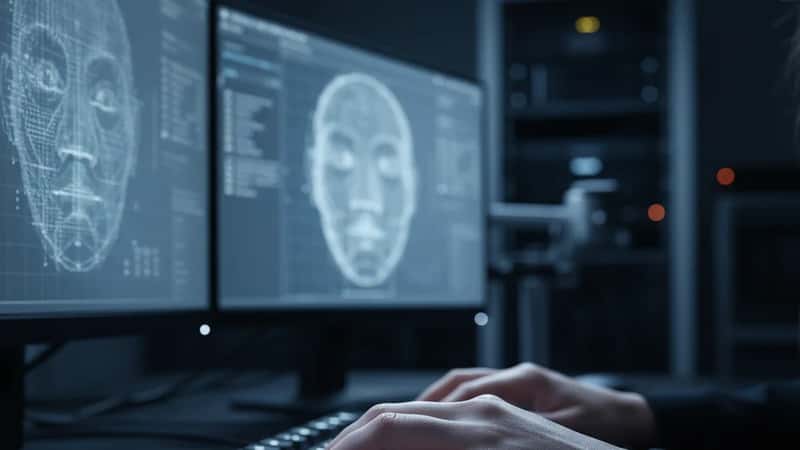
- Document before reporting: Screenshot the content, including the URL, date, username, and any metadata visible on screen. Courts in all jurisdictions discussed above require evidence of the specific image, not just a description.
- Submit a platform takedown request: All major platforms — Meta, TikTok, Telegram, X — have dedicated NCII (Non-Consensual Intimate Images) portals. The StopNCII hash-matching tool (operated by the Revenge Porn Helpline, UK) allows victims to create a digital fingerprint of an image and block it across multiple platforms simultaneously without re-uploading it.
- Contact national reporting bodies: eSafety Commissioner (Australia), Internet Watch Foundation (UK/EU), the NCMEC CyberTipline (USA). Each can issue removal orders independent of criminal proceedings.
- Consult a solicitor or attorney specialising in digital harm: Civil injunctions — restraining orders preventing further distribution — can be obtained within 24-48 hours in the UK and Australia under emergency relief provisions.
Key takeaway: Criminal law alone does not remove harmful content. Parallel civil and platform-level action almost always delivers faster results for victims than waiting for a prosecution.
Frequently Asked Questions
Is creating a deepfake always illegal in 2026?
Not universally. Creating a deepfake is only a criminal offence in jurisdictions that have specifically criminalised the creation act — currently including the UK, South Korea, Australia, and some US states. In the EU and Canada, criminal liability typically attaches at the distribution stage. Generating a non-intimate, non-defamatory deepfake for personal use remains a legal grey area in most countries.
Do deepfake laws cover non-intimate images — such as political disinformation?
Most current criminal statutes focus specifically on intimate imagery. Political deepfakes are governed by a separate and patchwork set of laws: the EU's Digital Services Act (DSA) requires platforms to label AI-generated political content; California's AB 730 prohibits distributing certain deepfake political material within 60 days of an election. Criminal liability for political deepfakes remains limited in most jurisdictions as of 2026.
Can a victim pursue both criminal and civil remedies simultaneously?
Yes, in all jurisdictions reviewed. Criminal proceedings are brought by the state; civil claims for damages — including injunctions, compensation for emotional distress, and loss of earnings — are brought by the victim independently. The two processes proceed in parallel and are not mutually exclusive. Victims should be aware that civil courts can act significantly faster than criminal courts for interim relief.
Legal disclaimer: The information on this page is provided for general informational purposes only and does not constitute legal advice. Laws governing deepfake imagery vary significantly by jurisdiction and are subject to ongoing legislative change. If you are a victim of non-consensual deepfake content or require legal guidance on a specific matter, consult a qualified lawyer in your jurisdiction.