 Emily Turner
The Reject Shop has recalled a children's craft product after laboratory testing detected traces of asbestos — and the timing has alarmed parents across Australia. The ACCC confirmed on 12 May 2026 that HTI-branded Scented Fun Sand — sold in blue, green, red and yellow varieties — was distributed at Reject Shop stores between 13 January 2025 and 7 May 2026. If your child played with this product at any point in the past 16 months, here is what doctors say you need to know.
What Type of Asbestos Was Found — and How Dangerous Is It?
Testing identified two types of asbestos fibres in some samples: anthophyllite asbestos and tremolite asbestos. Both are classified as carcinogenic substances under Australian law, and both are banned from manufacture, use, import, or supply under the Work Health and Safety Regulations 2011 (Cth) and equivalent state legislation.
The ACCC's advice contains an important qualifier: respiratory asbestos fibres — the form most associated with lung disease — were not detected in any tested samples. The regulator assessed that release of airborne fibres is "unlikely to occur in its current state, unless the sand is processed by mechanical means such as crushing or pulverising."
For a product marketed to children, however, "processing by mechanical means" is not an abstract risk. Children naturally compact, press, mould, and vigorously manipulate play sand. A paediatric health professional reviewing the exposure pathway would consider how the product was used — and whether any actions during play may have generated dust.
What Health Experts Say About Asbestos Exposure in Children
Asbestos-related diseases — including mesothelioma, asbestosis, and lung cancer — are almost universally linked to prolonged, high-level occupational exposure rather than brief incidental contact. A child who played with the Scented Fun Sand once or twice is not in the same category as a tradie who worked with asbestos insulation for years.
That said, there is no known safe level of asbestos exposure established by international health bodies. The World Health Organization classifies all forms of asbestos as carcinogenic to humans (Group 1). The latency period between asbestos exposure and the appearance of disease can span 20 to 50 years — which means that any cumulative exposure that occurred in childhood may not present symptoms until well into adulthood.
Parents should approach this recall with proportionate concern rather than panic. If your child used this product regularly — for example, as a frequent toy over several weeks or months — a conversation with your GP or paediatrician is warranted. A health professional can document the nature and duration of exposure and advise on whether any monitoring is appropriate.
How to Handle the Recalled Sand Safely
If you still have Scented Fun Sand at home — in its original packaging or elsewhere — the ACCC and SafeWork SA have issued specific disposal guidance:
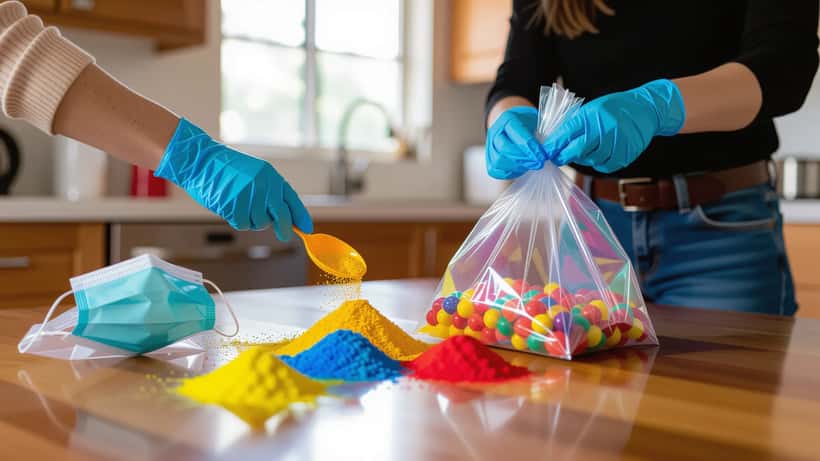
If the sand is still in its original packaging: Place the sealed package into a heavy-duty plastic bag, double-tape it securely, label it clearly (e.g., "asbestos product — do not open"), and store it in a secure location away from children and pets until collection or disposal instructions are updated.
If the sand has already been opened and used:
- Do not sweep or vacuum the area — this generates dust.
- Wet the surface where the sand was used before cleaning up.
- Wear gloves and a P2 or N95 disposable mask during clean-up.
- Use damp cloths or paper towels to collect the sand. Do not shake or dry-brush.
- Place the sand, gloves, mask, and cloths into a heavy-duty plastic bag. Double-bag the material and seal both bags with tape.
- Label the outer bag clearly and store in a secure location.
- Contact the Asbestos Safety and Eradication Agency (asbestossafety.gov.au) for state-specific guidance on disposal.
Do not return the opened product to a Reject Shop store. The retrieval of asbestos-containing material in a retail environment poses a risk to staff and other customers.
Your Refund and Consumer Rights
The Reject Shop is offering a full refund to customers who purchased the Scented Fun Sand. You do not need to return the physical product to receive a refund.
To claim your refund:
- Show proof of purchase at any Reject Shop store; or
- Email service@rejectshop.com.au with your proof of purchase attached.
Under the Australian Consumer Law (ACL), a mandatory recall of a product that poses a health or safety risk entitles consumers to a remedy — at minimum a full refund. You are not required to accept a replacement or store credit.
If you no longer have your receipt, a bank or credit card statement showing a transaction at The Reject Shop during the relevant period (13 January 2025 to 7 May 2026) may be accepted as proof of purchase. If the retailer disputes your claim without a valid reason, the ACCC and your state's fair trading office can assist.
When Should You See a Doctor?
Parents whose children used this product heavily and regularly — daily play sessions over weeks or months — may wish to discuss the exposure history with a paediatrician. This is particularly relevant if your child has any existing respiratory condition such as asthma or a history of airway sensitivity.
Key symptoms to monitor, though these are associated with high-level chronic exposure and are unlikely to emerge from limited contact:
- Persistent dry cough or breathlessness not explained by another condition
- Chest tightness or pain over an extended period
- Unexplained fatigue with respiratory symptoms
Document when the product was in your household, how frequently it was used, and in what setting (indoors or outdoors, with or without ventilation). This record could be medically relevant over the long term.
This article provides general health information and does not constitute medical advice. If you are concerned about potential asbestos exposure, speak with a qualified health professional who can assess your child's individual circumstances.
