 Jess Johnson
Haas confirmed on 15 October 2026 that Ferrari junior Rafael Câmara, 21, will make his Formula 1 debut with the American team in 2027, taking the seat Esteban Ocon vacates at the end of this season. The Brazilian still leads the Formula 2 standings, so a signed F1 deal now sits alongside an unfinished title fight.
What happened and why it matters
According to RaceFans, Haas is a Ferrari customer team and Câmara is expected to partner Oliver Bearman, another Ferrari academy driver. Team principal Ayao Komatsu said Haas was "really excited to sign such a young, amazing talent like Rafael Camara."
Câmara won the Formula Regional European Championship, then took the Formula 3 title at his first attempt. This year he drove a Haas chassis in a Test of Previous Cars at Portugal's Autódromo do Algarve and has also tested for Ferrari. He arrived at the announcement as the F2 points leader.
After the Baku round, Câmara had 207 points to Nikola Tsolov's 200, according to Grande Prêmio. A maximum of 78 points remain across Qatar (27-29 November) and Abu Dhabi (4-6 December). The FIA has not cancelled either round, though Middle East security concerns have delayed a final decision. If both were cancelled with no replacement, Câmara would be champion on the Baku standings.
None of this is a story about motor racing alone. Almost every young athlete who moves from a development programme to a first professional deal faces the same questions, and Australian families meet them every year in football, cricket, AFL and motorsport.
The question readers are asking: what is actually in a deal like this?
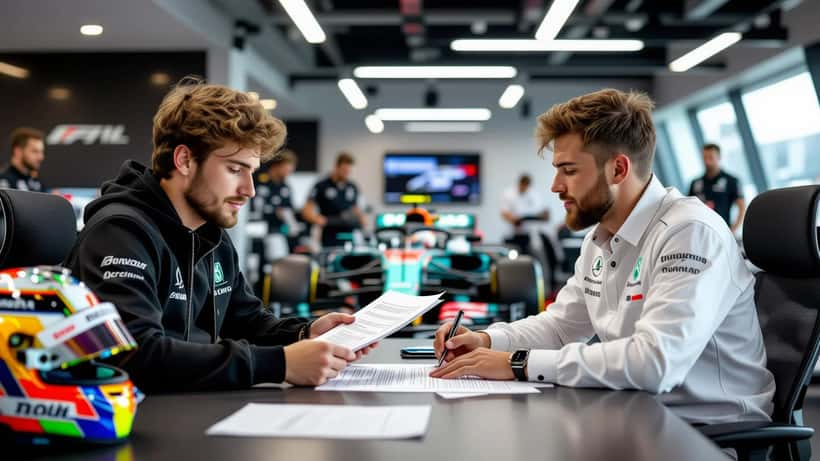
A rookie contract is rarely a single document. It is usually a bundle of agreements, and each one can be signed on different terms by different parties.
The driver or player agreement. This sets the base salary, performance bonuses, term and options. Options matter most. A team can hold a one-year deal with unilateral extension rights, while the athlete has no matching right to leave.
The academy or development agreement. Programmes such as Ferrari's often carry restrictions that outlast the original arrangement: exclusivity, first-refusal rights and release fees. A driver can find that a past academy contract still limits where they race.
The management or agent agreement. Commission is typically a percentage of earnings, and the key legal points are how long it lasts and whether it continues after the athlete changes representatives.
Sponsorship and image rights. Personal sponsors, helmet deals and social media rights are often assigned separately from the team contract. Clashes between a team's sponsors and a personal sponsor are a common source of disputes.
Reports say Haas considered Câmara over a period of months. That timing is typical. Option clauses, buy-outs and ownership of image rights are usually negotiated before any public announcement, which is why the early stages of a negotiation matter most.
What a lawyer checks before an athlete signs
Reading a long contract is not the same as understanding it. A sports or contracts lawyer typically works through five points:
- Term and exit. Is the length fixed, or can the other side extend it? What triggers early termination, and who pays?
- Money mechanics. Is pay guaranteed or performance-linked? Are bonuses tied to results the athlete only partly controls?
- Restraint clauses. Exclusivity and non-compete terms must be reasonable in scope and duration to be enforceable.
- Third-party payments. Agent fees, academy buy-outs and sponsor splits should be clear before the first payment arrives.
- Tax and residency. Where the athlete lives and works decides which country taxes which income. The Australian Taxation Office explains how Australian tax residency is determined, and it can change quickly when someone relocates for a career.
For minors and young adults, parents sometimes co-sign or guarantee obligations. That can leave a family exposed in ways nobody explained at the signing table.
A realistic scenario: a 19-year-old's first overseas contract
Take a hypothetical 19-year-old Australian footballer offered a first overseas contract in January 2027. The headline figure is A$180,000 a year for two seasons, with a third-year club option.
Suppose the player's agent has a three-year representation deal at 10% of earnings. Suppose also that a past development agreement gives the former club a 15% share of any transfer fee.
If the club exercises its third-year option at the same salary, the player earns A$540,000 over three years, and the agent's 10% comes to A$54,000 before tax. If a rival offers a deal worth A$320,000 a year in year three, the player cannot accept it unless the club agrees to release them. The release may carry a transfer fee, and 15% of that fee flows back to the old club.
If, on the other hand, the contract had a clause letting the player leave when a minimum payment is made, the same rival offer could be taken immediately. The difference between those two outcomes is A$140,000 a year in lost earnings, and it comes down to a single paragraph that most families skim.
The example is invented, but the structure is real. Amounts, percentages and options differ between sports. The mechanism rarely does: the party who holds the option holds the leverage.
Why timing matters for the athlete and the family
The speed of the Câmara announcement shows a pattern. Teams often sign promising juniors while they are still competing, as the F2 title fight shows. The athlete is under pressure to perform and to decide at the same time.
For families, three habits help:
- Ask for the full set of documents, not just a summary of the main one.
- Keep copies of every signed page, including side letters.
- Do not sign under a deadline you have not been able to test. A genuine offer survives a week of legal review.
What happens if the season does not go to plan
Contracts are written for the bad year as well as the good one. An injury, a poor run of results or a change of team management can all trigger clauses the athlete never expected to use. Ask three questions in advance: what happens to pay during injury, whether the team can terminate for underperformance, and who owns the data and media content produced while under contract.
Câmara's situation shows why this matters at every level. A driver who signs for 2027 while still racing in 2026 needs the two obligations to stay separate, so that a result in one cannot be used against him in the other. The same principle applies to a junior footballer finishing a season with one club while negotiating with another.
What to do now
If you or someone in your family is facing a first professional contract, an agent agreement or a sponsorship offer, get independent legal advice before signing. A contract lawyer or sports law specialist can map the options, restraint clauses and payment flows against your actual situation, and flag the clauses that carry the most risk.
Expert Zoom connects Australians with legal professionals who handle employment, contract and sports agreements, so the questions above are answered before the signature rather than after.
This article is general information, not legal or tax advice. Your circumstances and the specific documents involved will decide your rights and obligations.
