 Emie Wang
A 73-year-old South Australian farmer has been fined $60,000 in the Environment, Resources and Development Court of South Australia for unlawfully clearing 277 hectares of native vegetation near Port Wakefield — a ruling handed down on 5 October 2026 that has reverberated through farming communities across the state and put every rural landowner on notice about the cost of skipping the approval process.
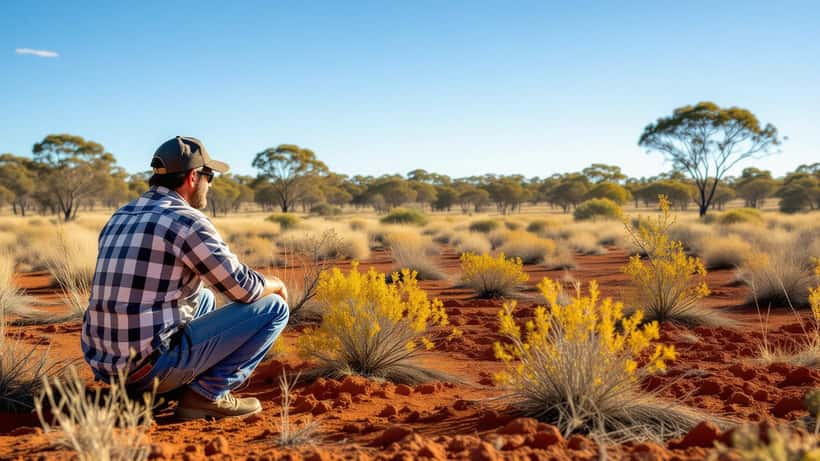
Senior Judge Durrant handed down the penalty after the farmer pleaded guilty to offences under the Native Vegetation Act 1991 (SA). The clearing occurred progressively between November 2023 and March 2024, affecting native chenopod shrubland communities including saltbush and samphire associations — slow-regenerating ecosystems that provide critical habitat for native fauna and play a significant role in preventing soil erosion in South Australia's semi-arid regions.
Why This Ruling Matters Beyond Port Wakefield
The Port Wakefield case is more than a regional farming story. It is a timely, public reminder that land clearing law in Australia is strictly enforced, technically complex, and carries penalties that can far exceed what many property owners anticipate.
In South Australia alone, the Native Vegetation Act 1991 imposes fines of up to $500,000 for individuals and up to $1 million for corporations who unlawfully clear protected vegetation. Courts have demonstrated they are prepared to act — even against landowners with long agricultural histories and no prior convictions. According to ABC News, which broke the story, the defendant had a "lifetime involvement in pastoral and agricultural enterprises." Senior Judge Durrant interpreted that not as a mitigating factor for inexperience, but as evidence the farmer should have known better.
The NVC uses satellite remote-sensing and compliance monitoring to detect clearing events across South Australia. The idea that rural clearings go undetected is no longer credible — the Port Wakefield clearing was documented through satellite imagery and NVC compliance reports, tracking the progressive removal of scrubland across multiple seasons.
What the Native Vegetation Act Actually Covers
The Native Vegetation Act 1991 (SA) applies to almost all native vegetation in South Australia, on both private and public land. Under the Act, "native vegetation" includes indigenous trees, shrubs, herbs, grasses, and associated plant communities. This means that even scattered mallee scrub, isolated sheoak, or a clump of native saltbush in a paddock corner may be fully protected.
Landowners wishing to clear native vegetation must apply to the Native Vegetation Council (NVC) for consent before any work begins. The NVC assesses each application against the Principles for Preventing Loss of Native Vegetation and only grants consent where the environmental impact can be adequately managed or where the clearing falls within an approved category.
Exempt categories include:
- Clearing in accordance with an approved property vegetation plan (PVP)
- Removal of declared weeds under the Landscape South Australia Act 2019
- Emergency clearing to remove an immediate threat to life or property
- Certain maintenance activities near infrastructure or buildings
However, the exemptions are narrower than many assume. Clearing for agricultural expansion, improved pasture, or new crop rotation does not automatically qualify. Many rural landowners operate under the misconception that if they own the land, they control the vegetation — the Native Vegetation Act 1991 renders that assumption legally dangerous.
What the Court Actually Found
The evidence reviewed by Senior Judge Durrant included satellite-derived records showing the defendant progressively cleared 277 hectares between November 2023 and March 2024. There was no consent from the NVC for any part of the clearing.
What made the case particularly significant was the defendant's prior familiarity with the NVC process. The court heard that he had previously been involved in a Council approval application affecting nearby land — meaning he was not unaware that consent was required. The judge found the farmer "knew the proposed clearance required consideration" and had proceeded regardless.
Mitigating factors accepted by the court included: the defendant's cooperation with investigators, his guilty plea, and the absence of prior convictions under the Act. Even with those factors fully weighed, the fine reached $60,000 — confirming that courts view unlawful clearing of ecologically significant shrubland communities as a serious environmental offence, not a technical administrative slip.
Concrete Case: What a Grape-Grower in the Barossa Could Face in 2026
Consider a scenario that is playing out on properties across South Australia right now. A second-generation grape grower near Nuriootpa, about 90 kilometres northeast of Port Wakefield, owns an undeveloped 12-hectare block adjacent to their existing vineyard. The block carries sparse native scrub — a mix of callitris pine, native wattle, and grasses. The grower wants to expand their shiraz planting onto the block in spring 2026.
Scenario A — proceeding without legal advice: The grower assumes that because the vegetation is sparse and the block is privately owned, clearing 12 hectares for agricultural use is permissible. Work begins in September 2026 using a contractor. The NVC's remote sensing system flags the clearing within six weeks, triggering a compliance investigation. Using the Port Wakefield precedent as a benchmark — $60,000 for 277 hectares, or approximately $217 per hectare — a proportional calculation suggests around $2,600 in fine value. But courts do not apply simple per-hectare maths. The statutory maximum is $500,000 regardless of area, and a first-time offence with aggravating factors (prior NVC knowledge, commercial motivation) routinely attracts fines in the $15,000 to $60,000 range even for sub-20-hectare clearings.
Scenario B — getting legal advice first: A 45-minute consultation with an environmental or planning lawyer in Adelaide costs $350 to $600. The lawyer confirms the vegetation is likely protected and submits an NVC consent application via SA's ePlanning portal. Consent for agricultural expansion of this type can take three to five months. If the application is approved, the grower proceeds. If it is refused, the grower avoids a conviction. Total professional cost: $1,800 to $4,500 (legal fees plus environmental assessment if required).
If/then: If the grower seeks legal advice before any clearing begins, the worst-case outcome is a delayed planting season and $4,500 in professional fees. If they proceed without it, they face a realistic fine of $15,000 to $60,000, a criminal conviction under environmental law, and potential remediation costs. The $4,500 consultation is not a cost — it is a saving of $10,000 to $55,000 minimum.
What to Do Before You Clear Any Native Vegetation on Your Property
The Port Wakefield ruling reinforces a checklist that environmental lawyers across South Australia recommend to every rural property owner in 2026.
Identify the vegetation type first. Contact the NVC or use the South Australian Biological Information System (BDBSA) mapping tool to determine whether the vegetation on your property is classified as native under the Act. If you are unsure, an ecological consultant can assess the site for $500 to $1,500.
Submit an NVC consent application before any work begins. Applications are lodged online through the SA government's ePlanning system. The NVC has a target assessment timeframe of 60 days for straightforward applications, though complex cases involving rare communities can take up to six months.
Consider a property vegetation plan (PVP) for long-term clearing decisions. A PVP provides pre-approved clearing rights for defined areas of a property, removing the need for case-by-case applications. Setting up a PVP typically costs $3,000 to $8,000 in environmental consultant and legal fees, but provides ongoing legal clarity for properties with regular clearing needs.
Seek legal advice if you receive any correspondence from the NVC or DPTI. Receiving a compliance notice is not the same as a conviction, and early legal engagement can often prevent escalation to court proceedings. According to the Environment, Resources and Development Court's published data, approximately 40 per cent of compliance matters that proceed to investigation are resolved by consent order without a formal hearing — but only when the landowner engages early.
For more information on consent requirements and the application process, the South Australian government's native vegetation guidance is available at environment.sa.gov.au.
This article is for general informational purposes only and does not constitute legal advice. Landowners should consult a qualified environmental or property lawyer before taking any action that may affect native vegetation on their property.
