 Chloe Anderson
The 2026 NFL season kicked off last weekend with the familiar double feature: spectacular football and a grim injury reel. Las Vegas Raiders tight end Brock Bowers went under the knife for a meniscus trim, Arizona Cardinals quarterback Kyler Murray was rattled after a late hit sent his helmet flying, and two rookies — Jayden Higgins and Chase Bisontis — lost their entire debut seasons before they played a meaningful snap. For Australians watching from the couch, these headlines carry a lesson that most of us ignore until we cannot walk on Monday morning.
The Week 1 Injury Toll Every Footy Fan Noticed
NFL Week 1 of the 2026 season produced a sobering injury ledger. Brock Bowers, the Raiders' elite tight end, underwent what the team called a "meniscus trim" — a procedure that sidelines many recreational athletes for months, though the Raiders optimistically hoped he would return by Week 2. Kyler Murray left Sunday's game against the Green Bay Packers after a late hit caused his helmet to come off, prompting immediate assessment of his head and neck.
The damage was not limited to game day. Houston Texans receiver Jayden Higgins suffered a torn ACL during training camp, ending his season before it began. Rookie offensive lineman Chase Bisontis — the 64th overall pick in the 2026 NFL Draft — tore his MCL on his very first preseason snap. San Francisco 49ers receiver Ricky Pearsall was also ruled out for the season after PCL surgery. Meanwhile, Chargers receiver Ladd McConkey exited with a chest injury in Sunday's game and was listed as questionable to return.
These are elite athletes. They train with full-time medical teams, daily physiotherapy, biomechanics coaches and recovery technology that no recreational league can replicate. And they still go down — often in the opening minutes of a season they spent months preparing for. For millions of Australians who lace up for weekend touch footy, park runs, or a casual game of backyard cricket, it raises an uncomfortable question: what is protecting you?
Why the NFL's Pain Should Be an Australian Wake-Up Call
There is a well-documented gap between professional athletes and recreational participants when it comes to injury risk — and it does not favour the weekend warrior. Professional players train five to six days a week, undergo systematic pre-season injury screening, and are pulled from training if biomechanical anomalies are detected. The recreational player, by contrast, sits at a desk all week and then sprints at near-maximum intensity on Saturday morning.
According to the Australian Institute of Health and Welfare (AIHW), around 61,000 sports-related injuries required a hospital admission in Australia in 2024–25. Roughly 19 per cent of all Australians aged 18 and over who participated in sport or physical activity sustained an injury during that period. Fractures accounted for more than half of all sports injury hospitalisations, and falls were the single largest cause — nearly one-third of all cases.
These figures are not driven by elite sport. The AIHW data captures everyday Australians: cyclists, soccer players, AFL participants, and the growing ranks of people whose primary fitness outlet is weekend social competition. The 61,000 hospital admissions figure does not include the vastly larger number of musculoskeletal injuries treated in GP clinics, physiotherapy rooms, and emergency departments without an overnight stay.
As NFL Week 1 made clear, joint injuries do not always telegraph themselves with obvious warnings. Bowers' meniscus issue likely developed gradually over a full preseason he appeared to complete without incident, only becoming acute under true game load. Higgins' ACL went in a training session, not a match. "Feeling fine" before a session is not the same as being cleared to compete at full intensity.
You can find more detail on how specific NFL match injuries translate into sports medicine lessons in our look at the Bills vs Lions sports injury consultation cases from earlier this season, and on what the Dallas Cowboys' minicamp revealed about NFL sports medicine protocols.
Concrete Case: The Saturday Touch Football Player
Consider the following scenario — grounded in what sports medicine clinics across Australia see routinely each spring.
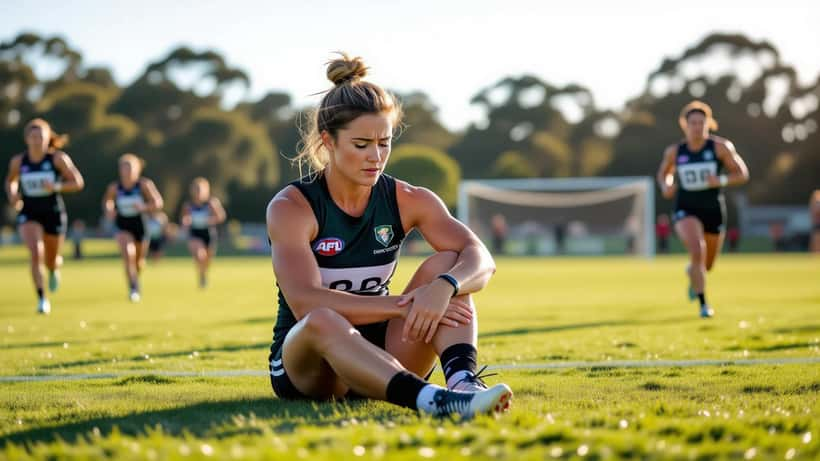
A 38-year-old marketing manager plays touch rugby on Saturday mornings with a workplace team. She exercised consistently through winter — gym sessions twice a week, the occasional lunch walk — but has not played contact-intensity sport since last summer. She felt no pain going into Saturday's game, stretched for five minutes on the sideline, and then felt sharp discomfort in her left knee approximately twenty minutes into the match. She completed the game, iced the knee that evening, and by Sunday it was swollen and restricting her range of motion.
Without professional guidance, she faces two outcomes.
If she waits it out: She rests for a week, the swelling reduces, she returns to the next game, and re-injures the same knee under load. Imaging eventually reveals a partial meniscal tear requiring six to twelve weeks of structured rehabilitation — or, in a subset of cases, keyhole surgery. Total time away from sport: three to five months. Out-of-pocket costs for imaging, physiotherapy and potential specialist referral: typically between $800 and $1,500.
If she books a consultation within 48 hours: A sports medicine doctor or musculoskeletal GP performs a clinical assessment, identifies the likely meniscal involvement, recommends targeted imaging at the appropriate stage, and prescribes a specific rehabilitation protocol — load management, quadriceps and hamstring strengthening, and a clear return-to-sport timeline. If managed conservatively from the outset, return to social sport in four to six weeks is realistic for a partial meniscal injury caught early. Cost: $150 to $300 for the initial consultation and early physiotherapy guidance.
The dollar difference is significant. The timeline difference is more so. The mistake most weekend warriors make is not getting injured — it is waiting too long after injury to seek professional input. Brock Bowers' meniscus is being managed minute-by-minute by a Raiders medical department. Your Saturday knee deserves at least 20 minutes with a specialist.
When to See a Doctor: Signs That Cannot Wait
Sports medicine physicians identify several indicators that distinguish injuries requiring prompt consultation from those manageable with rest and ice:
Rapid swelling within the first hour of injury is a red flag for structural damage — ligament tears, meniscal involvement or fractures all produce fast effusion. A knee or ankle that swells within 60 minutes of impact should be assessed within 24 to 48 hours, not monitored at home for a week.
Localised point tenderness — pain concentrated at a specific anatomical point rather than a diffuse muscle ache — suggests structural rather than muscular injury and warrants imaging guidance from a clinician.
Joint instability events — a knee that buckled, an ankle that turned under the body's weight, a shoulder that shifted — warrant professional assessment within 48 hours regardless of subsequent pain level, as these events can reflect ligament compromise that presents as "improving" in the short term.
Head and neck impacts, including any collision that produces dizziness, confusion, visual disturbance or ringing in the ears, require same-day medical evaluation. Kyler Murray's situation on Sunday illustrates the point: the Cardinals did not wait to assess him at half-time.
What to Do Before Your Next Game
The NFL's Week 1 injury roundup is a useful prompt for any Australian who plays weekend sport. If you are returning to competitive social sport after a period of inactivity, consider a pre-season consultation with a sports medicine specialist or a GP with a musculoskeletal background. A 20-minute appointment can identify previous injury patterns, assess current joint stability and give you a structured warm-up and progressive loading protocol.
Sports medicine consultations in Australia are accessible through Medicare with a GP referral, and many musculoskeletal GPs bulk-bill. The cost of prevention is a fraction of the cost — in time, money and physical impact — of managing an injury that was allowed to become acute.
If you have already picked up a niggle this week — a stiff knee from your morning run, a shoulder that complains after the gym, a hip that clicked on Saturday — now is the better time to have it reviewed. The body's connective tissue needs a minimum of six to eight weeks of progressive loading to adapt after a period of inactivity. Rushing that process is how weekend warriors end up in the same position as Chase Bisontis: out for the season after one snap.
This article is for general health information purposes only. It does not constitute medical advice. If you have sustained a sports injury, consult a qualified medical professional for assessment and treatment.
