 Liam Campbell
Melbourne Storm Suffer Their Most Humiliating Loss in Two Decades as Bellamy Faces Historic Skid
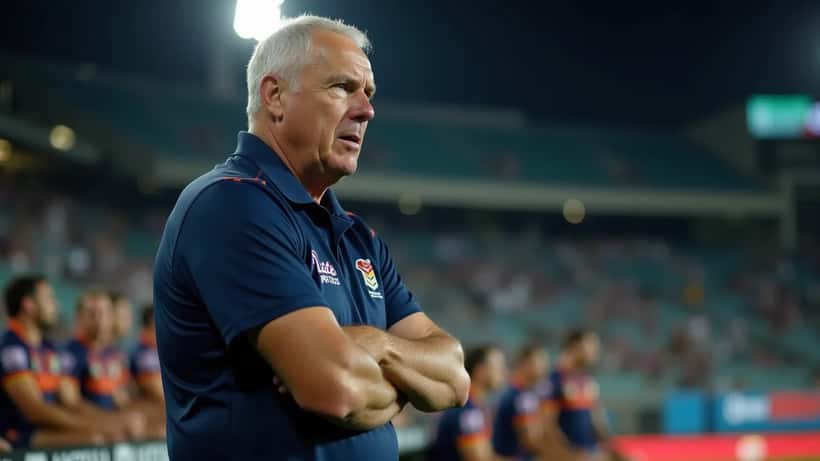
Melbourne Storm coach Craig Bellamy said he has never been more embarrassed by an NRL match in his career after his side were demolished 48-6 by South Sydney on Anzac Day, 25 April 2026. The result was Storm's sixth consecutive loss of the season — a streak not seen at the club since 2002, the year before Bellamy took over as head coach. It is, by almost any measure, the most severe performance crisis of his 24-year tenure.
South Sydney ran in nine tries to Melbourne's one. Latrell Mitchell was awarded the Spirit of the Anzac medal for a performance that included three line-break assists and 164 run metres. It was also the Rabbitohs' first win in Melbourne in 28 years — a historical footnote that made the result sting even harder for a club that had built its identity on defensive discipline and controlled aggression.
What Happened?
The Storm entered this season without several key figures. Ryan Papenhuyzen and Nelson Asofa-Solomona both retired before a ball was kicked. During the season, prop Tui Kamikamica suffered a stroke. Winger Xavier Coates tore his Achilles and is expected to miss at least two more rounds. Winger Eli Katoa has been ruled out for the entire season after suffering a brain bleed.
Injuries at this scale would test any squad. But Storm captain Harry Grant has resisted the temptation to use them as a shield. "You can't use (injuries) as an excuse," Grant said earlier this week, pointing to other NRL sides that have performed despite depleted rosters. He also noted that four of the five losses before the Anzac Day collapse were decided by approximately one try — games that were competitive before a structural failure in defence.
Then came the 48-point loss, and Bellamy's admission that he had never been so embarrassed in his NRL career.
The Paradox of the High-Performer Who Hits a Wall
What is unusual about the Storm situation is not the losses themselves — all sporting teams lose — but the gap between Craig Bellamy's track record and this stretch of results. He has coached Melbourne Storm to four premierships. He extended his contract until 2028 as recently as February of this year. He is, by most standard measures, the most successful coach in NRL history.
And yet here he is, publicly describing a match as the worst of his career, with his team recording a losing streak that has no precedent in his tenure.
This paradox — an elite performer producing outcomes completely inconsistent with their ability and history — is not unique to sport. General management experts and organisational consultants see it in boardrooms, professional practices, and leadership teams across every industry. The causes are usually structural rather than individual.
What Experts Say When a High Performer's Team Struggles
When organisations experience a sudden performance drop from a previously reliable leader, the instinct is often to act quickly — to restructure, reassign, or remove. That instinct is frequently wrong.
General consultants who advise on organisational performance typically point to three questions before any intervention is warranted: Has the environment changed significantly? Has the team composition changed significantly? And is the leader still applying the same process and effort that produced previous results?
In Storm's case, the environment has not changed — the NRL competition is as it was. But the team composition has changed dramatically. Three senior players will not play again this season. Two retired before it started. Sports performance bodies — including Sport Australia, the federal government authority for elite sport — recognise that team cohesion after significant personnel change is a process that cannot be rushed. Storm have not had that runway.
The Storm's board appears to have reached a similar conclusion. They backed Bellamy with a contract extension in February. Captain Harry Grant expressed public support this week. The organisation is betting on institutional knowledge and process over short-term reaction.
When Loyalty and Accountability Are Both Right
There is a version of this story that ends with a coaching change. Some organisations, when facing this level of public embarrassment — a 42-point loss, a historic negative milestone — conclude that the credibility cost of staying the course is too high.
But the more careful read of the Melbourne Storm situation points in a different direction. Grant's assessment that "no one works harder than Craig" carries weight precisely because it comes from a captain under pressure. The injury load is quantifiable and genuine. And Bellamy himself has demonstrated, across more than two decades, the capacity to rebuild from poor periods.
Organisations facing a similar leadership paradox — a trusted, capable leader delivering uncharacteristic results — benefit most from a structured diagnostic rather than a reactive decision. A general management consultant or external adviser can assess whether the performance problem is systemic (processes, resources, team composition) or individual (motivation, skill decay, strategic drift), and recommend an appropriate response.
For Melbourne Storm, the diagnosis seems clear: the problem is structural. The solution is time, recovery, and reinforcement — not removal.
Whether Bellamy delivers his way out of this stretch, or the board eventually recalibrates, the case study will be studied. High performers do not become low performers overnight. And the organisations that rush to that conclusion often discover the hard way that what they had was not as replaceable as it seemed.
ExpertZoom connects you with qualified general management consultants and business advisers who can help organisations navigate leadership challenges and performance crises with clarity.
