 Liam Campbell
Martin Baturina to the Premier League? Why 2026 Could Be His Breakout Year
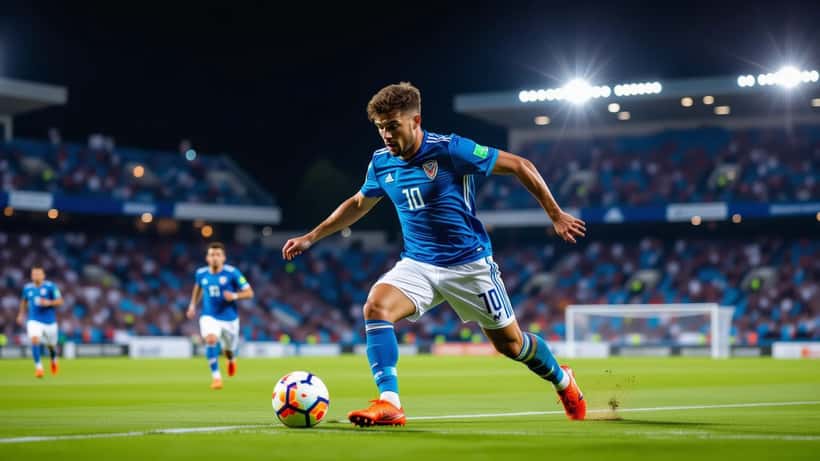
Martin Baturina is no longer a secret reserved for Croatian football obsessives. By mid-2026, the Dinamo Zagreb midfielder has become one of the most discussed young playmakers in European football, with Premier League scouts reportedly making regular trips to Maksimir Stadium. At 23, Baturina sits at the perfect intersection of experience and upside: he has already played Champions League football, won domestic titles and represented Croatia, yet still carries the resale value that makes modern sporting directors dream.
What Makes Baturina Special
Baturina’s game is built on composure rather than athletic explosion. He operates best in the half-spaces between midfield and attack, where his left foot can dissect compact defences with through-balls that seem to bend time. He is not the fastest player in transition, but his anticipation allows him to arrive in dangerous areas before defenders have adjusted. That quality — reading the game a beat early — is notoriously difficult to coach and is the reason elite clubs are willing to pay a premium for it.
His defensive work has also improved. Early in his career, critics labelled him a luxury player who needed protecting. In recent seasons he has learned to press intelligently, use his body to shield the ball and recover possession in midfield thirds. He will never be a destroyer, but he no longer needs to be hidden in a defensive structure. That positional flexibility makes him attractive to Premier League clubs, where the pace and physicality demand more than pure technique.
The Transfer Market Context in 2026
The summer of 2026 arrives at an interesting moment for English football. Financial fair play rules have tightened, homegrown quotas remain a pressure point, and clubs are increasingly reluctant to pay inflated fees for established stars in their late twenties. The result is a renewed focus on young, internationally proven players who can improve the first team immediately and retain value for future windows.
Baturina fits that profile precisely. He is not a raw teenager who needs two years of development; he is a senior international with European minutes under his belt. A transfer fee in the region of €30–40 million would represent a calculated gamble rather than a speculative punt. In a market where English domestic talents often command double that price, clubs see players like Baturina as relative value.
The Expert Angle: Evaluating Young Talent
Behind every transfer rumour is a small army of analysts, scouts, data scientists, lawyers and medical staff. The process has become extraordinarily sophisticated. Clubs now track everything from expected assists to pressing efficiency, from injury history to social media sentiment. But data is only as useful as the expertise interpreting it.
A football analyst might flag Baturina’s progressive passing numbers as elite, but it takes a scout with local knowledge to explain how those numbers translate against English pressing schemes. A contract lawyer needs to understand Croatian employment law, Dinamo Zagreb’s sell-on clauses and the UK work permit framework. A sports physician must evaluate load management history and predict how his body will handle a 38-game Premier League season plus cups. No single expert owns the answer; the best clubs assemble the right panel at the right moment.
This is where specialist consultation becomes decisive. The difference between a successful signing and an expensive mistake often comes down to asking the right expert the right question before the money moves. Whether the client is a football club, an agent representing the player or an investment group acquiring a stake, access to domain-specific expertise reduces risk and sharpens negotiation leverage.
Why 2026, Why Now
Timing is everything in transfers. Baturina’s contract situation, Dinamo Zagreb’s Champions League qualification status and the wider economic climate of European football all point toward 2026 being a logical exit window. If Zagreb fails to reach the group stage, the club may need to cash in. If Baturina has another strong season, his value may never be higher. If a Premier League club misses out on a primary target, he becomes an attractive Plan B who can slot in quickly.
For Australian readers, the parallel is clear even if the names are different. The A-League has its own talent pipeline, with young players regularly moving to Europe or Asia. Understanding how those transfers are evaluated — what scouts look for, how contracts are structured, how agents position their clients — is just as relevant in Sydney or Melbourne as it is in London or Manchester.
The Bigger Picture: Career Architecture
Baturina’s potential move is also a reminder that elite careers are constructed, not stumbled into. The players who make the jump from promising youngster to established star are usually the ones who make smart decisions about representation, physical preparation and public profile. They surround themselves with people who tell them the truth, not just what they want to hear.
In that sense, Baturina’s 2026 story is relevant far beyond football. Any professional facing a major career inflection point — a relocation, a contract renegotiation, a switch of industry — can learn from the principle: gather specialised advice, understand the market, and move before the window closes.
What Happens Next
Expect the rumour mill to accelerate once the European season ends. If Baturina is called into Croatia’s senior squad for summer fixtures, his profile will rise further. If he produces a standout performance against a high-profile opponent, the price tag will move with it. By August 2026, he could be unveiled at a Premier League training ground, or he could decide on one more year in Zagreb to guarantee regular minutes before a bigger leap.
Either outcome is defensible. The important point is that the decision will be shaped by expert input at every stage. In modern football, no transfer is simply a coach asking a chairman for a cheque. It is a multi-disciplinary project involving dozens of professionals, each contributing a narrow but critical piece of insight.
Conclusion
Martin Baturina’s potential Premier League transfer is one of the most intriguing storylines of 2026 for anyone interested in football strategy. It is not just about whether he can adapt to a faster league or handle the physical demands. It is about how clubs evaluate risk, how young players navigate career transitions and how specialised expertise turns raw potential into a structured, valuable move. For fans, it is entertainment. For decision-makers, it is a masterclass in modern talent acquisition.
