 Liam Taylor
As an "explosive diarrhoea" outbreak dominates headlines in July 2026, Australian households are turning their attention to the one place they can actually control: the home kitchen. The culprit behind the current scare is cyclospora, a microscopic parasite that has sickened close to 3,000 people across North America this northern summer, with fresh produce identified as the likely source. While Australian case numbers remain low, the outbreak has renewed a practical question for renovators and home cooks alike — is your kitchen actually built to keep food safe?
The answer, for a surprising number of homes, is no. Food safety experts and kitchen-fit-out specialists say the difference between a kitchen that quietly harbours risk and one that protects a family often comes down to a handful of low-cost upgrades rather than a full renovation.
Why this outbreak has kitchens in focus
Cyclosporiasis is a foodborne illness caused by the cyclospora parasite, which spreads when people eat food or drink water contaminated with faecal matter. The symptoms are hard to ignore: intense, watery and sometimes uncontrollable diarrhoea that can last from a few days to more than a month, often alongside nausea, fatigue and bloating. The parasite is almost always traced back to fresh produce, which is exactly why the outbreak has households rethinking how they store, wash and prepare fruit and vegetables at home.
Importantly, cyclospora is stubborn. Unlike many bacteria, it is not reliably killed by a quick rinse, and cooking remains the most dependable way to destroy it. That does not make kitchen hygiene pointless — far from it. The same setup that limits cross-contamination and keeps food out of the temperature danger zone is your best everyday defence against the far more common bugs, from salmonella to campylobacter, that send thousands of Australians to the doctor each year.
The fridge is your first line of defence
Food Standards Australia New Zealand (FSANZ) advises keeping perishable food refrigerated at 5°C or colder, yet many home fridges drift warmer than their owners assume, especially when packed full or opened frequently in summer. A cheap fridge thermometer — under $15 — is the single most useful food-safety upgrade most homes are missing. If the reading sits above 5°C, adjusting the thermostat or decluttering the shelves can bring it back into the safe range without any spend at all.
Home-improvement specialists increasingly recommend a dedicated crisper strategy, too: storing ready-to-eat produce above raw meat so juices cannot drip down onto foods that will be eaten uncooked. In older kitchens with a single-shelf layout, a simple set of sealed containers achieves the same separation.
Design out cross-contamination
The second big win is designing cross-contamination out of the workflow. FSANZ recommends keeping raw meat, poultry, seafood and eggs strictly separate from fruit, vegetables and ready-to-eat foods — using one cutting board and knife for raw proteins and a different set for anything that will not be cooked. A set of colour-coded boards, a staple of commercial kitchens, costs little and makes the habit automatic for the whole household.
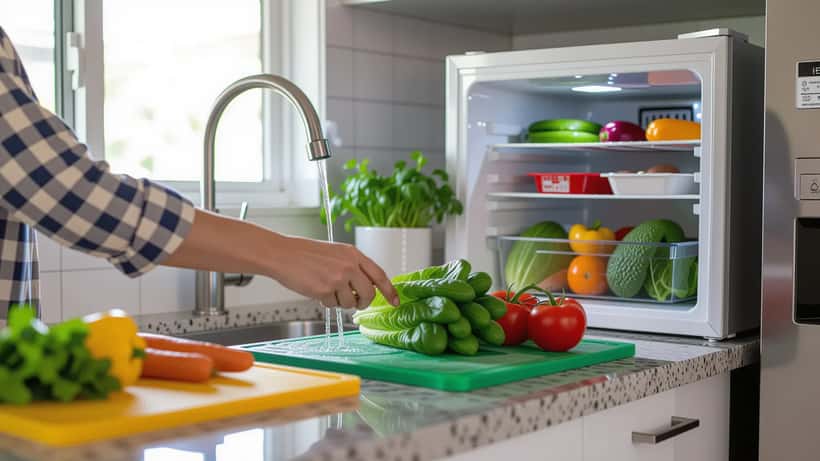
Bench materials matter more than most people realise. Porous or heavily scratched timber and laminate surfaces are far harder to sanitise than sealed stone or solid composite. When a kitchen is due for an update, choosing a non-porous benchtop and installing a deep, single-bowl sink large enough to wash produce under running water is a genuine food-safety improvement, not just an aesthetic one. FSANZ is clear that fresh fruit and vegetables should be washed under running water — and equally clear that soap, disinfectants and detergents should never be used on food.
Small plumbing and layout fixes
A well-placed handwash point makes a measurable difference. Where budget allows, a dedicated tap or a soap dispenser positioned away from the raw-food prep zone encourages the frequent, thorough handwashing that breaks the faecal-oral chain the cyclospora parasite depends on. Rainwater-tank households, in particular, may want to talk to a qualified professional about filtration or point-of-use treatment, since contaminated water is a recognised transmission route for this class of parasite.
Ventilation and drainage upgrades round out the picture. Damp, poorly drained under-sink cabinets breed the biofilm that makes surfaces hard to keep clean, and a leaking waste pipe can quietly contaminate the very cupboard where you store cookware.
What to do now
None of this requires ripping out a kitchen. Start with the free and near-free steps: check the fridge temperature, separate raw and ready-to-eat foods, wash produce under running water only, and never leave perishable food at room temperature for more than two hours. Keep hot cooked food above 60°C until serving, and use up refrigerated leftovers within a few days.
For anything structural — a new benchtop, a reconfigured prep zone, a dedicated handwash tap or water treatment on tank supply — a home-improvement or kitchen-renovation expert can assess your layout and recommend upgrades that pay off in safety as well as resale value. On ExpertZoom you can compare qualified kitchen and renovation specialists in your area and get tailored advice before committing to a spend.
A note on health: this article covers kitchen design and food-safety practices, not medical treatment. Cyclosporiasis and other foodborne illnesses can require prescription medication, and anyone experiencing severe, persistent or bloody diarrhoea — or symptoms in an infant, elderly person or someone immunocompromised — should seek medical advice promptly. The outbreak may be making news, but a safer kitchen is a permanent upgrade worth making regardless of the headlines.
