 Lachlan Mitchell
New Zealand's Kazuma Kobori tees off at The 154th Open Championship at Royal Birkdale from 16 July 2026, and for Australian households following the trans-Tasman story, the tournament is more than a sporting drama. It is a ready-made maths lesson. The 24-year-old, who turned professional in 2023 and won four times on the PGA Tour of Australasia during a record-breaking 2023–24 rookie season, is competing in a 156-player field where every score, cut line and leaderboard swing is built on the kind of numbers your child studies at school.
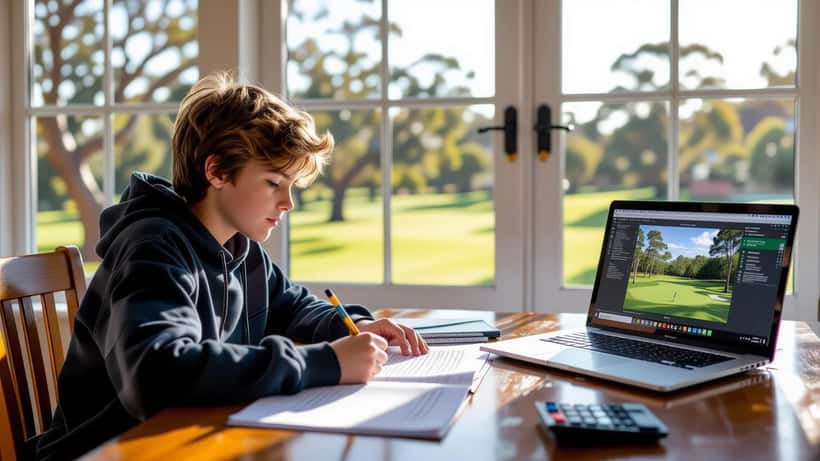
Golf is one of the few sports where the maths is visible on every hole. Par, birdies, bogeys, stroke averages and the odds of surviving the halfway cut all translate directly into fractions, percentages and probability — topics that sit at the heart of the Australian Curriculum. If your child groans at a worksheet but lights up watching the leaderboard, this weekend is a chance to connect the two.
What is happening at Royal Birkdale
Royal Birkdale in Southport, England, hosts The Open for the first time since 2017. The 2026 layout measures 7,223 yards and plays to a par of 70, with holes 5, 7, 14, 15 and 18 significantly redesigned. The format is stroke play: every shot counts, and the player with the fewest total strokes after 72 holes wins the Claret Jug.
There is a catch that makes the event perfect for a probability lesson. After 36 holes, only the low 70 players and ties advance to the weekend. For a debutant like Kobori, making the cut is its own achievement — and working out what score he needs is exactly the sort of problem a Year 6 or Year 8 student can solve at the kitchen table.
Turning the leaderboard into a maths lesson
Start with scoring relative to par. If Royal Birkdale plays to par 70, a round of 68 is "two under par" and a round of 73 is "three over par". Ask your child to convert a full leaderboard into plus-and-minus figures. This is integer arithmetic — adding and subtracting positive and negative numbers — and it is far more engaging when a real name sits next to the total.
Then move to averages. Over four rounds, a player's scoring average is the total strokes divided by rounds played. If Kobori shoots 71, 69, 72 and 70, his average is 282 divided by 4, or 70.5 strokes per round. Older students can calculate the mean, then find the range and median of the whole field's opening-round scores — the exact statistics skills described in the Australian Curriculum for mathematics.
Probability is where the tournament really earns its place on the homework desk. Suppose 156 players start and 70 (plus ties) make the cut. A quick estimate of the chance that a randomly chosen player survives is 70 divided by 156, or roughly 45 per cent. That is a single fraction a primary student can simplify and a secondary student can express as a percentage and a decimal. From there you can discuss why the real figure for a top-ranked player is much higher, and why it is much lower for a first-time qualifier — an introduction to conditional probability without the jargon.
Why a maths tutor can make this stick
Sport is a hook, not a curriculum. The value of a moment like The Open is that it lowers a child's resistance to the subject; the harder work is turning that spark into durable understanding. A private tutor or maths specialist can take the golf example and build a proper sequence around it — from negative numbers, to mean and median, to the basics of probability — so the concepts survive long after the Claret Jug is handed over.
This matters most for students who have decided they are "not a maths person". Research-backed tutoring works because it diagnoses the exact gap — is it the subtraction of negatives, or the idea of an average? — and fills it with targeted practice. A generic worksheet cannot do that. A specialist watching your child work through the leaderboard can spot the misconception in minutes.
Parents in Australia can find qualified maths tutors and homework-help specialists through expert marketplaces, matching a child's year level and specific struggle to the right person. If your family already follows golf, cricket or the NRL, an experienced tutor can reuse those interests every week, not just during a major.
What to do this weekend
You do not need to be good at golf, or at maths, to run this lesson. Follow these steps as the tournament unfolds:
- Track par. Each time Kobori or a leader posts a score, ask your child to state it as a plus or minus against par 70.
- Build an average. After two rounds, calculate a player's mean score and predict round three.
- Estimate the cut. Work out the fraction of the field that makes the weekend, then convert it to a percentage.
- Compare and rank. Use the top-10 scores to find the range, median and mode of the leaders.
For more sport-based maths practice, Expert Zoom has walked families through turning an NRL clash into a probability lesson and using a football friendly to teach odds. The method is the same: take a real number your child already cares about and ask a maths question about it.
The statistics and probability concepts behind every leaderboard are set out in the official Australian Curriculum for mathematics, which shows exactly what each year level is expected to master.
Kazuma Kobori's debut is a story about a young New Zealander testing himself against the best in the world. For an Australian family, it can also be the weekend a child stops seeing negative numbers, averages and probability as abstract worksheet problems — and starts seeing them on the leaderboard. If the spark takes hold, a maths tutor is the fastest way to turn one memorable weekend into a lasting gain at school.
