 Emie Wang
Nepal's five-wicket victory over Japan at the Asian Games in Nisshin on 26 September 2026 lit up cricket scoreboards across Asia — but for thousands of Australians who live abroad and play cricket competitively, the match raised a question that has nothing to do with which team lifted the trophy: could an Australian expat actually represent Japan or Nepal on the international stage, and what does the law say if they tried?
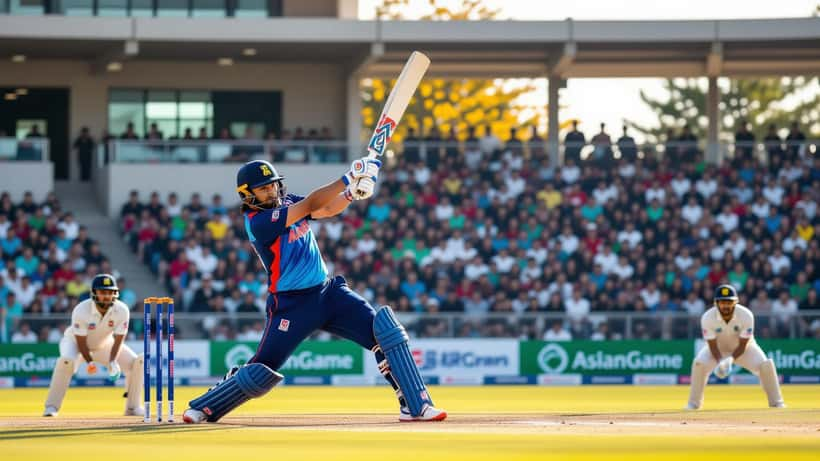
Nepal beat Japan with 12 balls to spare at Kōrogi Sports Park in Nisshin, Aichi Prefecture, finishing with a dominant display that confirmed their top-of-table position in Group A of the Asian Games men's T20 competition. It was a result that underscored how quickly cricket has developed in East Asia — and how national squads in countries like Japan are increasingly built from players with globally diverse origins.
Nepal's Win Puts Associate Cricket in the Spotlight
The 2026 Asian Games cricket competition in Nisshin is being played in the T20 format across 10 men's teams divided into two groups. Group A features Japan, Nepal, and Afghanistan — three nations at very different stages of cricketing development. The top two from each group will advance to the quarter-finals, where they will join four seeded nations: India, Pakistan, Bangladesh, and Sri Lanka. Medal matches are scheduled for 3 October.
Japan's squad includes players born in countries including India, Australia, and New Zealand — all qualified under the International Cricket Council's eligibility rules. Nepal's own roster features several players who developed in Indian domestic competition. For cricket fans watching on television in Sydney or Melbourne, this cosmopolitan make-up may seem like a curiosity. For sports lawyers, it is a source of growing professional inquiry.
As the Asian Games bring associate cricket to a broader global audience for the first time at real scale, Australian law firms with sports law practices report a measurable uptick in questions from clients exploring their eligibility to represent an associate nation. The questions range from the simple to the genuinely legally complex — and the consequences of getting it wrong fall not only on the individual player but on the entire national federation.
The ICC's Three-Year Residency Rule — What It Really Means in Practice
The International Cricket Council's Player Eligibility Regulations set out three primary routes to representing a nation: birth, citizenship, and residency. For Australian expatriates, the residency pathway is the most relevant.
Under the ICC framework, a player qualifies through residency if they can demonstrate that they have had their "primary and permanent home" in the relevant country for the immediately preceding three years. This is not simply a matter of holding a valid long-term visa or signing a rental agreement — the regulations require evidence of a "close, credible and established link" with the country in question.
In practice, the ICC and national cricket federations look at a cluster of factors: where the player files their tax return, where their immediate family is based, whether they have stable employment or a business in the country, evidence of consistent participation in the national club competition, and whether they own or rent long-term accommodation. Meeting the three-year calendar threshold is a necessary but not always sufficient condition. Players who spend extended periods living outside the country during those three years — even for work — may find their residency clock complicated. The ICC's eligibility committee rules on these matters case-by-case, which is precisely why the regulations leave room for professional interpretation.
There is one provision that is particularly significant for players considering a switch between associate nations. Under current ICC rules, a zero stand-out period applies when a player has previously represented an Associate Member National Cricket Federation and wishes to qualify for another. Unlike the multi-year cooling-off periods that apply to players switching from a Full Member nation such as Australia, the transition between associate member teams can happen without any mandatory waiting period — provided all eligibility criteria are genuinely satisfied. This provision has accelerated movement between associate cricket nations considerably in recent years, and Japan's growing talent pool reflects exactly this dynamic.
Why Australian Sports Lawyers Are Watching Japan's Cricket Development
Australia's connection to associate cricket is deeper than most fans appreciate. The national club competition draws participants from more than 60 nationalities, and in Brisbane, Melbourne, and Sydney, there are active leagues populated by players who have spent years living in Japan, Hong Kong, Nepal, and Oman. When a high-profile event like the Asian Games brings Japan's cricket team into mainstream sports coverage, it triggers a wave of genuine eligibility inquiries.
The questions that sports lawyers hear most often fall into two categories. First, straightforward residency cases: "I've lived and worked in Japan for four years and play in the JCA national league — what do I need to do to be considered for selection?" Second, more complex prior representation issues: "I played two state-level domestic matches for a Queensland under-19 side eight years ago — does that affect my eligibility for Japan?"
The answer to the second question is nuanced and depends heavily on whether those matches were ICC-sanctioned International Matches between two Full Member nations or domestic competition within Australia. The regulations draw a sharp and consequential distinction between the two categories — a distinction that many recreational players with historical ties to Australian representative cricket do not fully understand until they seek formal advice.
If you have previously sustained an injury while playing for a team internationally, the physical and contractual implications are also worth understanding alongside eligibility questions — particularly if your claim against a national federation or employer depends on your legal status as an official representative player.
The Concrete Case: An Australian Engineer in Tokyo, 30 Months Residency
Take a specific scenario that reflects the inquiries Australian sports lawyers are seeing in 2026. A 29-year-old civil engineer from Brisbane moved to Tokyo in March 2024 to work for a construction firm on a long-term work visa. She began playing for a club in the Japan Cricket Association's national league in April 2024, has played every season since, and has been selected for prefectural representative matches on three occasions. She lives with her partner in Yokohama, pays Japanese income tax, and holds a three-year renewable work visa with no prior international cricket representation at any level.
As of 26 September 2026, she has been a Japanese resident for exactly 2 years and 6 months.
Under the ICC three-year rule, she falls 6 months short of the mandatory residency threshold. She cannot be formally nominated for Japan's national squad until at least March 2027 — and only then if all markers of genuine connection are confirmed as continuous and uninterrupted. If Japan Cricket were to include her in a squad roster before that date and the ICC audited the submission, the federation would face sanctions, the match result could be overturned, and the player's future eligibility could be jeopardised.
If the same engineer had instead moved to Tokyo in September 2023 rather than March 2024, she would today — on 26 September 2026 — have precisely three years of residency and would almost certainly qualify. The difference between eligibility and ineligibility, in this scenario, is exactly six months.
There is a further complication that practitioners encounter frequently. If the engineer spent eight weeks in Australia in late 2025 working remotely for an Australian firm during her holiday period — while her partner remained in Tokyo and her permanent address stayed the same — does that period disrupt the residency requirement? The ICC regulations do not define a minimum number of days per year that constitute "primary and permanent" residence. This grey area is adjudicated on the totality of the evidence, and the outcome can vary. Getting a legal opinion before lodging a formal eligibility application is not optional — it is essential.
What to Do Before You Nominate for Selection
For any Australian living abroad who is serious about cricket representation, the steps are clear regardless of which country is on the table.
Start documenting your residency from the day you arrive — not retrospectively. Rental contracts, employment records, tax filings, utility bills, and JCA (or equivalent) club registration records all serve as evidence of genuine and continuous residency. Gaps in documentation are harder to explain than they are to prevent.
Understand your prior cricket history in full. If you have represented any team at an ICC-sanctioned International Match level — even for Australia's youth or emerging players programme — clarify what stand-out period, if any, applies to your situation. For most recreational players with no national representation history, this will not be an issue, but it is worth confirming.
Seek formal legal advice before you ask your club or national federation to begin the nomination process. The ICC's Player Eligibility Regulations are publicly available at icc-cricket.com, but interpreting them in the context of your specific circumstances — particularly across multiple jurisdictions — requires expertise. A one-hour consultation with a sports lawyer who has ICC eligibility experience is a modest cost compared to the consequences of an incorrect application.
Nepal's win over Japan at the 2026 Asian Games was a compelling cricket result. For Australians watching from halfway around the world with cricket dreams of their own, it was also a reminder that the game's global growth creates real legal pathways — and real legal risks — worth taking seriously.
This article is for informational purposes only and does not constitute legal advice. Each eligibility case involves specific facts and circumstances. Consult a qualified sports lawyer before taking any formal steps regarding cricket representation eligibility.
