 David Kelly
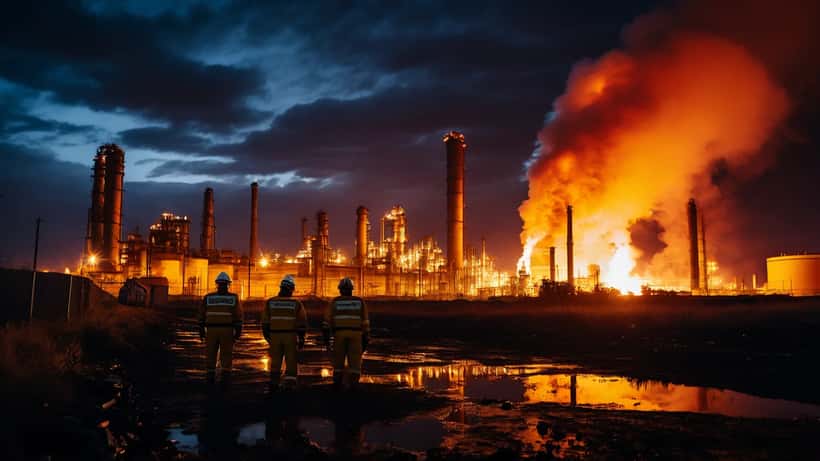
A fire at Australia's largest oil refinery in Geelong has disrupted national petrol production and sent fuel prices higher across Victoria, exposing just how fragile the country's energy supply chain has become. The blaze, which broke out at Viva Energy's Corio facility at approximately 11:05 PM on Wednesday, April 15, 2026, sent 60-metre flames into the sky over Geelong and burned for nearly 12 hours before crews brought it under control on the afternoon of April 16.
No workers were injured. But the damage to the refinery's gasoline complex has cut petrol output to just 60 per cent of normal capacity — with diesel and aviation fuel faring only slightly better at 80 per cent.
What Happened and Why It Matters
The fire started with a valve failure that triggered a significant leak of flammable gases and liquid hydrocarbons, according to Fire Rescue Victoria. The leak ignited, damaging two units in the LPG-blending and gasoline complex — the section that produces high-octane petrol. Isolation valves protected jet fuel and diesel production areas.
The timing could hardly have been worse. Australia was already managing a fuel supply crunch caused by disruptions to Middle East oil shipments. The Viva Energy Geelong refinery is one of only two operational refineries remaining in Australia — the other is Ampol's Lytton facility in Brisbane — and supplies more than 50 per cent of Victoria's fuel needs and approximately 10 per cent of national supply. It has been running at maximum capacity since the Iran supply crisis began.
"This is not good timing, and this is a setback," Energy Minister Chris Bowen told reporters on April 16. He added the fire "is likely to impact local production in Australia for some time."
Prime Minister Anthony Albanese visited the site on April 18, flanked by Bowen and Defence Minister Richard Marles, and confirmed the government had secured 100 million litres of fuel from Brunei and South Korea. He urged motorists to buy only what they need: "Our job is to restrict the impact this will have."
According to Viva Energy's official statement, the company plans to replace lost petrol production through its import programme. The Australian Competition and Consumer Commission (ACCC) said it was actively monitoring retail prices to prevent price gouging.
What It Means for Your Wallet and Your Car
Victorian drivers are facing the most direct hit. Analysts estimate unleaded petrol will cost an extra 10 to 25 cents per litre in the short term — that's between $6 and $15 more per 60-litre fill. For households with two cars, that can add up to $30 or more per week above already elevated fuel costs.
Nationally, the impact is more moderate, since the broader price of imported fuel is the bigger driver. One partial cushion: the federal government had already cut the fuel excise by 26.3 cents per litre from April 1 to June 30, 2026, saving motorists roughly $19 on a full tank. But that excise relief, designed to offset the Middle East supply shock, is now being partially erased by production disruption at home.
Beyond the price pump, this fuel shock has practical implications for vehicle maintenance. Mechanics Australia-wide are advising drivers to think carefully about a few things.
Fuel grade matters more when supply is tight. In the short term, the government has relaxed fuel sulphur standards — allowing imports of 50 parts per million sulphur content, up from the standard 10 ppm. Most modern engines handle this fine, but older vehicles or high-performance engines tuned to premium-grade fuel may notice performance changes. If your car runs on 95 or 98 RON premium, ask your mechanic whether 91 RON is safe during periods of constrained premium supply, rather than switching without advice.
Don't run your tank dry. With potential supply variability, particularly in regional Victoria, mechanical workshops are seeing a small increase in fuel-related breakdowns — mostly from drivers letting tanks drop too low and exposing fuel pumps to air and debris. Keep at least a quarter tank as a buffer.
Watch for contaminated fuel. When new suppliers are rapidly brought online during supply disruptions, there is a small but non-zero risk of fuel quality variations reaching bowsers. Symptoms include rough idling, hesitation on acceleration, or the engine management warning light. If you notice any of these in the weeks after refuelling, have a mechanic run a diagnostic scan before the problem worsens.
Service intervals hold even more weight during fuel crises. Operating on slightly lower-quality fuel for extended periods puts more strain on fuel injectors, O2 sensors, and catalytic converters. If your car is due for a service in the next month, don't put it off.
How Long Will This Last?
Macquarie analysts estimate the production disruption could last anywhere from three weeks to three months depending on the extent of damage to the affected gasoline units. They project an EBITDA impact on Viva Energy of AU$20 million at the low end and AU$70 million if the outage extends to three months.
Viva Energy confirmed it expects to offset near-term production cuts through imports. Government shipments secured through May provide a baseline, but Prime Minister Albanese noted on April 18 that those 100 million litres represent "just over one day's worth of fuel supplies" nationally — underlining how exposed Australia remains.
This is not a new vulnerability. According to analysis published by The Conversation following the fire, Australia has reduced its operational refineries from eight to two since 2003. The IEA recommends nations hold 90 days of fuel reserves; Australia's current stock sits at approximately 29 to 39 days for petrol — well below that threshold.
Australia's Bigger Fuel Security Challenge
The Geelong fire has intensified calls for structural change. Tony Wood of the Grattan Institute named three policy priorities in a post-fire analysis: accelerating the electrification of transport, increasing onshore strategic fuel storage capacity, and scaling up biofuel production.
"After the Geelong refinery fire," Wood wrote, "the case for a longer-term plan to rapidly electrify transport becomes more urgent."
For Australian motorists today, the immediate advice is practical: use the government's fuel excise cut window, find the cheapest station via apps like My NRMA, avoid panic-buying, and keep your vehicle serviced. If you're unsure whether your car's fuel system has been affected by running on imported or varying-grade fuel, a qualified mechanic can run diagnostics and check injector health before a minor issue becomes an expensive repair.
For all fuel, vehicle maintenance, and automotive advice, you can connect with verified mechanics near you through Expert Zoom.
This article contains general information about fuel supply conditions and vehicle maintenance. For specific advice about your vehicle, consult a licensed automotive mechanic. ACCC advice: do not stockpile fuel beyond what you need for safety reasons.
