 Jess Johnson
With Ford Australia confirming the Bronco Basecamp for late 2027 delivery, dealerships are already fielding registrations of interest — and some are asking for holding deposits. A Sydney-based commercial solicitor says the rush to secure a place in the queue is understandable, but cautions that buyers who sign without reading the fine print could find themselves fighting for their money back if specs or pricing shift between now and when the car arrives.
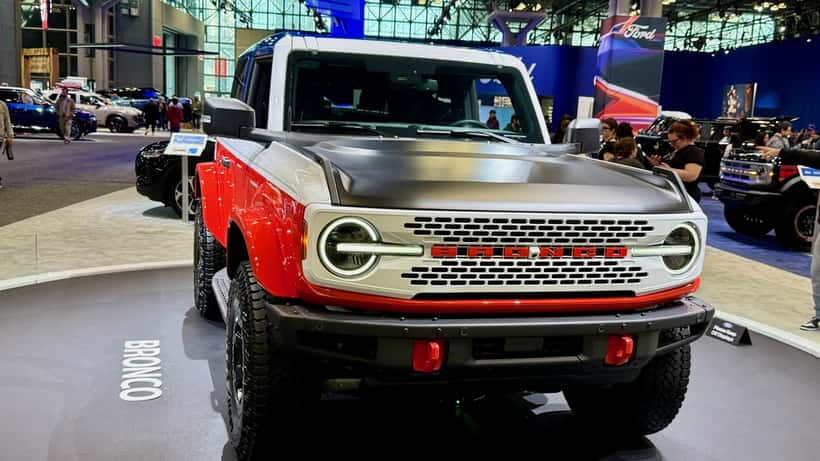
Ford Bronco Basecamp: What Australia Is Getting in 2027
The announcement, made in September 2026, confirms the Bronco Basecamp as a range-extender electric SUV (REEV) — built on a monocoque chassis with a 1.5-litre turbocharged petrol engine acting solely as a generator for two electric motors. Ford quotes a combined driving range of 800–900 km on the WLTP cycle, a combined output of 310 kW and 600 Nm of torque, and a usable battery capacity of 49 kWh.
The vehicle measures 5,025 mm long with a 2,950 mm wheelbase — roughly the footprint of a Ford Everest — making it one of the most substantial SUVs Ford has offered in Australia for years. Australian and New Zealand deliveries are scheduled for the second half of 2027, with the range built around two grades, including the headline Outer Banks variant.
The Outer Banks is the spec generating most of the consumer excitement: a pop-up lift roof that opens at the touch of a button, a full-length flat sleeping configuration when both seat rows fold down, an integrated 7.5-litre thermal storage console, and 6.6 kW of battery-supplied off-grid power — enough to run a cooktop, kettle, or a set of power tools. According to coverage from CarExpert, demand registrations are described as unusually strong for a vehicle still more than a year away from showrooms.
While Ford Australia has not confirmed final driveaway pricing, industry estimates place the entry-level variant around $55,000 and the Outer Banks grade somewhere between $65,000 and $76,000 — a significant sum that makes the legal status of any pre-order deposit worth understanding before you sign.
The Expert View: Australian Consumer Law and Pre-Order Deposits
Australian consumer law treats the purchase of goods — including motor vehicles — under Schedule 2 of the Competition and Consumer Act 2010 (CCA 2010), commonly referred to as the Australian Consumer Law (ACL). The ACL provides robust protections once you have purchased a vehicle: statutory guarantees of acceptable quality, fitness for purpose, and conformity to description cannot be waived by any dealer or manufacturer.
The complication arises with pre-orders and holding deposits placed before a vehicle has reached showrooms, received final pricing, or been fully specified. At this stage, no supply contract has been formed for a finished product — and the ACL's strongest guarantee protections are harder to invoke.
The key provisions that do apply are ACL s.18 and s.29. Section 18 prohibits misleading or deceptive conduct in trade or commerce, and s.29 prohibits false representations about the price of goods. If a dealer explicitly states a price of $65,000 to secure your deposit and subsequently delivers the car at $74,990, that price representation may engage both provisions — depending critically on what was documented in writing versus what was said verbally.
Under ACL s.20, unconscionable conduct in consumer transactions is also prohibited. If a deposit agreement contains a clause stating that the deposit is "non-refundable in all circumstances," a tribunal may find that clause unconscionable where pricing or specifications change materially before settlement. The ACCC has taken enforcement action in several vehicle pre-order cases in recent years where non-refundable deposit clauses were applied to price rises exceeding 10 per cent of the quoted amount.
A solicitor reviewing the situation early — before the dispute escalates — will typically focus on three questions: what price was communicated at the time the deposit was paid, what the deposit agreement actually says about refunds, and whether the vehicle specification committed to at the time of deposit matches what is eventually offered for delivery.
The Concrete Case: Your $3,000 and a $10,000 Price Rise
Consider this scenario. A buyer in September 2026 pays a $3,000 holding deposit at a Ford dealership for the Bronco Basecamp Outer Banks. The sales consultant verbally quotes a delivery price of "around $65,000 to $70,000 drive-away." The deposit agreement is a one-page document confirming the vehicle model, the deposit amount, and a clause stating the deposit is "refundable only at the dealer's discretion."
In early 2027, Ford Australia releases confirmed pricing: the Outer Banks is $76,990 drive-away — $7,000 to $12,000 above what the buyer was led to expect. The buyer decides not to proceed and asks for their $3,000 back. Under the "dealer's discretion" clause, the dealer refuses.
If the buyer has text messages, emails, or a signed spec sheet showing the $65,000–$70,000 price was presented at time of deposit, they may have a credible claim under ACL s.18. The ACCC's guidance on price representations confirms that where a specific price range is communicated in a way a reasonable consumer would treat as reliable, a substantial deviation from that range can constitute misleading conduct.
If there is no written documentation of the quoted price, the buyer's position weakens significantly. The dispute becomes a verbal evidence question — one that typically favours the dealer's written contract.
If the deposit is $3,000 or below, the buyer can escalate to their state's consumer tribunal (e.g., NCAT in NSW, VCAT in Victoria, QCAT in Queensland) without legal representation, at a filing fee typically between $100 and $180. Claims of this size sit within the minor civil claims division of most state tribunals, meaning a hearing can be scheduled within eight to twelve weeks. On a $3,000 claim, a successful outcome recovers the deposit plus the filing fee; on a $5,000 deposit, engaging a solicitor for a letter of demand first often resolves the matter before a tribunal is needed.
Three Things to Document Before You Hand Over Money
Any commercial solicitor asked to advise on a pre-order deposit dispute will begin by requesting three things:
The deposit agreement itself — specifically refund and cancellation clauses. Phrases like "non-refundable in all circumstances" or "subject to final pricing at time of delivery" carry very different legal weight. A lawyer can advise whether any such clause is enforceable or unconscionable under the ACL given the gap between quoted and final price.
All price communications — every email, brochure, or text message in which a price or price range was represented. Screenshot these immediately; digital communications are frequently deleted once a dispute arises. If you receive a verbal quote that differs from any written material, send a follow-up email confirming what you were told: "Thanks for quoting $65,000 to $70,000 drive-away for the Outer Banks — just confirming that in writing before I sign." A single email like that can settle a $3,000 dispute before it reaches a tribunal.
The specification commitment — if the deposit was placed for a specific grade with specific features (the pop-up roof, the off-grid power output, the full-length sleeping platform), and the dealer subsequently confirms that grade is not available in Australia as specified, the ACL guarantee of conformity to description may apply to the deposit agreement itself.
If you paid by credit card, check whether a chargeback is still within your card's dispute window. Many credit card providers honour chargeback requests where a pre-ordered product is materially different from what was represented at time of payment — a separate and often faster avenue than a tribunal claim.
When It Is Worth Talking to a Solicitor
Pre-order disputes for high-value consumer goods are a well-established area of Australian consumer law practice. If you have paid a deposit exceeding $1,500 for a vehicle yet to be delivered, and the dealer is refusing to return it after pricing or specifications have shifted, you have meaningful options under Australian law — but the outcome depends heavily on your documentation.
The ACL applies to all Australian consumers regardless of the state or territory in which the purchase was made. Federal protections under the CCA 2010 are enforceable through the Federal Court, state and territory courts, and consumer tribunals. A consultation with a solicitor experienced in consumer law typically costs less than the deposit itself, and many offer fixed-fee initial advice for straightforward pre-order disputes.
On a platform like Expert Zoom, you can connect directly with Australian solicitors experienced in consumer law, vehicle purchase disputes, and ACL claims — without the friction of a traditional referral or the uncertainty of walking into a law firm cold.
This article provides general legal information only and does not constitute legal advice. For advice specific to your circumstances, consult a qualified Australian solicitor.
