 David Kelly
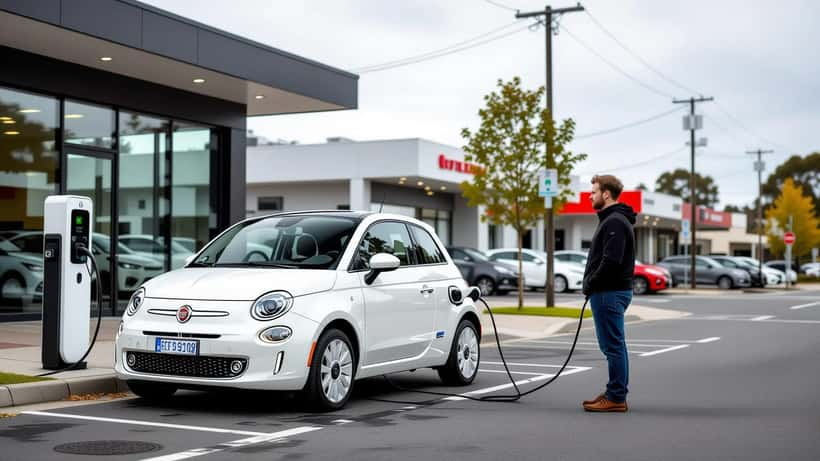
Fiat has confirmed it will not bring any more electric 500e micro cars to Australia, and with dealer stock of the 500e and its Abarth sibling almost sold out, the Italian brand's passenger line-up here is effectively finished for now. According to CarExpert, that leaves Fiat and Abarth with no passenger models on local price lists, while Stellantis Australia keeps a presence only through Fiat Professional vans such as the Ducato and the revived Scudo. Stellantis insists this is "not the end" of the Italian brands in the market — but for the thousands of people who already own a 500e, a petrol 500 or an Abarth, the immediate question is more practical: what happens to my car now?
What Stellantis actually said
The decision is a run-out, not a recall. Existing cars are unaffected in the way they drive, and Stellantis Australia has publicly committed to staying in the market rather than pulling out. That distinction matters. When a brand exits a country entirely, warranty and parts obligations can become messy. When a brand simply stops selling a passenger model but keeps a corporate footprint — as Fiat is doing through Fiat Professional — the support network usually remains in place.
Still, a discontinued model tends to slip down the priority list over time. Dealers order fewer specialist parts, fewer technicians stay current on the platform, and courtesy stock of common consumables thins out. None of that is a crisis in 2026, but it is worth planning for if you intend to keep your Fiat for another five or ten years.
Your rights do not disappear when the model does
This is the point many owners miss. Under Australian Consumer Law, a manufacturer's obligations are tied to the car you bought, not to whether the model is still on sale. The Australian Competition and Consumer Commission is explicit that consumer guarantees — including the guarantee of acceptable quality and the requirement that spare parts and repair facilities be available for a reasonable period — continue to apply after a model is withdrawn.
"Reasonable period" is not defined as a fixed number of years; it depends on the type of product, its price and what a reasonable buyer would expect. For a car costing tens of thousands of dollars, that expectation is measured in years, not months. If a manufacturer cannot supply a part within a reasonable time, you may have a remedy — so keep your purchase documents and service records. You can read the detail on consumer guarantees at the ACCC's official guidance page, accc.gov.au.
Your factory warranty also survives the model's discontinuation. If your 500e is still inside its warranty window, that cover runs for its full term regardless of the run-out.
Servicing a car the showroom no longer sells
From a workshop's perspective, a discontinued Fiat is not an orphan overnight. Here is how an experienced mechanic would approach the next few years of ownership.
Keep to the logbook schedule. A car that stays fully within its manufacturer service intervals holds its warranty rights and flags wear early — which matters more, not less, once a model is winding down.
Bank the wear items early. If you rely on the car, it is sensible to source model-specific consumables — cabin filters, wiper blades, drive-unit coolant, and for the 500e, the correct 12-volt auxiliary battery — while they are still easy to order. These are cheap to stockpile and awkward to chase later.
Find an independent EV-capable workshop now. The 500e is a battery-electric car, so it needs a technician trained in high-voltage safety, not just any general mechanic. Building a relationship with a competent independent specialist before you need one protects you if dealer coverage thins out. For petrol 500 and Abarth owners, the parts pool is far deeper — the platform has been on Australian roads for years — so routine servicing should stay straightforward.
Watch the software. On the electric 500e, over-the-air and dealer-applied software updates handle everything from charging behaviour to battery management. Confirm with Stellantis that update support continues, because a car cut off from updates can develop niggles that have nothing to do with mechanical wear.
What it means for resale value
Discontinuation cuts both ways. In the short term, a run-out can soften used prices as buyers worry about long-term support. But the 500e and the Abarth 500e are distinctive, low-volume cars, and scarcity can work in an owner's favour once the last examples sell. The practical advice is unchanged: a complete service history, kept to schedule at a qualified workshop, is the single biggest lever you control over resale value on any discontinued car.
When to get an expert involved
Most owners will never need more than a good independent mechanic. But there are moments when professional advice pays for itself:
- A dealer tells you a part is unavailable and offers no timeframe — that is exactly the scenario the consumer-guarantee rules are designed for, and worth a second opinion.
- You are buying a used 500e or Abarth in 2026 and want a pre-purchase inspection focused on battery health and update history.
- Your warranty claim on a discontinued model is refused, and you need someone to assess whether the refusal is fair.
A qualified mechanic can give you a clear read on the car's real condition, tell you which parts are genuinely getting scarce, and document faults properly — the paperwork that turns a vague complaint into an enforceable claim. Connecting with the right automotive expert early is far cheaper than discovering a support gap the week your car breaks down.
Fiat's retreat from the Australian passenger market is a headline about the brand. For the people who already own one, it is really a maintenance-planning story — and it is an easy one to get on top of while parts are plentiful and the network is intact.
This article is general information, not legal or mechanical advice for your specific vehicle. For a warranty dispute or a car-specific fault, consult a qualified mechanic or a consumer-law professional.
